ENTERPRISE APPLICATION ARCHITECT RESUME EXAMPLE
Updated: Nov 28, 2025 - The Enterprise Application Architect leads the architecture strategy for a SaaS product, driving modernization across all application layers. Plays a key role in technical leadership, solution development, and ensuring enterprise-wide design standards. Collaborates with cross-functional teams to optimize data models, enhance integrations, and align architecture with business goals.

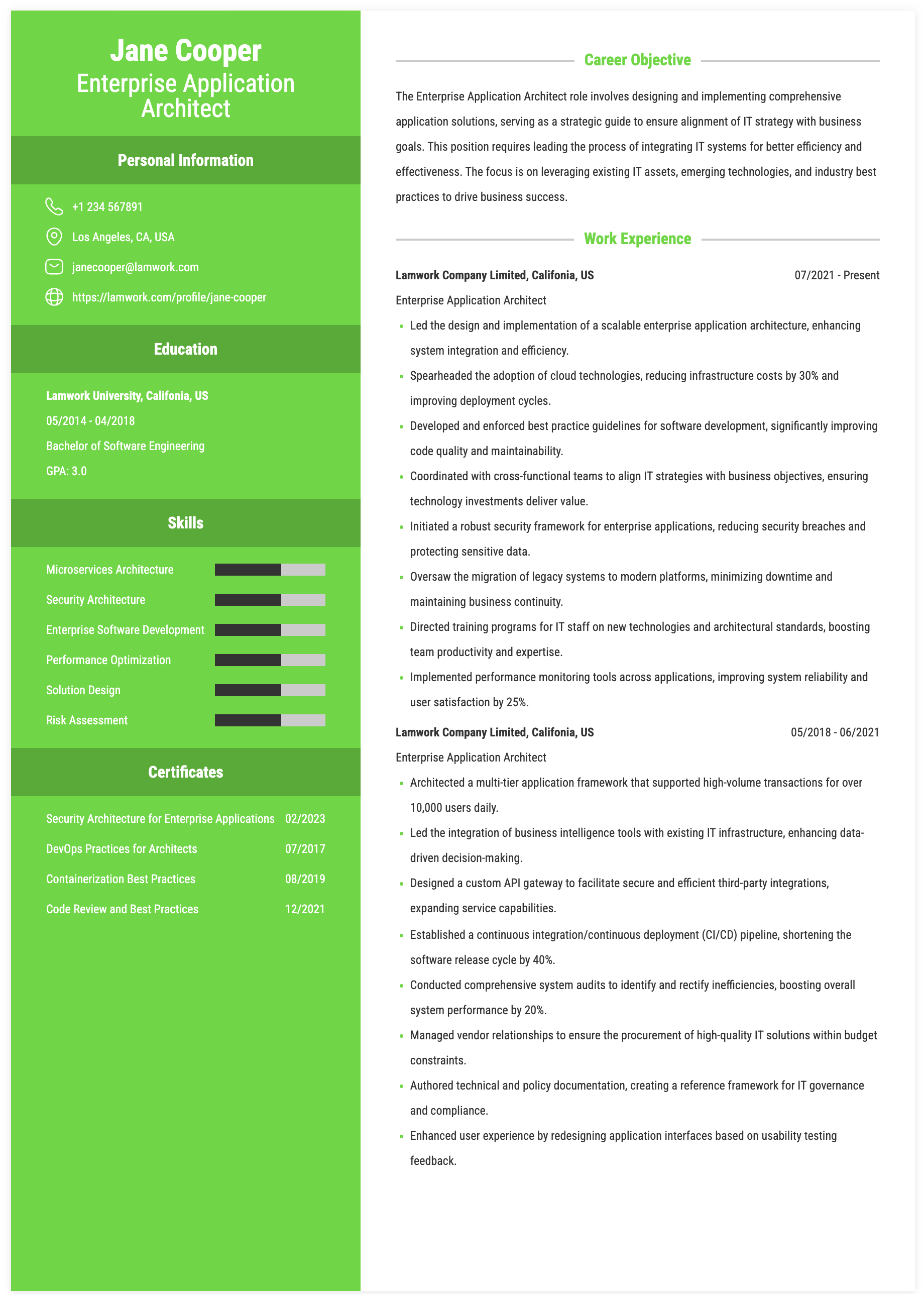
Tips for Enterprise Application Architect Skills and Responsibilities on a Resume
1. Enterprise Application Architect, Mizuho Americas, New York, NY
Job Summary:
- Drive architecture design initiatives and provide architecture guidance across ERP, Customer Experience, Data analytics and business applications
- Establish, maintain and enforce enterprise architecture principles, best practices and policies that govern the use of IT across the Group in different IT domains in line with strategic business priorities
- Formulate architectural framework to promote the use of standards, and patterns and facilitate a more agile and responsive IT environment for delivery and operations
- Apply architecture principles and governance mechanisms in Architecture review meetings with active contribution to solutions, technology adoption, data strategy, security, and operation support
- Plan and evaluate emerging technologies and drive innovative IT ideas in the development of strategic proposals through proof-of-concept projects
- Articulate the architecture vision and promote the adoption of IT strategic projects to senior stakeholders
- Develops artifacts that describe WM architecture standards, patterns and best practices.
- Evaluate and make product or solution architecture recommendations based on understanding business requirements
- Develops code snippets to illustrate solution patterns.
- Provides guidance to application teams for the adoption of standards and reusable solution patterns in applications.
- Initiates and drives architecture working groups to ensure that appropriate standards are developed based on common use cases
Skills on Resume:
- Architecture Design (Hard Skills)
- Enterprise Principles (Hard Skills)
- Framework Formulation (Hard Skills)
- Governance Application (Hard Skills)
- Technology Evaluation (Hard Skills)
- Vision Articulation (Soft Skills)
- Artifacts Development (Hard Skills)
- Solution Recommendation (Hard Skills)
2. Enterprise Application Architect, MassMutual, Boston, MA
Job Summary:
- Lead the Enterprise Application architecture for the SAAS product.
- Play a hands-on role in developing a modernization roadmap for all layers of large-scale enterprise applications.
- Providing technical leadership to the application development team.
- Conduct research/POC on emerging technologies in support of solution development efforts and make recommendations
- Perform cost-benefit and return-on-investment analyses for proposed solutions to aid management in making implementation decisions
- Design and create reusable components to be leveraged across various applications
- Ensuring that uniform enterprise-wide application design standards are maintained
- Collaborating with internal and external stakeholders to ensure the architecture is aligned with business requirements
- Analyze use cases to optimize data models and data integrations for multiple products.
- Partner with Engineering & Product teams across the organization to develop a roadmap for application and database modernization.
- Partner with the Central Data & Analytics team to facilitate data consumption within and outside of CDK.
- Provide strategic advice and guidance to Engineering teams on Application architecture from database to frontend layer.
Skills on Resume:
- Enterprise Application Architecture (Hard Skills)
- Roadmap Development (Hard Skills)
- Technical Leadership (Soft Skills)
- Emerging Technologies Research (Hard Skills)
- Cost-Benefit Analysis (Hard Skills)
- Component Design (Hard Skills)
- Standards Compliance (Hard Skills)
- Stakeholder Collaboration (Soft Skills)
3. Enterprise Application Architect, HPTech Inc., New York, NY
Job Summary:
- Set and maintain architectural standards, policies, and frameworks that govern all aspects of application development, maintenance, and ultimately retirement, that continuously converge enterprise landscape towards a smaller, well-defined set of technologies that improve business agility and drive down IT operating costs.
- Maintains a technology roadmap that helps forecast the future state of the technical stack based on industry and technology trends, projected growth and the evolution of applications.
- Develop full stack “blueprints” for application architectures that encompass middleware (messaging, API etc) through digital user interfaces.
- Design and develop a core set of shared services that can be consumed by all divisions.
- Promote reuse and leveraging of existing software components and services.
- Bring together and lead a “guild” of like-minded professionals across MMC that unlocks the size and scale of talent within the organization.
- Create, maintain, and/or enhance a target enterprise application landscape (TAL) that drives reuse where appropriate across the enterprise.
- Monitors the current-state solution portfolio to identify deficiencies through the aging of the technologies used by the application or organic growth of applications.
- Collaborates with application teams across the enterprise and provides recommendations on competitive frameworks and solutions to address application inefficiencies, increase stability, and support scaling efforts
- Contribute directly to enterprise-wide projects.
Skills on Resume:
- Architectural Standards (Hard Skills)
- Roadmap Forecasting (Hard Skills)
- Architecture Design (Hard Skills)
- Services Development (Hard Skills)
- Reusability Promotion (Soft Skills)
- Team Leadership (Soft Skills)
- Landscape Management (Hard Skills)
- Portfolio Monitoring (Hard Skills)
Resume Standards 2026
Lamwork's key guidelines and best practices for writing a professional, ATS-friendly resume.
1. Contact Information
Name, phone number, professional email, LinkedIn, portfolio (if applicable)
2. Professional Summary (2-3 lines)
Role + years of experience + key strengths
3. Work Experience
Title + company + dates
Bullet points: action verbs + metrics + impact
Add context (what/why) when needed
Not recommended: Increased sales by 20%
Recommended: Increased B2B sales by 20% by optimizing outreach strategy
4. Skills
Hard skills only + match job description keywords (ATS)
5. Education
Degree, school, year (GPA if strong)
6. Projects (if relevant)
Name + tools + outcomes
7. Format
0-5 years: 1 page
5-10 years: up to 2 pages
Clean font, no photo, no personal details
8. ATS Optimization
Use exact keywords from the job description
Avoid tables or columns
Example:
Job says "Data Analysis" -> use "Data Analysis"
Do not change it to "Analyzing Data"
9. Do Not Include
Photo, age, gender, full address, references
10. Final Check
No typos, consistent verb tense, tailored for each job
File name: FirstName_LastName_Resume.pdf
Editorial Process and Content Quality
This content is developed by the Lamwork Editorial Team using structured analysis of real-world job data, skill requirements, and hiring patterns.
Research framework by Lam Nguyen, Founder & Editorial Lead.
Reviewed by Thanh Huyen, Managing Editor.
Learn more about our editorial standards.