COMPUTER HARDWARE TECHNICIAN RESUME EXAMPLE
Published: August 9, 2024 - The Computer Hardware Technician inspects and tests lease-end returned computers to diagnose and repair hardware malfunctions, ensuring proper maintenance and operation. This role involves using testing devices and factory manuals, malfunctions are identified and corrected by upgrading components and monitoring equipment performance for quality assurance. The technician also supports both software and hardware, with technical expertise aiding in project implementation, IT systems, networking, and telecommunications assistance.

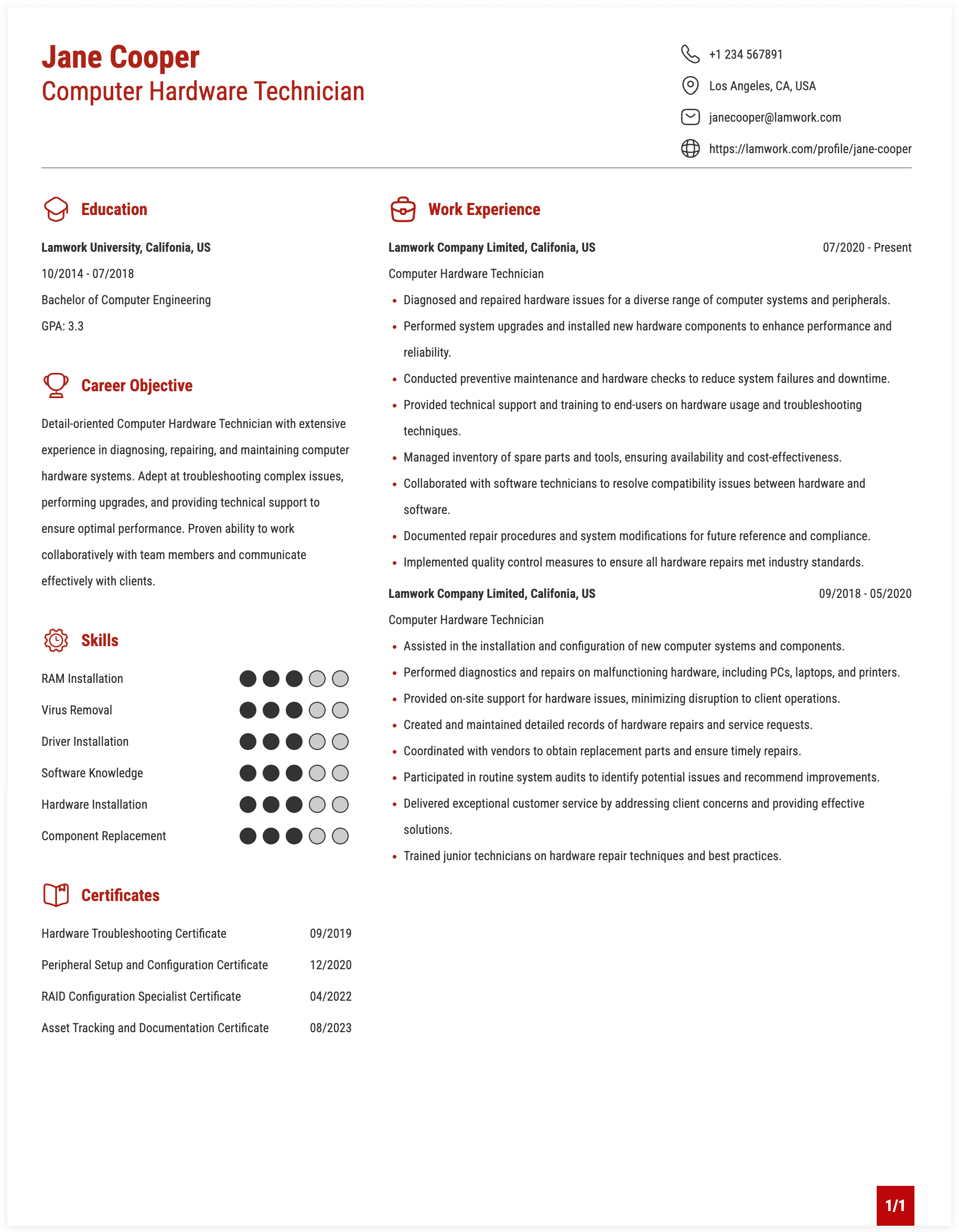
Tips for Computer Hardware Technician Skills and Responsibilities on a Resume
1. Computer Hardware Technician, TechSolutions Inc, Buffalo, NY
Job Summary:
- Resolve Lab Issues by working with proper internal customers and consulting/utilizing the lab infrastructure team.
- Perform lab safety reviews.
- Process and perform lab changes by working with engineering teams and construction vendors.
- Process all bench and lab requests.
- Setup and work on lab Pre-Production hardware.
- Perform High-Value Inventory process control.
- Process local and international lab shipping.
- Support the ‘lab ticket’ system by creating, modifying, and enhancing the capabilities of this system. Support the local lab network.
- Respond to and resolve local network issues, i.e. blocked ports, SED lines, IP address issues, and equipment changes.
- Perform SharePoint implementation of the Lab Support team site.
Skills on Resume:
- Lab Issue Resolution (Soft Skills)
- Lab Safety Reviews (Hard Skills)
- Lab Change Management (Hard Skills)
- Hardware Setup (Hard Skills)
- Inventory Control (Hard Skills)
- Shipping Coordination (Hard Skills)
- Network Support (Hard Skills)
- SharePoint Implementation (Hard Skills)
2. Computer Hardware Technician, Innovative IT Services, Raleigh, NC
Job Summary:
- Institute SharePoint Online for the team for collaboration and reporting.
- Perform platform setup and rework by connecting oscilloscopes and/or analyzers.
- Perform hardware platform configurations by working with engineers.
- Configure HOST systems and SUT/DUT-based systems per engineer instructions.
- Perform software platform configurations with Flash of BIOS and Firmware.
- Perform System Triage including 2nd level triage with engineers on the phone.
- Resolve Linux and Windows issues on the SUT/DUT systems.
- Assist in remote support
- Address user incident and service requests within the defined SLA's
- Assist with other Tier II associates, take guidance from the Tier III technical lead
Skills on Resume:
- SharePoint Online Setup (Hard Skills)
- Platform Setup (Hard Skills)
- Hardware Configuration (Hard Skills)
- System Configuration (Hard Skills)
- Software Configuration (Hard Skills)
- System Triage (Soft Skills)
- Linux and Windows Troubleshooting (Hard Skills)
- Incident Resolution (Soft Skills)
3. Computer Hardware Technician, Digital Dynamics Corp, Austin, TX
Job Summary:
- Inspect and test lease-end returned computers to identify and troubleshoot the problems
- Diagnose and repair hardware malfunctions and perform the maintenance of computers
- Use testing devices and follow the factory manuals to locate malfunctions in computers
- Assess computer hardware malfunctions to determine the cause of error and apply appropriate actions to correct problems and repair computers to maintain operations
- Perform all technical functions following the factory technical manuals, such as installing, maintaining and repairing/replacing electronic components of computers
- Modify and upgrade computers and provide support for both software and hardware
- Monitor the performance of equipment and make necessary adjustments to ensure quality performance
- Complete work orders in the T&A system.
- Provide assistance and technical knowledge to aid the implementation of projects.
- Working with IT systems, IT Networking and IT Telecommunications to assist where needed
Skills on Resume:
- Computer Inspection (Hard Skills)
- Hardware Diagnosis (Hard Skills)
- Testing Device Utilization (Hard Skills)
- Error Assessment (Hard Skills)
- Technical Functions Execution (Hard Skills)
- Computer Modification (Hard Skills)
- Performance Monitoring (Hard Skills)
- Project Assistance (Soft Skills)
Resume Standards 2026
Lamwork's key guidelines and best practices for writing a professional, ATS-friendly resume.
1. Contact Information
Name, phone number, professional email, LinkedIn, portfolio (if applicable)
2. Professional Summary (2-3 lines)
Role + years of experience + key strengths
3. Work Experience
Title + company + dates
Bullet points: action verbs + metrics + impact
Add context (what/why) when needed
Not recommended: Increased sales by 20%
Recommended: Increased B2B sales by 20% by optimizing outreach strategy
4. Skills
Hard skills only + match job description keywords (ATS)
5. Education
Degree, school, year (GPA if strong)
6. Projects (if relevant)
Name + tools + outcomes
7. Format
0-5 years: 1 page
5-10 years: up to 2 pages
Clean font, no photo, no personal details
8. ATS Optimization
Use exact keywords from the job description
Avoid tables or columns
Example:
Job says "Data Analysis" -> use "Data Analysis"
Do not change it to "Analyzing Data"
9. Do Not Include
Photo, age, gender, full address, references
10. Final Check
No typos, consistent verb tense, tailored for each job
File name: FirstName_LastName_Resume.pdf
Editorial Process and Content Quality
This content is developed by the Lamwork Editorial Team using structured analysis of real-world job data, skill requirements, and hiring patterns.
Research framework by Lam Nguyen, Founder & Editorial Lead.
Reviewed by Thanh Huyen, Managing Editor.
Learn more about our editorial standards.