WHAT DOES A SCRUM MASTER DO?
Updated: Mar 10, 2026. The Scrum Master coaches teams in self-management, ensures adherence to quality and organizational processes, and facilitates productive Scrum events. This role supports Product Owners in backlog management, prioritization, and roadmap planning while removing impediments and fostering stakeholder collaboration. The position also promotes Agile adoption, continuous improvement, and transparency across the organization.

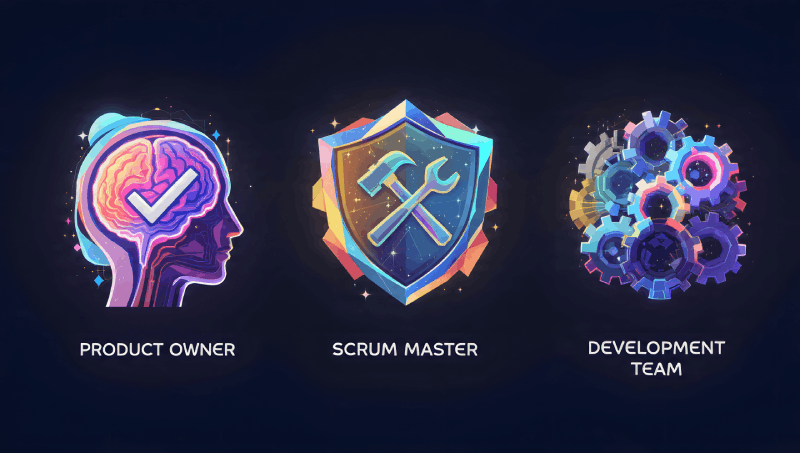
A Review of Professional Skills and Functions for Scrum Master
1. Scrum Master Responsibilities
- Ensuring clarity: Ensuring that everyone in the Scrum team clearly understands the goals and the scope of the product, as well as the particular sprint goals, which should also be clear to the team members.
- Quality oversight: Keeping an eye on the quality and alerting when the criteria of an effective ticket aren’t met.
- Scrum facilitation: Making sure that the appropriate Scrum meetings are held and that they serve their real purpose.
- Meeting observation: Carefully observing the course of Scrum meetings and concluding orders to suggest improvements, streamline the process of development, and enhance adaptation while constantly learning from experience.
- Team enablement: Making sure that the team is fully independent and always possesses all the necessary tools or competences to tackle tasks and react whether there is any lack that may cause trouble in completing work.
- Work organization: Keeping an eye on the work organization within a team.
- Self-organization: Raising awareness of the importance of self-organization in achieving the sprint goal and providing support in scheduling work properly.
- Scrum standards: Managing good Scrum practices in the whole organization, setting the best Scrum standards that are adjusted especially to the company’s needs, and actively promoting them across the projects.
- Scrum assessment: Investigating the chances and risks of introducing Scrum to the projects that don’t benefit from that methodology yet.
- Estimation improvement: Suggesting ideas for more effective time estimation, investigating why estimates happen to be inaccurate, and developing ways to improve the process of estimation.
- Project transparency: Looking after the transparency in a project, coaching the team on the importance of transparency, and having all the project-related information easily accessible for every team member.
2. Scrum Master Accountabilities
- Team guidance: Guide the teams, stakeholders, and product owner on the Scrum Framework.
- Team maturity: Coach the team to higher levels of maturity, at a pace that is sustainable and comfortable for the team and organization.
- Continuous improvement: Coach the team to continuously improve and do so with data.
- Impediment removal: Remove impediments or guide the team to remove impediments.
- Team facilitation: Facilitate discussion, decision-making, and conflict resolution.
- Safe environment: Build a trusting and safe environment where problems can be raised without fear of blame, retribution, or being judged, with an emphasis on learning and problem-solving.
3. Scrum Master Details and Accountabilities
- Transformation coaching: Help the team and lab to embed transformation principles and practices and continuously improve their ways of working (WoW).
- Agile support: Support the Team and Lab to understand and utilise Agile frameworks (Scaling, Scrum, Kanban, etc) and Agile events (Scrum of Scrums, PI planning, retrospectives, etc) to understand the value and purpose of them.
- Backlog management: Help the product owner to manage an effective Product Backlog.
- Work clarification: Coach the team in clarifying work items and questioning details of work to attain a DOR, promoting best practices in refinement, prioritisation, stakeholder engagement, and introducing tools and techniques.
- Self-management: Coach and empower the team to self-manage, utilise feedback for continuous learning and improvement in efficient and incremental value delivery.
- Performance metrics: Guide the team to measure and understand their performance through metrics (throughput, cycle time, happiness, etc) and use this as the basis for their improvement activity.
- Blocker resolution: Coach and support the team to identify blockers/barriers to effective delivery and remove these.
4. Senior Scrum Master Additional Details
- Agile guidance: Guide the team on how to leverage Agile/Scrum practices and values to maximize the delivery of business value
- PO support: Support and educate the Product Owner in applying the Scrum framework and agile principles, and in particular, the importance of refining and maintaining the product backlog
- Metric management: Manage the team to develop, capture, and analyze metrics to facilitate team improvements
- Team protection: Protect the team from ant patterns
- Scrum learning: Work with a Sr Scrum Master to learn from others' experiences on the journey
- Ceremony facilitation: Facilitate and coordinate, and encourage participation from all team members in Scrum ceremonies (Scrum, Backlog Refinement, Sprint Planning, Sprint Review, and Retrospective) and longer-term planning exercises (road mapping, release planning), and participation in ART ceremonies such as PI planning, inspect and adapt, and problem-solving workshops
- Team progress: Facilitates team progress toward the goal and commitments through improvement in quality, predictability, flow, and velocity
- Team leadership: Lead collaborative discussion, decision-making, and problem-solving sessions for the team
- Agile standards: Work with the Agile Center for Excellence to share Agile standards that foster team and organizational agility
5. Scrum Master General Responsibilities
- Team improvement: Identifies and implements ways to improve team, process, and service performance and suggests and implements changes to how the team operates.
- Servant leadership: Acts as a team-based servant leader in service to the team’s needs.
- Team engagement: Fosters team engagement by building a safe environment where problems can be raised, and failure is seen as an opportunity to learn.
- Agile coaching: Coaches the team on Agile principles, methods, and practices, in alignment with Agile Coaches, to understand maturity models and coaching strategies.
- Capability uplift: Executes capability uplift and training, in alignment with Agile Coaches and the organization at large.
- Scrum collaboration: Works with other Scrum Masters to improve the application of Agile practices and cross-collaboration on delivery execution.
- Agile championing: Champions Agile and contributes best practices to the internal community as well as external Agile communities and the wider business.
- Team coordination: Coordinates a diverse team to deliver technical initiatives that enable benefits for customers, aligned to the portfolio strategy.
- Stakeholder alignment: Partners with a range of internal and external stakeholders to align on planned initiatives, resolve issues and bottlenecks, and achieve collective benefits.
- Backlog support: Partners with, coaches, and supports the Product Owner in managing the backlog to ensure it is properly prioritized and appropriately sized.
- Scrum facilitation: Facilitates all Scrum ceremonies (e.g, backlog grooming, planning meetings, daily stand-ups, retrospectives, demos/showcases).
- Team optimization: Optimises team allocation and resourcing by guiding the team on how to get the most out of self-organization.
- Technical delivery: Leverages technical expertise to deliver initiatives, from definition to implementation, to achieve customer outcomes aligned to strategy.
- Risk resolution: Identifies opportunities to resolve risks and issues relating to delivery and any impacts on related components or teams.
- Quality focus: Helps the team to focus on the delivery of high-quality stories on a predictable, sustainable cadence.
- Outcome focus: Focuses on outcomes and achieving benefits (e.g., high product quality, high customer satisfaction, reduced risks, improved project controls, faster ROI).
- Metric tracking: Promotes continuous improvement by tracking and communicating Agile metrics to the team, management, and any impacted stakeholders (e.g, team velocity and sprint progress/burn down chart).
- Risk escalation: Escalates risks, roadblocks, and cross-team dependencies that are unresolvable by the team.
6. Agile Scrum Master Roles and Details
- Scrum meetings: Organize and facilitate all Scrum-related meetings (stand-ups, retrospectives, reviews, demos, etc.).
- Client exposure: Gain experience working with a variety of clients across multiple industries.
- Relationship building: Build long-term relationships with a range of roles, including client sponsors and stakeholders.
- Agile leadership: Apply trusted Agile principles and leadership skills to enable bringing client visions to market.
- Team support: Help serve one or more teams of technology pros who are using the latest development technologies.
7. Scrum Master Responsibilities and Key Tasks
- Self-organization: Help the software development teams become self-organized
- Agile coaching: Coach both individuals and teams on their Agile journey
- Practice development: Contribute to building global agile delivery competency by formalising and spreading the adoption of good practices across the Foundational Platforms teams
- Agile training: Contribute to the sharing of Agile adoption through training and workshops about Agile principles, Scrum, Compliance, Product Delivery, etc.
- Agile onboarding: Onboard the business into Agile specifics at the beginning of the project/product
- Product mindset: Contribute to transforming a project-centric culture into a product-oriented one
- Mentoring support: Get mentoring from senior colleagues
8. Scrum Master Duties and Roles
- Self-management: Support and coach Scrum teams in self-management.
- Quality assurance: Ensure the Scrum team follows all quality requirements.
- Event facilitation: Ensure that all Scrum events are conducted by the teams, are well managed, and are productive.
- Impediment removal: Work to remove any internal and external impediments to the Scrum team's progress.
- Backlog support: Support Product Owners in defining and managing an effective Product Backlog.
- Backlog prioritization: Support Product Owners in Backlog prioritization and roadmap planning.
- Stakeholder collaboration: Facilitate the collaboration between the Scrum teams and stakeholders.
- Scrum training: Train and coach the Scrum Team members in Scrum processes and values.
- Process compliance: Ensure the Scrum team follows all processes by the organization.
- Agile planning: Plan and implement Agile methods with the organization.
- Continuous improvement: Facilitate the Scrum Teams' continuous improvement.
- Team transparency: Support Scrum Teams' reporting and transparency according to organizational requirements.
- Team establishment: Plan and implement the new Scrum Team establishment.
- Capacity alignment: Ensure that the team's capacity and costs are aligned with the requirements.
- Risk management: Ensure that the Scrum teams manage their risks effectively.
- Agile process: Support the organization in defining and improving processes with an Agile mindset.
9. Scrum Master Details
- Scrum adherence: Ensure a Scrum team operates by the values and practices of Scrum.
- Impediment removal: Remove any impediments to progress, working with the Core Team.
- Scrum facilitation: Facilitate the team’s Scrum, Sprint Planning, Release Planning, Demo, and Retrospective meetings.
- Team empowerment: Ensure that the Team is fully functional and productive, and facilitates team creativity and empowerment.
- Team shielding: Shield the team from external barriers and help protect the team from the injection of unplanned work.
- Management liaison: Represent management to the team and the team to management.
- Process improvement: Ensure that the team is constantly improving their processes and tools, and becoming more efficient through the use of retrospective techniques.
- Sprint accountability: Ensure the team is accountable for meeting sprint commitments and for the quality of their work and product.
- Data quality: Ensure the team is maintaining data quality in the agile tool.
- Cross collaboration: Engage in cross-team collaboration with other SMs to share lessons learned and innovate process evolution within a Product or Portfolio.
- Team coaching: Encourages and focuses on ever-improving team dynamics and performance, and coaches the team in self-management.
- Knowledge sharing: Leverages their knowledge and experience to teach others
10. Scrum Master Overview
- Project practices: Implement Project Management/Best Practices
- Backlog arrangement: Arrange and Optimize Product Backlog
- CI advocacy: Scrum Master is expected to encourage the use of continuous integration (CI) and automation to improve efficiency
- Progress monitoring: Monitor project progress, provide timely feedback, and drive a culture of agility and learning
- Impediment resolution: Resolve Impediments and be the Change agent
- Business outcomes: Maximize business outcomes via Scrum
- Team onboarding: Smoothly onboard new employees and team members
- PO assistance: Assist the product owner (by actionable feedback, backlog refinement, ...)
- Event facilitation: Facilitate Scrum events and enhance team planning
Editorial Process and Content Quality
This content is developed by the Lamwork Editorial Team using structured analysis of real-world job data, skill requirements, and hiring patterns.
Research framework by Lam Nguyen, Founder & Editorial Lead.
Reviewed by Thanh Huyen, Managing Editor.
Learn more about our editorial standards.