ENTRY LEVEL ELECTRICAL ENGINEER RESUME EXAMPLE
Updated: Jan 08, 2026 - The Entry Level Electrical Engineer designs, develops, and supports electronic product designs, including PC board layouts and mechanical designs, while managing projects from concept to production. The role involves testing prototypes, developing new products, and customizing designs for clients, along with updating documentation and supporting manufacturing engineering. Additionally, this position develops control electronics for laser systems, writes firmware/software for various components, and assists in quality validation and debugging PCB systems.

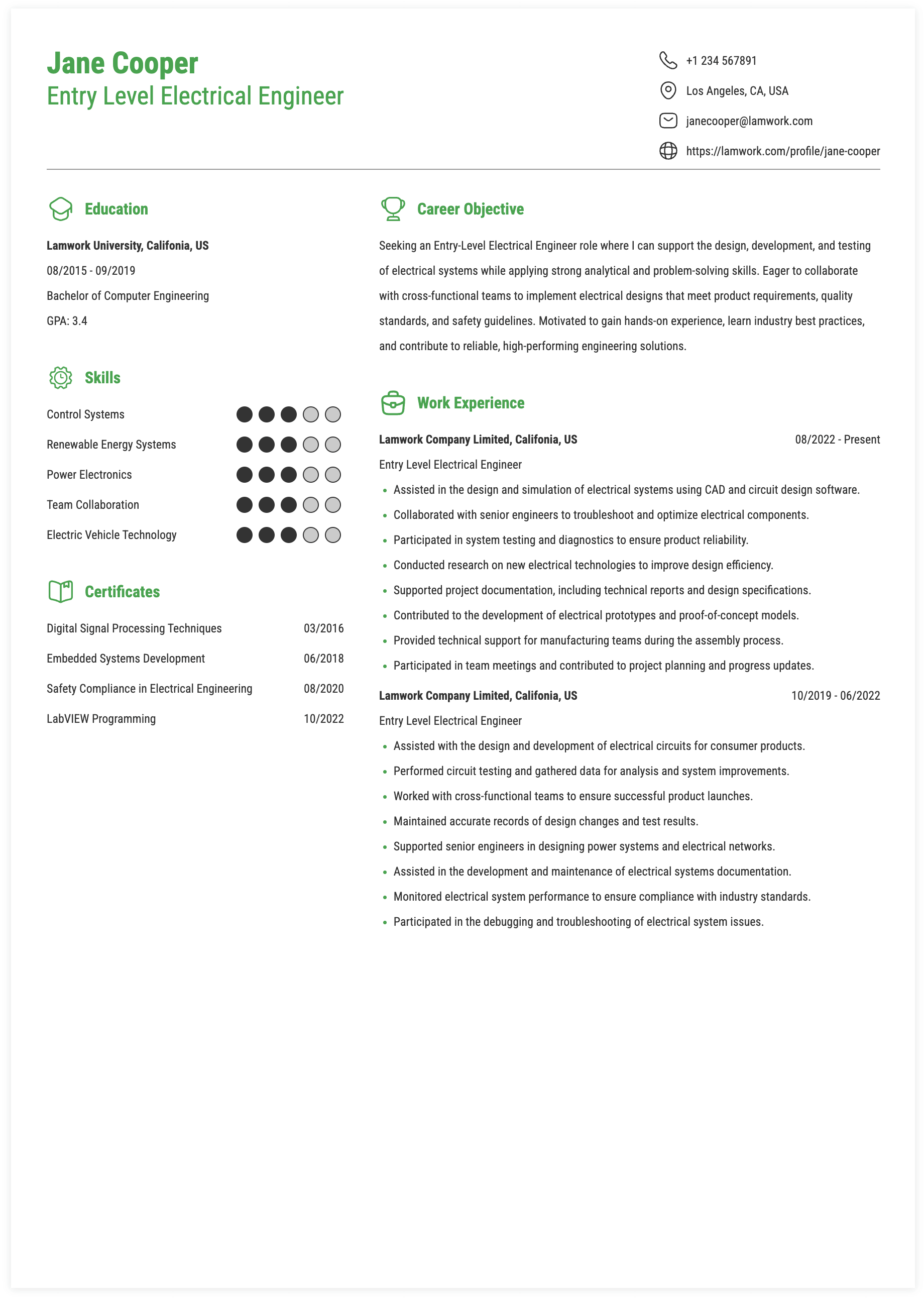
Tips for Entry Level Electrical Engineer Skills and Responsibilities on a Resume
1. Entry Level Electrical Engineer, Kappa Engineering, Seattle, WA
Job Summary:
- Conduct Electrical Engineering testing and evaluation.
- Perform electrical system analysis using electrical power system modeling programs.
- Perform field investigation and troubleshooting to resolve problems that occur in the electrical power distribution system.
- Provide verbal and written technical direction to operations personnel.
- Perform and document safety analyses.
- Obtain and maintain qualifications in areas related to environmental safety, quality control, and electrical safety.
- Preparation of design drawings and specifications.
- Maintaining work scope for project engineering within time and budget parameters.
- Establishing and maintaining client relationships, with a strong emphasis on communication.
- Maintaining awareness of future business opportunities at customer facilities, and participating in company efforts to expand client base.
- Demonstrating a commitment to continuous personal, peer and process improvement.
- Development of project management skills.
Skills on Resume:
- Electrical Analysis (Hard Skills)
- Troubleshooting (Hard Skills)
- Technical Communication (Soft Skills)
- Safety Management (Hard Skills)
- Design Preparation (Hard Skills)
- Project Management (Hard Skills)
- Client Relations (Soft Skills)
- Continuous Improvement (Soft Skills)
2. Entry Level Electrical Engineer, VoltEdge Solutions, Charlotte, NC
Job Summary:
- Designing, developing, and supporting electronic product design, including PC Board layout design and some mechanical design
- Managing projects from design through manufacture and customer support
- Developing new products for the standard catalog through new product development and research and development activities
- Perform testing and develop prototypes in the engineering lab
- Designing customized products for customers
- Updating old drawings and documentation
- Supporting manufacturing engineering through developing instructions and assembly drawings as well as general production floor support
- Assisting with updating and developing the internal quality validation program
- Develop control electronics (hardware) for laser systems
- Firmware/software writing to control LDD, TEC, Motor, RF, other peripherals
- Testing and debugging PCB that controls LDD, TEC, Step motors, other peripherals
Skills on Resume:
- PCB Layout Design (Hard Skills)
- Project Management (Soft Skills)
- Product Development (Hard Skills)
- Prototyping and Testing (Hard Skills)
- Customization Design (Hard Skills)
- Drawing Updates (Hard Skills)
- Manufacturing Support (Soft Skills)
- Firmware Development (Hard Skills)
3. Entry Level Electrical Engineer, Orion Energy Solutions, Minneapolis, MN
Job Summary:
- Contributes to team effort by accomplishing required projects
- Assisting the manufacturing department in the development and/or improvement of new or existing processes or procedures.
- Design, assemble, test and maintain fixtures and software applications, which provide automated testing and database record keeping.
- Creates/updates documentation of the manufacturing process.
- Develop and/or evaluate manufacturing processes by studying product requirements
- Applying knowledge of assembly, manufacture test methods and quality standards of RF power equipment.
- Analyzes assembly flow and throughput for various processes and initiates acquisition, development, and modification of manual and automated assembly equipment to improve quality, reduce cost and increase production capacity.
- Analyzes production assembly issues, troubleshoots to component level and provide guidance on rework and disposition.
- Attend management meetings to present updates on projects and present technical information.
Skills on Resume:
- Teamwork (Soft Skills)
- Process Improvement (Hard Skills)
- Fixture Design (Hard Skills)
- Documentation (Hard Skills)
- Process Evaluation (Hard Skills)
- Assembly Knowledge (Hard Skills)
- Troubleshooting (Hard Skills)
- Presentation (Soft Skills)
Resume Standards 2026
Lamwork's key guidelines and best practices for writing a professional, ATS-friendly resume.
1. Contact Information
Name, phone number, professional email, LinkedIn, portfolio (if applicable)
2. Professional Summary (2-3 lines)
Role + years of experience + key strengths
3. Work Experience
Title + company + dates
Bullet points: action verbs + metrics + impact
Add context (what/why) when needed
Not recommended: Increased sales by 20%
Recommended: Increased B2B sales by 20% by optimizing outreach strategy
4. Skills
Hard skills only + match job description keywords (ATS)
5. Education
Degree, school, year (GPA if strong)
6. Projects (if relevant)
Name + tools + outcomes
7. Format
0-5 years: 1 page
5-10 years: up to 2 pages
Clean font, no photo, no personal details
8. ATS Optimization
Use exact keywords from the job description
Avoid tables or columns
Example:
Job says "Data Analysis" -> use "Data Analysis"
Do not change it to "Analyzing Data"
9. Do Not Include
Photo, age, gender, full address, references
10. Final Check
No typos, consistent verb tense, tailored for each job
File name: FirstName_LastName_Resume.pdf
Editorial Process and Content Quality
This content is developed by the Lamwork Editorial Team using structured analysis of real-world job data, skill requirements, and hiring patterns.
Research framework by Lam Nguyen, Founder & Editorial Lead.
Reviewed by Thanh Huyen, Managing Editor.
Learn more about our editorial standards.