AIRFRAME AND POWERPLANT MECHANIC RESUME EXAMPLE
Airframe and Powerplant Mechanic resume examples by level covering FAA A&P documentation, Flightdocs, and inspection record presentation.

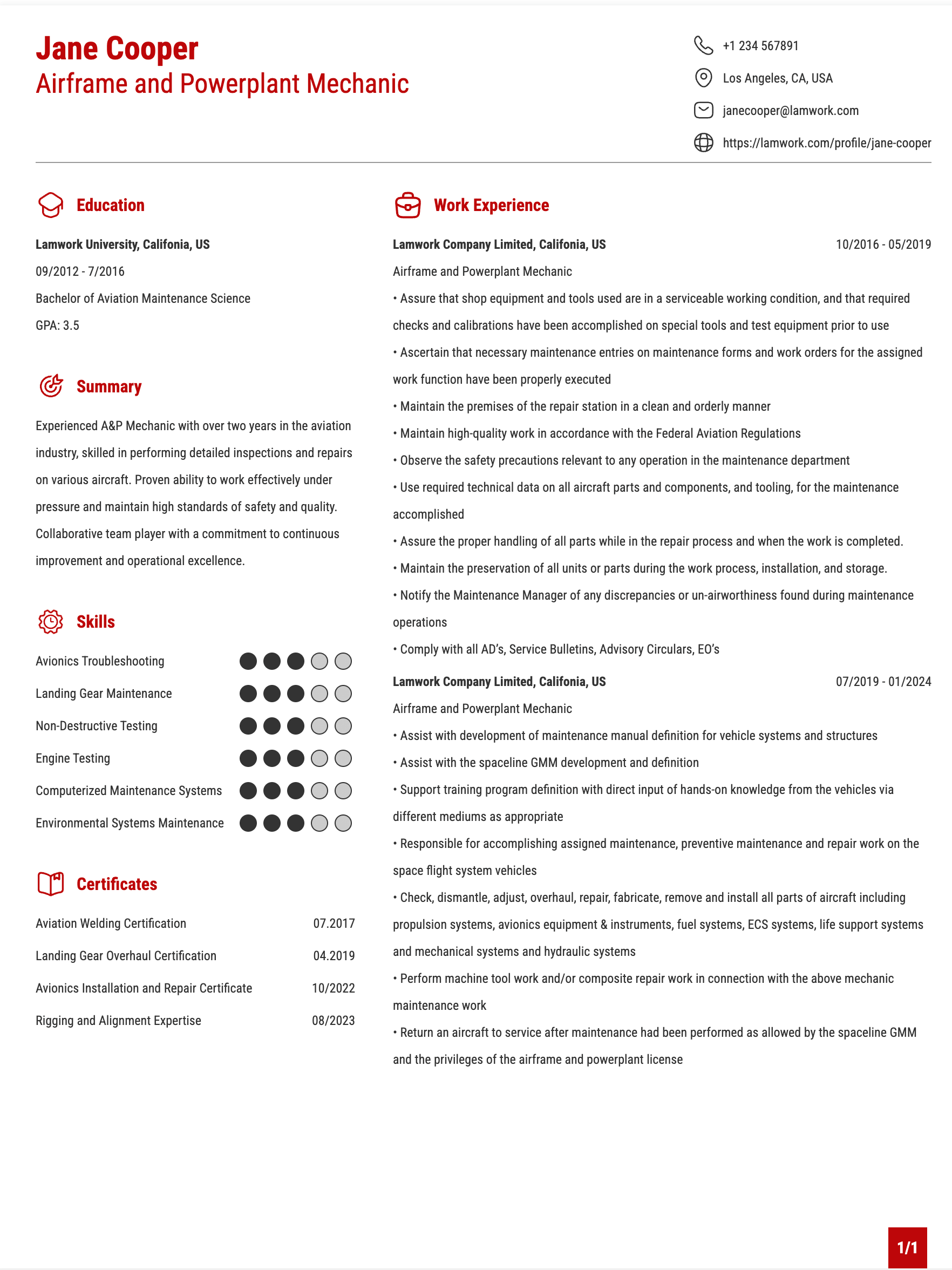
Airframe and Powerplant Mechanic Resume by Experience Level
1. Entry-Level / Junior Airframe and Powerplant Mechanic Resume
Tyler Bennett
Wichita, KS
(316) 555-2847
tyler.bennett.aero@gmail.com
linkedin.com/in/tyler-bennett-aandp
SUMMARY
Results-driven Airframe and Powerplant Mechanic with 2+ years of experience in aircraft inspections, preventive maintenance, and troubleshooting within the aviation maintenance industry. Proven record of supporting 95% on-time maintenance completion through accurate inspections, component replacement, and FAA-compliant documentation. Expertise in hydraulic systems and aircraft diagnostics to optimize aircraft reliability, mitigate operational downtime, and drive maintenance efficiency across scheduled and unscheduled repair operations.
SKILLS
Aircraft Inspection
Hydraulic Systems
FAA Compliance
Engine Troubleshooting
Technical Documentation
Operational Testing
EXPERIENCE
Airframe and Powerplant Mechanic
Skyward Aviation Services, Wichita, KS
June 2024 – Present
- Performed scheduled and unscheduled maintenance on regional aircraft, completing 120+ inspection and repair assignments while maintaining 100% FAA documentation compliance.
- Diagnosed hydraulic, electrical, and engine discrepancies using maintenance manuals and diagnostic equipment, reducing repeat maintenance actions by 14%.
- Replaced aircraft components, including brakes, pumps, and flight control assemblies, improving aircraft turnaround efficiency by 11% during overnight maintenance operations.
- Conducted operational testing and post-maintenance inspections across multiple aircraft systems, supporting safe return-to-service procedures for daily flight schedules.
Aircraft Maintenance Technician Trainee
Midwest Aero Support, Salina, KS
August 2022 – May 2024
- Assisted senior mechanics with aircraft inspections, servicing, and troubleshooting activities across 75+ scheduled maintenance events annually.
- Maintained detailed repair logs, maintenance records, and compliance paperwork, contributing to zero audit discrepancies during FAA review periods.
- Supported aircraft towing, ground support operations, and component cleaning procedures while maintaining organized and safe work environments.
- Interpreted technical manuals, ATA codes, and engineering drawings to support structural repairs and routine maintenance assignments efficiently.
EDUCATION
Associate of Applied Science in Aviation Maintenance Technology
Kansas Technical Institute, Wichita, KS
2. Mid-Level Airframe and Powerplant Mechanic Resume
Brandon Mitchell
Mesa, AZ
(480) 555-7319
brandon.mitchell.maintenance@gmail.com
linkedin.com/in/brandonmitchellaandp
SUMMARY
Results-driven Airframe and Powerplant Mechanic with 5+ years of experience in line maintenance, airframe repair, and engine troubleshooting within commercial aviation operations. Proven record of reducing maintenance turnaround time by 18% through efficient troubleshooting, FAA-compliant inspections, and accurate maintenance documentation. Expertise in flight controls and aircraft systems to optimize fleet reliability, mitigate operational disruptions, and drive maintenance performance across high-volume maintenance environments.
SKILLS
Line Maintenance
Flight Controls
Aircraft Systems
FAA Regulations
Structural Repair
Diagnostic Testing
EXPERIENCE
Airframe and Powerplant Mechanic
Frontier Aviation Technologies, Mesa, AZ
March 2022 – Present
- Conducted overnight maintenance on Boeing and regional aircraft fleets, completing 200+ scheduled and unscheduled maintenance assignments annually.
- Diagnosed and repaired flight control, fuel, hydraulic, and electrical system discrepancies, decreasing repeat mechanical write-ups by 19%.
- Executed engine removal, installation, and operational testing procedures while maintaining 100% compliance with FAA maintenance standards.
- Coordinated daily with maintenance planning teams and quality assurance personnel to improve workflow efficiency and reduce aircraft downtime by 16%.
- Maintained detailed aircraft logbooks, repair documentation, and compliance records supporting successful FAA and internal maintenance audits.
Aircraft Maintenance Technician
Desert Ridge Aerospace, Tucson, AZ
January 2020 – February 2022
- Performed preventive maintenance, annual inspections, and corrective repairs on turbine and piston-powered aircraft across 150+ maintenance operations.
- Repaired landing gear, braking systems, structural assemblies, and avionics components while improving maintenance completion rates by 13%.
- Utilized engineering drawings, ATA codes, and technical manuals to troubleshoot aircraft discrepancies and support return-to-service inspections efficiently.
- Assisted with aircraft launch, recovery, and ground support operations while sustaining zero safety violations during maintenance activities.
EDUCATION
Associate Degree in Aviation Maintenance Technology
Pima Aviation College, Tucson, AZ
3. Senior Airframe and Powerplant Mechanic Resume
Christopher Reynolds
Fort Worth, TX
(817) 555-9421
christopher.reynolds.aero@gmail.com
linkedin.com/in/christopher-reynolds-aviation
PROFESSIONAL SUMMARY
Results-driven Airframe and Powerplant Mechanic with 10+ years of experience in aircraft maintenance, airworthiness compliance, and powerplant systems within commercial and defense aviation environments. Proven record of improving maintenance reliability by 24% through advanced troubleshooting, inspection management, and operational testing initiatives. Expertise in regulatory compliance and aircraft diagnostics to optimize maintenance operations, mitigate operational risk, and drive fleet readiness across complex aviation maintenance programs.
CORE SKILLS
Airworthiness Compliance
Powerplant Systems
Aircraft Diagnostics
Maintenance Planning
Engine Overhaul
Quality Inspections
EXPERIENCE
Senior Airframe and Powerplant Mechanic
Lone Star Aviation Systems, Fort Worth, TX
April 2020 – Present
- Directed complex maintenance operations across commercial and military aircraft platforms, supporting 300+ scheduled inspections and corrective repair assignments annually.
- Evaluated engine performance data, airworthiness directives, and maintenance tracking records, improving compliance accuracy and reducing audit findings by 22%.
- Led troubleshooting and repair activities involving avionics, hydraulic, environmental, and propulsion systems while decreasing aircraft downtime by 20%.
- Coordinated with quality assurance, engineering, and maintenance planning departments to streamline operational workflows and improve maintenance turnaround efficiency.
- Mentored junior mechanics and maintenance technicians on FAA procedures, operational testing, and advanced troubleshooting methods across high-volume maintenance operations.
Airframe and Powerplant Mechanic
AeroCore Maintenance Group, Oklahoma City, OK
June 2016 – March 2020
- Executed line maintenance, heavy inspections, and structural repair activities on Boeing and regional aircraft fleets across 250+ maintenance events annually.
- Performed engine overhauls, flight control rigging, operational testing, and component replacement procedures while maintaining full FAA regulatory compliance.
- Interpreted engineering schematics, technical manuals, and maintenance documentation to resolve aircraft system discrepancies and improve repair accuracy by 17%.
- Managed maintenance records, parts tracking, and inspection documentation supporting successful FAA audits and zero compliance violations during review cycles.
EDUCATION
Bachelor of Science in Aviation Maintenance Management
Oklahoma Aeronautics University
Sample ATS-Friendly Work Experience for Airframe and Powerplant Mechanic Roles
1. Airframe and Powerplant Mechanic, AeroVista Aviation, Phoenix, AZ
- Executed routine inspections on airframe structures, engines, and hydraulic systems across 25+ aircraft, ensuring continuous compliance with FAA maintenance standards.
- Diagnosed mechanical discrepancies using technical manuals, blueprints, and functional testing procedures, reducing unscheduled maintenance delays by 18% during peak operational periods.
- Replaced defective components and calibrated aircraft systems for more than 120 maintenance tasks annually while maintaining accurate service documentation and labor tracking.
- Operated specialized aviation tools and ground equipment to tow, park, and service aircraft safely, supporting daily turnaround schedules for multi-aircraft operations.
- Interpreted engineering drawings and maintenance specifications to resolve structural and system-related issues, improving inspection accuracy by 22% across recurring repair assignments.
- Sustained organized work areas and followed established safety procedures, contributing to zero compliance violations and consistent on-time project completion throughout assignments.
Core Skills:
- Airframe Inspection
- Engine Troubleshooting
- Hydraulic Systems
- FAA Compliance
- Blueprint Interpretation
- Functional Testing
Employers read daily inspection volume as a sign of dependable output, and the duties employers formally list show how they frame that expectation.
2. Airframe and Powerplant Mechanic, Summit Air Services, Tulsa, OK
- Performed scheduled and corrective maintenance on company-managed aircraft under the Director of Maintenance's approval, supporting fleet readiness across 30+ maintenance events annually.
- Sourced new, overhauled, and repairable aircraft components from approved vendors, decreasing procurement costs by 17% while minimizing operational downtime for critical maintenance activities.
- Collaborated with maintenance leadership and safety management teams to strengthen IS-BAO, ARG/US Platinum, and Air Charter Safety Foundation compliance initiatives across flight operations.
- Monitored aircraft maintenance status reports and assembled detailed work packages, ensuring 100% adherence to manufacturer-recommended service intervals and FAA regulatory requirements.
- Verified maintenance release documentation and post-repair inspection records before aircraft return-to-service, improving audit accuracy and reducing documentation discrepancies by 21%.
- Managed parts inventory, conducted operational testing after repairs, and documented inspection findings precisely, contributing to zero FAA compliance violations during maintenance review periods.
Core Skills:
- Aircraft Maintenance
- Parts Procurement
- FAA Compliance
- Maintenance Planning
- Inventory Control
- Operational Testing
3. Airframe and Powerplant Mechanic, Falcon Ridge Aerospace, Wichita, KS
- Inspected and calibrated specialized maintenance tools and testing equipment before operational use, sustaining 100% compliance with required serviceability and calibration standards.
- Documented maintenance activities, repair actions, and work orders accurately across 150+ service events, ensuring complete traceability under Federal Aviation Administration regulations.
- Maintained organized repair facilities and enforced operational safety precautions, contributing to zero workplace incidents and uninterrupted maintenance productivity throughout scheduled assignments.
- Applied current technical manuals, engineering data, and revision-controlled procedures during aircraft component servicing, improving maintenance accuracy and reducing repeat corrective actions by 16%.
- Preserved aircraft parts and assemblies throughout repair, installation, and storage processes while identifying un-airworthy conditions and escalating discrepancies promptly to maintenance leadership.
- Executed maintenance tasks in accordance with Airworthiness Directives, Service Bulletins, Advisory Circulars, and Engineering Orders, sustaining full regulatory compliance during inspection audits.
Core Skills:
- Tool Calibration
- Maintenance Documentation
- Technical Manuals
- Aircraft Preservation
- Regulatory Compliance
- Safety Procedures
4. Airframe and Powerplant Mechanic, Liberty Jet Maintenance, Charlotte, NC
- Performed line maintenance and corrective repairs on commercial aircraft with minimal supervision, completing daily assignments efficiently while maintaining high first-time quality performance standards.
- Interpreted Aircraft Maintenance Manuals, Structural Repair Manuals, Illustrated Parts Catalogs, and FAA directives to execute complex repairs across 40+ scheduled maintenance operations annually.
- Diagnosed aircraft system malfunctions and restored operational performance using approved technical data, reducing repeat maintenance actions by 19% across recurring troubleshooting assignments.
- Removed and installed aircraft components according to regulatory procedures while verifying system functionality through detailed inspections, operational checks, and post-repair testing activities.
- Maintained strict adherence to FAA regulations, company maintenance policies, and workplace safety procedures, contributing to zero compliance findings during internal quality audits.
- Sustained clean and organized maintenance environments while applying comprehensive airframe and powerplant expertise to support safe, reliable, and on-time aircraft operations consistently.
Core Skills:
- Aircraft Troubleshooting
- Line Maintenance
- Technical Manuals
- Component Replacement
- FAA Regulations
- System Testing
5. Airframe and Powerplant Mechanic, Horizon Aircraft Solutions, Dallas, TX
- Supported scheduled and unscheduled aircraft maintenance activities by assisting with inspections, component servicing, and corrective repairs across 60+ operational maintenance assignments annually.
- Assisted technicians in diagnosing and repairing fuel leaks, oil leaks, and engine-related discrepancies, reducing aircraft downtime by 14% during active maintenance operations.
- Removed and installed airframe and engine components using approved technical procedures while supporting operational checks and post-maintenance system functionality testing activities.
- Prepared maintenance documentation, technical records, and compliance reports according to company procedures, customer technical orders, and government regulatory requirements without documentation discrepancies.
- Participated in aircraft launch and recovery operations, including preflight inspections, ground support coordination, post-flight evaluations, and payload installation for mission-ready aircraft operations.
- Maintained safe operating practices while inspecting and operating ground support equipment, contributing to full compliance with organizational safety standards and operational procedures consistently.
Core Skills:
- Aircraft Maintenance
- Engine Repair
- Component Installation
- Ground Operations
- Technical Documentation
- Operational Testing
6. Airframe and Powerplant Mechanic, SkyBridge Aviation, Jacksonville, FL
- Promoted safety, security, and quality standards during daily aircraft maintenance operations, contributing to zero regulatory violations and consistent adherence to FAA and organizational procedures.
- Reported un-airworthy conditions immediately to maintenance leadership while coordinating with cross-functional teams to maintain uninterrupted workflow across time-sensitive repair assignments and inspections.
- Interpreted maintenance manuals, ATA codes, blueprints, and service bulletins to troubleshoot aircraft systems effectively, improving maintenance turnaround efficiency by 18% across recurring service operations.
- Performed rigging adjustments, safety wiring, powerplant removals, flight control installations, and aircraft system overhauls while ensuring continued airworthiness and operational reliability standards.
- Managed maintenance records, parts tagging procedures, and repair documentation accurately for 140+ maintenance actions, reducing audit discrepancies and strengthening compliance tracking processes.
- Operated ground support equipment safely while completing aircraft servicing tasks, including wheel replacements, brake maintenance, engine oil servicing, and structural inspections under demanding physical conditions.
Core Skills:
- Aircraft Servicing
- Safety Compliance
- Flight Controls
- Powerplant Systems
- Maintenance Documentation
- Ground Equipment
7. Airframe and Powerplant Mechanic, Titan Aero Systems, Atlanta, GA
- Conducted scheduled and unscheduled aircraft inspections and repairs in accordance with Federal Aviation Regulations and Repair Station Manual standards across 75+ maintenance activities annually.
- Repaired engines, landing gear, hydraulic systems, and aircraft structures while replacing defective components, improving operational reliability, and reducing repeat maintenance discrepancies by 17%.
- Interpreted maintenance manuals, technical schematics, and engineering data to troubleshoot structural and electrical issues involving fuselage assemblies, wings, rigging, and control surfaces.
- Disassembled and inspected aircraft components for wear, corrosion, and operational defects, ensuring accurate repair decisions and maintaining full compliance with aviation safety requirements.
- Managed aircraft parts tagging, storage procedures, and workspace organization while operating specialized maintenance tools and equipment under strict quality and safety standards consistently.
- Collaborated professionally with supervisors, mechanics, pilots, office personnel, and customers while supporting post-maintenance flight operations and delivering high-quality maintenance service outcomes.
Core Skills:
- Aircraft Inspection
- Structural Repair
- Hydraulic Systems
- Electrical Wiring
- Landing Gear
- Technical Manuals
8. Airframe and Powerplant Mechanic, BlueRock Air Support, Denver, CO
- Performed scheduled and unscheduled maintenance on piston and turbine-powered aircraft, supporting 80+ general aviation service events annually while maintaining strict FAA regulatory compliance standards.
- Executed annual, progressive, 100-hour, and phase inspections using approved manufacturer instructions, improving aircraft readiness and reducing deferred maintenance discrepancies by 16%.
- Analyzed logbook records, airworthiness directives, service bulletins, and advisory circulars to verify inspection status and ensure conformity with certification requirements consistently.
- Prepared detailed maintenance records, work orders, and compliance documentation for customers, strengthening transparency and increasing post-service customer satisfaction across maintenance operations.
- Coordinated aircraft maintenance workflows and prioritized repair activities effectively while supporting line maintenance, structural alterations, and off-site Aircraft on Ground recovery assignments.
- Represented maintenance leadership professionally through clear verbal and written communication, delivering technical guidance and timely project completion for customer-focused aviation support services.
Core Skills:
- Aircraft Inspections
- FAA Compliance
- Logbook Research
- Line Maintenance
- Airworthiness Directives
- Technical Documentation
To judge whether your Airworthiness Directive compliance record is strong enough, the competency bar across A&P postings provides the benchmark to measure against.
9. Airframe and Powerplant Mechanic, Vanguard Flight Services, Nashville, TN
- Ensured aircraft airworthiness under 14 CFR requirements by researching maintenance records, Airworthiness Directives, and manufacturer service bulletins for 50+ assigned aircraft annually.
- Performed preventive maintenance, inspections, and corrective repairs in accordance with company standards, FAA regulations, and industry best practices to maximize aircraft operational reliability.
- Verified aircraft logbook entries, permanent maintenance records, and compliance documentation accurately, reducing audit discrepancies by 19% across recurring maintenance review cycles.
- Updated computerized maintenance tracking systems and coordinated effectively with vendors and internal departments to streamline maintenance scheduling and improve workflow efficiency by 15%.
- Delivered technical support to maintenance personnel and management teams while independently resolving complex maintenance issues with minimal supervision during time-sensitive operational assignments.
- Maintained safe working conditions and traveled for routine maintenance and aircraft breakdown support during peak operational periods, ensuring timely restoration of aircraft serviceability standards.
Core Skills:
- Airworthiness Compliance
- Maintenance Tracking
- Preventive Maintenance
- Logbook Management
- Technical Support
- FAA Regulations
10. Airframe and Powerplant Mechanic, Precision AeroWorks, Columbus, OH
- Performed aircraft inspections and maintenance in accordance with Repair Station Manual procedures, maintaining airworthy conditions and completing 120+ documented maintenance tasks annually.
- Researched manufacturer maintenance manuals and coordinated with technical representatives to resolve complex repair issues, reducing maintenance delays and improving task completion efficiency by 14%.
- Documented daily maintenance activities, progressive sign-offs, and component removals accurately, ensuring full traceability and compliance with repair station documentation standards consistently.
- Inspected and maintained ground support equipment while safeguarding aircraft interiors, exteriors, and components from operational damage during active maintenance and servicing procedures.
- Communicated project progress, setbacks, and technical findings effectively with supervisors, supporting streamlined workflow coordination and minimizing operational disruptions across maintenance assignments.
- Maintained organized work environments, enforced unsafe action stoppage procedures, and recorded on-the-job training activities, contributing to zero safety violations during recurring maintenance operations.
Core Skills:
- Aircraft Inspection
- Repair Procedures
- Ground Equipment
- Technical Research
- Maintenance Documentation
- Safety Compliance
11. Airframe and Powerplant Mechanic, NorthStar Aviation Group, Boise, ID
- Supported the development of maintenance manuals and General Maintenance Manual procedures for space flight systems, improving technical documentation consistency across vehicle maintenance operations.
- Contributed hands-on technical expertise to training program development, enhancing maintenance readiness and reducing onboarding time for newly assigned aerospace maintenance personnel by 20%.
- Performed preventive maintenance, repairs, and overhaul activities on propulsion, avionics, hydraulic, fuel, environmental control, and life support systems for advanced aerospace vehicles.
- Fabricated, installed, and repaired aircraft and spacecraft components using machine tools and composite repair techniques, increasing structural repair efficiency across recurring maintenance assignments.
- Completed and signed maintenance records accurately while inspecting assemblies and subassemblies to verify airworthiness, regulatory compliance, and operational reliability before vehicle return-to-service authorization.
- Executed base maintenance workloads independently across multiple vehicle systems while supporting turbine and rocket propulsion operations under strict maintenance and safety performance standards.
Core Skills:
- Propulsion Systems
- Composite Repair
- Avionics Systems
- Hydraulic Systems
- Maintenance Documentation
- Technical Training
12. Airframe and Powerplant Mechanic, Patriot Aircraft Systems, Oklahoma City, OK
- Performed scheduled and unscheduled maintenance on airframes and engines for FAA-registered aircraft, supporting operational reliability across 70+ maintenance assignments annually.
- Inspected replacement aircraft components for defects and verified serviceability standards, reducing installation discrepancies and improving maintenance quality performance by 15%.
- Diagnosed mechanical and electrical malfunctions using maintenance manuals, technical documents, and diagnostic equipment to restore aircraft systems efficiently and accurately.
- Repaired aircraft structures, braking systems, and electrical components while replacing defective parts with approved tooling and manufacturer-compliant maintenance procedures consistently.
- Analyzed aircraft records and interpreted flight test data to identify performance issues, strengthening troubleshooting accuracy and reducing repeat corrective maintenance actions by 18%.
- Assembled aircraft components, conducted precision measurements and testing procedures, and installed system software databases to maintain full operational and regulatory compliance standards.
Core Skills:
- Aircraft Maintenance
- Electrical Systems
- Diagnostic Testing
- Flight Data
- Component Assembly
- FAA Compliance
13. Airframe and Powerplant Mechanic, Crestline Aerospace, Grand Rapids, MI
- Performed scheduled and unscheduled maintenance on remotely piloted aircraft systems, supporting operational readiness and mission reliability for advanced surveillance and reconnaissance platforms.
- Inspected powerplant systems and related aircraft components according to approved maintenance manuals and government technical order requirements across 65+ maintenance operations annually.
- Diagnosed and repaired fuel leaks, oil leaks, and engine malfunctions while removing and replacing airframe components to restore aircraft performance and airworthiness standards.
- Reviewed maintenance records and technical documentation thoroughly, ensuring 100% compliance with company procedures, customer requirements, and government regulatory maintenance guidelines consistently.
- Executed aircraft launch and recovery operations, including preflight inspections, ground observer duties, post-flight evaluations, and ground support equipment operational testing activities.
- Supported onboarding and technical development initiatives by assisting with specialist training and contributing hands-on expertise toward new powerplant and aircraft system improvements.
Core Skills:
- Powerplant Maintenance
- Aircraft Inspection
- Ground Operations
- Technical Documentation
- Engine Troubleshooting
- System Testing
14. Airframe and Powerplant Mechanic, IronWing Aviation, Birmingham, AL
- Performed aircraft maintenance in accordance with government regulations, manufacturer maintenance manuals, company directives, and approved technical data across complex maintenance operations annually.
- Guided junior mechanics by sharing technical expertise and troubleshooting methods, improving task accuracy and reducing maintenance rework by 13% within assigned work centers.
- Monitored maintenance progress on assigned aircraft while evaluating engine and dynamic component conditions following operations outside established performance parameters and inspection thresholds.
- Collaborated with supervision and Quality Assurance teams to resolve serviceability concerns, ensuring compliant repair procedures and uninterrupted maintenance workflow across critical assignments.
- Applied blueprints, schematics, test equipment, and ground support equipment to perform corrosion treatment, structural cleaning, and aircraft system maintenance activities safely and efficiently.
- Maintained strict adherence to Foreign Object Damage prevention standards and Tool Control Program procedures while supporting off-site aircraft maintenance and recovery operations as authorized.
Core Skills:
- Aircraft Maintenance
- Corrosion Control
- Quality Assurance
- Ground Equipment
- Technical Schematics
- Tool Control
15. Airframe and Powerplant Mechanic, Pinnacle Air Logistics, Louisville, KY
- Complied with industrial safety regulations, contract requirements, and maintenance procedures while supporting aircraft operations with zero documented safety or compliance violations annually.
- Executed collateral duty inspection responsibilities and verified Quality Assurance standards across 90+ maintenance and operational support assignments throughout recurring maintenance cycles.
- Removed and reinstalled aircraft cowlings, panels, and access doors while documenting completed maintenance actions within government and company information management systems accurately.
- Performed corrosion control cleaning and treatment procedures using approved hazardous material handling precautions, improving aircraft structural preservation and reducing preventable surface deterioration by 12%.
- Supported hangar line movement operations and safeguarded government-owned equipment inventories while enforcing security, preservation, Foreign Object Damage prevention, and operational safety procedures consistently.
- Conducted engine rinse program, ground turns, and out-of-phase operational checks using specialized maintenance instructions, ensuring aircraft performance reliability during high-power testing activities.
Core Skills:
- Quality Inspections
- Corrosion Control
- Operational Testing
- Maintenance Documentation
- Ground Operations
- Safety Compliance
16. Airframe and Powerplant Mechanic, Meridian Flight Operations, Salt Lake City, UT
- Removed and replaced aircraft components using specialized tooling and ground support equipment, completing routine and non-routine maintenance assignments within established operational timelines consistently.
- Diagnosed complex aircraft system discrepancies and performed advanced troubleshooting procedures, reducing repeat maintenance actions by 18% across heavy commercial maintenance operations annually.
- Executed rigging, installation, and operational testing of flight control systems while supporting engine removal and replacement activities according to approved maintenance procedures.
- Guided and trained junior maintenance personnel on technical procedures, safety standards, and equipment handling, improving overall task efficiency and reducing procedural errors within work groups.
- Maintained serviceable tools and organized work environments while adhering to strict aviation safety practices and company maintenance quality standards throughout daily operations.
- Documented on-the-job training activities and completed required technical development courses, strengthening maintenance proficiency across aircraft systems, operational checks, and corrective repair assignments.
Core Skills:
- Aircraft Troubleshooting
- Flight Controls
- Engine Replacement
- Ground Equipment
- Operational Testing
- Technical Training
Flight hours across Boeing and regional fleet types vary in how they count toward IA eligibility, and the A&P salary and certification outlook maps where each type sits.
17. Airframe and Powerplant Mechanic, AeroCore Maintenance, Indianapolis, IN
- Performed hangar and line maintenance on Boeing commercial aircraft, including 747, 767, and 777 fleets, supporting safe and reliable daily flight operations.
- Conducted preventive maintenance, scheduled inspections, and corrective repairs across aircraft engines, landing gear, braking systems, pumps, and structural components annually.
- Documented inspection findings, maintenance actions, and repair activities accurately, ensuring 100% compliance with FAA maintenance schedules, regulatory standards, and operational requirements consistently.
- Diagnosed aircraft mechanical discrepancies and executed post-maintenance operational testing, reducing repeat maintenance events by 16% across recurring commercial aviation service assignments.
- Repaired exterior aircraft structures, including wings, doors, paint surfaces, and sealing components, improving aircraft integrity and maintaining airworthiness under demanding operational conditions.
- Applied strong troubleshooting expertise and FAA-regulated maintenance procedures to resolve aircraft performance issues efficiently while sustaining high-quality safety and reliability standards consistently.
Core Skills:
- Line Maintenance
- Aircraft Troubleshooting
- FAA Compliance
- Structural Repair
- Engine Systems
- Operational Testing
18. Airframe and Powerplant Mechanic, Reliant Jet Services, Richmond, VA
- Inspected aircraft systems and performed diagnostic testing to identify mechanical and operational issues, improving maintenance accuracy and reducing unexpected equipment failures by 15%.
- Executed corrective repairs and preventive maintenance procedures on aircraft components, ensuring maximum operational reliability across scheduled and unscheduled maintenance assignments consistently.
- Diagnosed and reported aircraft malfunctions and resolved technical discrepancies efficiently, decreasing maintenance turnaround times and supporting uninterrupted daily flight operations successfully.
- Performed detailed servicing of aircraft equipment and systems while applying lubricants and cleaning procedures to extend component lifespan and maintain airworthiness standards.
- Advised maintenance personnel and operators on preventive maintenance practices, strengthening equipment reliability and reducing recurring mechanical issues during operational service periods.
- Maintained accurate maintenance logs, documented repair activities, and supported special projects, including aircraft washing and facility support duties under established safety procedures.
Core Skills:
- Aircraft Diagnostics
- Preventive Maintenance
- Corrective Repairs
- System Troubleshooting
- Maintenance Logging
- Equipment Servicing
19. Airframe and Powerplant Mechanic, Stratus Aviation Solutions, Albuquerque, NM
- Inspected, serviced, and repaired aircraft systems to ensure safe operation while supporting routine and unscheduled maintenance across multiple aviation maintenance assignments annually.
- Performed preventive maintenance and corrective repairs on engines, landing gear, brakes, pumps, and related aircraft systems, improving operational reliability by 14% during service cycles.
- Interpreted blueprints, ATA codes, maintenance manuals, and illustrated parts catalogs to troubleshoot aircraft discrepancies and execute manufacturer-approved repair procedures accurately.
- Conducted operational testing after maintenance activities and verified system functionality, reducing repeat corrective actions and strengthening aircraft performance consistency across maintenance operations.
- Maintained strict compliance with FAA regulations and established maintenance standards while supporting safe, efficient, and high-quality aircraft servicing procedures consistently.
- Documented inspections, repairs, maintenance procedures, and ordered parts accurately within detailed maintenance records, ensuring full traceability and audit-ready regulatory compliance standards.
Core Skills:
- Aircraft Inspection
- Preventive Maintenance
- FAA Compliance
- System Troubleshooting
- Operational Testing
- Maintenance Documentation
20. Airframe and Powerplant Mechanic, EaglePoint Aerospace, Omaha, NE
- Inspected aircraft engines, pumps, brakes, valves, landing gear, air-conditioning systems, and pressurized components to ensure safe and reliable operational performance consistently.
- Performed hourly, annual, and phase inspections across multiple aircraft systems, improving maintenance accuracy and reducing recurring mechanical discrepancies by 16% during inspection cycles.
- Completed aircraft maintenance, component replacements, and corrective repairs according to approved technical procedures while maintaining full compliance with FAA and company standards.
- Diagnosed system malfunctions and executed fitting and installation procedures efficiently, supporting timely aircraft return-to-service and minimizing operational downtime across maintenance assignments.
- Researched and applied technical manuals, engineering data, and illustrated parts documentation to identify repair solutions and order appropriate aircraft components accurately.
- Prepared detailed maintenance documentation and inspection records for regulatory compliance purposes while following established aviation safety procedures and operational maintenance protocols consistently.
Core Skills:
- Aircraft Inspection
- Landing Gear
- System Troubleshooting
- Component Installation
- Technical Documentation
- FAA Compliance
21. Airframe and Powerplant Mechanic, Vector Air Technologies, Huntsville, AL
- Assembled gas turbine engine modules and accessories using assembly drawings, specifications, and computerized systems to support production and overhaul operations efficiently.
- Performed engine overhaul, repair, and component assembly procedures while measuring tolerances precisely, reducing rework rates, and ensuring compliance with specified dimensional standards consistently.
- Utilized specialized tooling, holding fixtures, and mechanical equipment to install engine details and maintain operational readiness across assigned maintenance and assembly work areas.
- Supported engine testing operations and component evaluations according to structured test schedules, contributing to accurate performance verification and improved troubleshooting efficiency during maintenance activities.
- Executed airframe overhaul, modification, and repair assignments involving engines, structural systems, and aircraft components while assisting licensed mechanics during complex maintenance operations.
- Coordinated aircraft towing, equipment setup, and component cleaning procedures while supporting retrofit projects, customer programs, and new engine implementation initiatives across maintenance assignments.
Core Skills:
- Gas Turbines
- Engine Overhaul
- Component Testing
- Aircraft Assembly
- Airframe Repair
- Specialized Tooling
22. Airframe and Powerplant Mechanic, Frontier Aircraft Support, Spokane, WA
- Interpreted engineering drawings, blueprints, and technical specifications to perform aircraft system installations, engine inspections, and maintenance procedures across complex repair assignments annually.
- Diagnosed and repaired flight controls, hydraulic systems, fuel systems, environmental systems, and electrical components, reducing recurring mechanical discrepancies by 17% during operational maintenance cycles.
- Executed engine runs, routine inspections, LRU replacements, and troubleshooting activities while maintaining engine runup qualifications and supporting aircraft readiness for scheduled operations consistently.
- Collaborated with engineering teams, maintenance personnel, and operational staff to support new technology integration, aircraft modifications, and efficient maintenance workflow coordination successfully.
- Maintained accurate aircraft logbooks, repair station paperwork, and service records while ensuring compliance with FAA policies and approved maintenance documentation procedures.
- Removed, installed, and repaired cabin and mechanical aircraft components, including seating systems, cargo linings, oxygen systems, and air-conditioning assemblies under strict safety standards.
Core Skills:
- Flight Controls
- Hydraulic Systems
- Engine Troubleshooting
- Aircraft Documentation
- Electrical Systems
- Cabin Components
23. Airframe and Powerplant Mechanic, Atlas Aero Maintenance, Tampa, FL
- Performed airframe, powerplant, and propeller maintenance in accordance with FAA regulations, manufacturer manuals, and approved company maintenance procedures consistently.
- Documented aircraft discrepancies, repair activities, and maintenance actions accurately, ensuring full compliance with contractual requirements and reducing audit discrepancies by 15% annually.
- Executed routine inspections and troubleshooting procedures across aircraft systems, improving maintenance response efficiency and supporting safe, reliable aircraft operational performance consistently.
- Interpreted technical manuals, engineering drawings, and maintenance specifications to complete assigned repairs and aircraft modifications according to FAA and organizational standards.
- Collaborated with pilots during maintenance training activities to provide technical guidance, strengthening operational awareness, and improving communication between maintenance and flight personnel.
- Maintained organized work environments, safeguarded company tools and equipment, and completed ongoing manufacturer training programs to enhance technical proficiency and maintenance quality standards.
Core Skills:
- Aircraft Maintenance
- Powerplant Repair
- Technical Manuals
- FAA Compliance
- Aircraft Troubleshooting
- Maintenance Documentation
24. Airframe and Powerplant Mechanic, Keystone Flight Systems, Pittsburgh, PA
- Performed overnight maintenance on Dornier 328-300 and Embraer 135 aircraft, supporting airworthiness releases and on-time return-to-service operations across scheduled maintenance cycles.
- Executed organizational and intermediate-level maintenance on King Air and military aircraft platforms, improving aircraft reliability and reducing recurring mechanical discrepancies by 18%.
- Diagnosed, repaired, and modified avionics, electrical, engine, flight control, and airframe systems using technical manuals, service bulletins, and FAA-approved maintenance procedures consistently.
- Operated diagnostic equipment, power tools, welding equipment, rivet guns, and precision measuring devices to complete structural, mechanical, and electronic aircraft repairs efficiently.
- Documented maintenance activities, inspections, troubleshooting results, and repair actions accurately while collaborating daily with maintenance planning and control teams to meet operational deadlines.
- Maintained aircraft, tools, equipment, and work areas according to company policies, manufacturer standards, and Federal Aviation Regulations to ensure safe and compliant maintenance operations.
Core Skills:
- Aircraft Maintenance
- Avionics Systems
- Flight Controls
- Electrical Troubleshooting
- Structural Repair
- FAA Compliance
Present your FAR Part 43 inspection record and Flightdocs proficiency on a resume that gets shortlisted.
Resume Standards 2026
Lamwork's key guidelines and best practices for writing a professional, ATS-friendly resume.
1. Contact Information
Name, phone number, professional email, LinkedIn, portfolio (if applicable)
2. Professional Summary (2-3 lines)
Role + years of experience + key strengths
3. Work Experience
Title + company + dates
Bullet points: action verbs + metrics + impact
Add context (what/why) when needed
Not recommended: Increased sales by 20%
Recommended: Increased B2B sales by 20% by optimizing outreach strategy
4. Skills
Hard skills only + match job description keywords (ATS)
5. Education
Degree, school, year (GPA if strong)
6. Projects (if relevant)
Name + tools + outcomes
7. Format
0-5 years: 1 page
5-10 years: up to 2 pages
Clean font, no photo, no personal details
8. ATS Optimization
Use exact keywords from the job description
Avoid tables or columns
Example:
Job says "Data Analysis" -> use "Data Analysis"
Do not change it to "Analyzing Data"
9. Do Not Include
Photo, age, gender, full address, references
10. Final Check
No typos, consistent verb tense, tailored for each job
File name: FirstName_LastName_Resume.pdf
Editorial Process and Content Quality
This content is developed by the Lamwork Editorial Team using structured analysis of real-world job data, skill requirements, and hiring patterns.
Research framework by Lam Nguyen, Founder & Editorial Lead.
Reviewed by Thanh Huyen, Managing Editor.
Learn more about our editorial standards.