ADJUNCT INSTRUCTOR COVER LETTER TEMPLATE
Adjunct Instructor cover letter examples connecting LMS administration, FERPA compliance, and active learning outcomes to measurable student retention results.

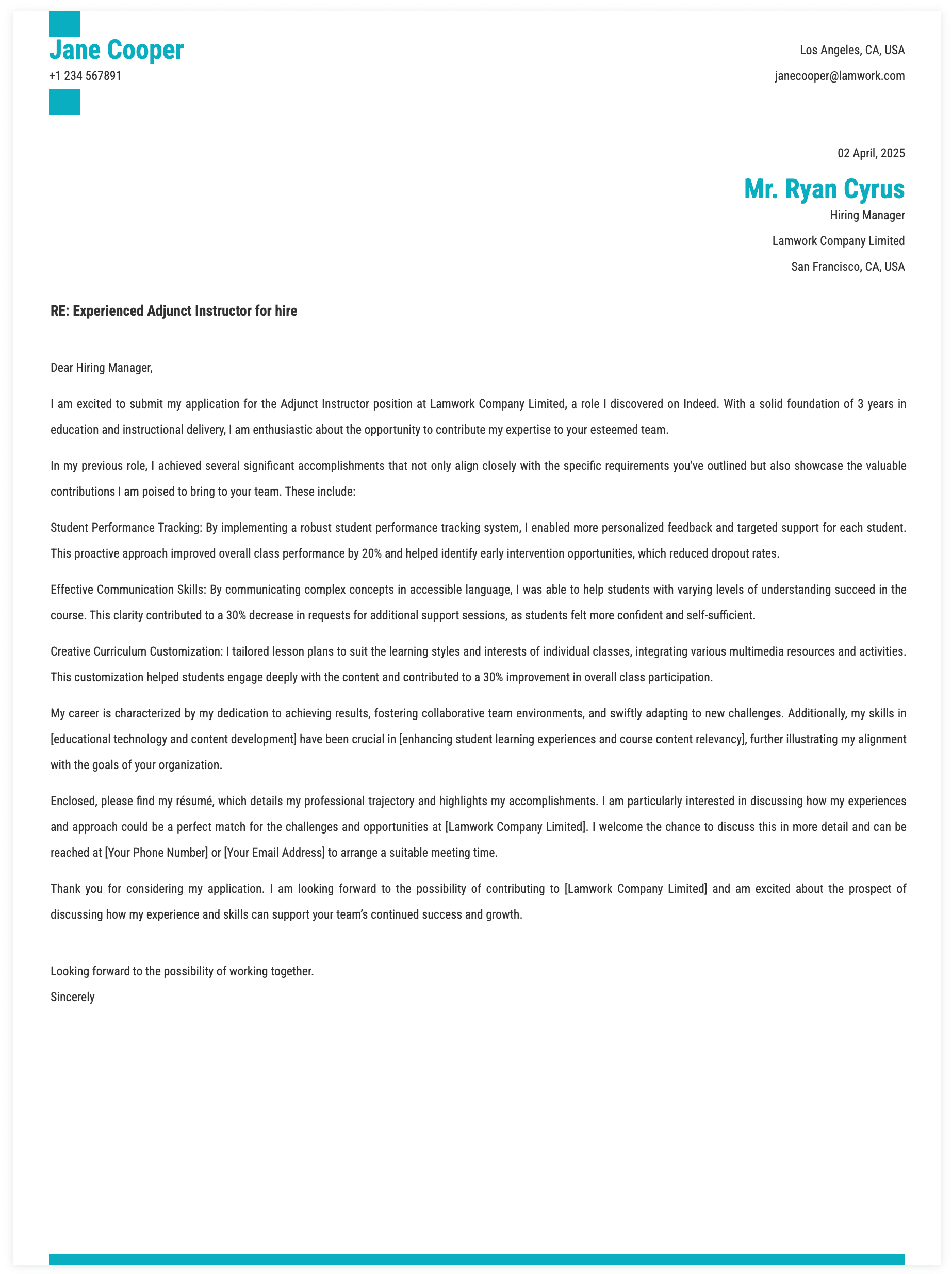
Adjunct Instructor Cover Letter Examples by Experience Level
1. Entry-Level Adjunct Instructor Cover Letter
Ethan Caldwell
(312) 555-4819
ethan.caldwell.hr@gmail.com
May 07, 2026
Melissa Turner
Academic Program Coordinator
Lamwork Company Limited
RE: Adjunct Nursing Instructor Application
Dear Turner,
Recent instructional training and blended-learning experience in nursing education have strengthened my ability to support students through structured, technology-driven academic environments. Exposure to online teaching platforms, curriculum planning, and student mentoring has prepared me to contribute effectively to your instructional team while continuing to expand my professional capabilities.
During my academic and clinical teaching experience, I supported course facilitation, monitored learner progress, and assisted students from diverse educational and cultural backgrounds. I also became comfortable adapting lesson delivery for online and hybrid settings while maintaining compliance with nursing education standards and institutional expectations. These experiences allowed me to apply instructional methods that improved student participation and strengthened classroom engagement.
Digital Instruction: Assisted hybrid nursing courses serving 60+ students, improving assignment completion rates by 14% through timely LMS communication and structured learning support.
Student Mentorship: Guided at-risk learners during clinical and online activities, contributing to a 12% increase in course retention within one academic term.
Curriculum Support: Helped update competency-based course materials and assessment activities, reducing grading turnaround time by 20% across multiple instructional modules.
I am eager to contribute to a student-centered academic environment while continuing to grow as an educator in nursing and healthcare instruction. I would welcome the opportunity to support your department’s instructional goals and learner success initiatives.
Respectfully,
2. Junior Adjunct Instructor Cover Letter
Sophia Bennett
(404) 555-2671
sophia.bennett.edu@gmail.com
May 08, 2026
Daniel Harper
Director of Academic Affairs
Lamwork Company Limited
RE: Adjunct Nursing Instructor Application
Dear Harper,
Consistent instructional performance in hybrid nursing education environments has allowed me to improve learner engagement, streamline academic communication, and support stronger student achievement outcomes. My experience teaching diverse student populations and integrating digital learning systems aligns closely with the operational and instructional needs of your program.
In recent academic roles, I independently managed online and blended nursing courses, coordinated assessment activities, and provided individualized academic support to students navigating clinical and theoretical coursework. I also collaborated with faculty teams to strengthen curriculum delivery, maintain compliance with nursing education standards, and implement instructional improvements that enhanced learner accessibility and participation. My background in healthcare instruction and educational technology enables me to adapt quickly while maintaining instructional quality in fast-paced environments.
Blended Learning: Managed hybrid nursing courses for 120+ learners annually, increasing student participation by 18% through adaptive instructional delivery and proactive outreach.
Academic Assessment: Reduced grading and feedback turnaround times by 25% while maintaining full compliance with institutional reporting and accreditation requirements.
Student Retention: Supported intervention initiatives that improved course completion rates by 15% through individualized mentoring and timely learner engagement strategies.
I look forward to contributing operationally effective instruction and measurable student success outcomes to your academic team. The opportunity to support learner achievement while enhancing instructional performance strongly aligns with my professional goals.
Respectfully,
3. Senior Adjunct Instructor Cover Letter
Victoria Reynolds
(617) 555-9034
victoria.reynolds.faculty@gmail.com
May 09, 2026
Jonathan Whitaker
Vice President of Academic Operations
Lamwork Company Limited
RE: Adjunct Nursing Instructor Application
Dear Whitaker,
Leading high-volume hybrid nursing education initiatives across diverse learner populations has enabled me to drive measurable improvements in student retention, instructional quality, and operational efficiency within technology-enabled academic environments. My background combines healthcare leadership, advanced curriculum execution, and cross-functional faculty collaboration to support scalable, student-centered nursing programs aligned with evolving educational and workforce standards.
Throughout my career, I have overseen blended and online nursing instruction while partnering with academic leadership, clinical stakeholders, and compliance teams to strengthen curriculum alignment, faculty coordination, and learner success outcomes. I have directed initiatives focused on instructional modernization, retention strategy execution, and digital learning integration that improved engagement across multicultural student cohorts while ensuring adherence to accreditation and state nursing education requirements. My ability to balance academic leadership with operational execution has consistently supported stronger learner progression and institutional performance.
Instructional Leadership: Directed multi-format nursing programs serving 250+ students annually, increasing retention outcomes by 21% through integrated faculty coordination and learner support initiatives.
Curriculum Optimization: Led competency-based curriculum enhancements that reduced remediation rates by 19% while improving assessment performance across online and hybrid delivery models.
Digital Learning Strategy: Implemented LMS and virtual-learning process improvements that accelerated faculty response efficiency by 28% and strengthened student engagement metrics institution-wide.
I am prepared to contribute strategic instructional leadership, operational rigor, and measurable academic outcomes that support long-term program growth and student success. I welcome the opportunity to help advance your institution’s nursing education initiatives through high-impact academic execution and collaborative leadership.
Respectfully,
Skills, Experience, and Responsibilities to Highlight When Writing an ATS-Friendly Adjunct Instructor Cover Letter
1. Adjunct Instructor | 200+ Learners Supported Annually | Learning Management Systems
- Learning Management Integration: Administered end-to-end course delivery through enterprise learning platforms, optimizing curriculum execution, attendance tracking, and grade reporting workflows for 200+ learners annually while ensuring full compliance with academic and registrar requirements.
- Curriculum Quality Assurance: Delivered advanced technology-focused instruction aligned to evolving course outcome frameworks, continuously refining syllabi, assessment models, and instructional content each term to improve learner achievement rates by 16% across mature student cohorts.
- Student Performance Evaluation: Directed structured academic progress reviews, midterm and final assessment processes, and individualized learner support strategies that reduced intervention escalations by 22% while strengthening retention and course completion outcomes.
- Industry-Aligned Instruction: Collaborate with cross-functional faculty teams and external sector stakeholders to maintain current, workforce-relevant training standards, contributing to stronger learner engagement, practical skill application, and consistent instructional delivery across 50+ course sessions annually.
LMS administration and syllabus-aligned delivery like this connect directly to the matching resume samples by experience level.
2. Adjunct Instructor | 20% Competency Improvement | Adult Education Curriculum Design
- Individualized Learning Design: Developed adaptive academic programs across mathematics, reading, writing, and secondary equivalency preparation, tailoring instructional pathways for 150+ learners annually and improving measurable competency attainment rates by 20% through data-driven academic planning.
- Career Readiness Integration: Integrated workforce preparation, leadership development, and service-learning initiatives into cross-disciplinary curriculum frameworks, enabling students to strengthen post-secondary readiness while increasing program completion and credential transition outcomes across diverse learner populations.
- Instructional Delivery Optimization: Applied differentiated teaching methodologies, collaborative curriculum adaptation, and multi-format instructional strategies to address varied learning styles, reducing learner disengagement by 18% and accelerating instructional effectiveness within high-volume adult education environments.
- Academic Progress Management: Directed ongoing attendance monitoring, competency tracking, and individualized feedback processes through structured learning contracts and performance reviews, ensuring consistent compliance with academic standards while improving student retention and goal progression across multi-course programs.
3. Adjunct Instructor | 17% Retention Growth | Grant-Funded Program Coordination
- Participant Engagement Management: Cultivated structured, learner-centered environments that balanced academic accountability with individualized support, increasing program participation and completion rates by 17% across multi-level training cohorts while reinforcing behavioral and performance expectations.
- Cross-Functional Case Coordination: Partnered closely with program leadership, case management teams, instructors, and external stakeholders to address attendance, behavioral, and skill-development challenges, enabling faster intervention response times and improving participant retention outcomes across grant-funded initiatives.
- Grant Performance Execution: Monitored participant milestones, assessment data, and outcome tracking frameworks tied to workforce and educational placement objectives, contributing to consistent achievement of grant performance targets and measurable progression across 100+ active participant cases annually.
- Program Operations Facilitation: Directed scheduling and execution of workshops, guest presentations, field activities, and professional development events while maintaining continuous communication with internal teams and partner organizations to strengthen learner engagement, employment readiness, and coordinated service delivery.
4. Adjunct Instructor | 21% Engagement Increase | Clinical Instruction Operations
- Instructional Delivery Governance: Directed full-cycle academic instruction across classroom and clinical environments, managing curriculum execution, attendance compliance, grading operations, and academic reporting for 200+ students annually while consistently meeting institutional submission timelines and instructional quality standards.
- Educational Technology Integration: Leveraged digital learning platforms, presentation systems, and blended instructional tools to enhance course engagement and streamline content delivery, contributing to a 21% improvement in learner participation and overall instructional efficiency across multiple course sections.
- Curriculum Execution Planning: Developed structured syllabi, lecture sequences, applied projects, and competency-based instructional frameworks that ensured comprehensive coverage of course objectives while improving knowledge retention and assessment performance among diverse learner populations.
- Classroom Operations Management: Fostered disciplined, inclusive learning environments through effective classroom coordination, cross-functional collaboration, and adaptive teaching methodologies, supporting stronger student engagement and consistent instructional continuity across high-volume academic schedules.
- Clinical Instruction Coordination: Organized and implemented hands-on clinical and applied learning activities in alignment with academic standards and operational requirements, strengthening practical competency development and increasing successful course completion outcomes within career-focused training programs.
5. Adjunct Instructor | 19% Project Completion Improvement | Film Production Training
- Film Production Instruction: Delivered advanced directing and production workshops through hands-on, studio-based learning environments, guiding 120+ students annually in cinematic storytelling, technical execution, and professional filmmaking workflows while improving practical project completion rates by 19%.
- Creative Curriculum Development: Designed and managed immersive course syllabi, production exercises, and applied learning modules aligned to industry-standard directing methodologies, ensuring consistent achievement of course objectives across classroom and production settings.
- Collaborative Learning Facilitation: Fostered high-engagement academic environments that encouraged constructive critique, creative experimentation, and cross-functional collaboration, strengthening student participation and peer-driven project outcomes within diverse creative cohorts.
- Production Operations Oversight: Supervised on-set instructional activities, equipment handling, and safe production protocols during workshops and practical exercises, reducing operational disruptions and reinforcing professional production standards across multi-project learning environments.
- Academic Community Engagement: Contributed to institutional development through mentoring initiatives, curriculum assessments, faculty committees, and specialized workshops, supporting stronger student retention, community integration, and department-wide program enhancement initiatives.
6. Adjunct Instructor | 22% Equipment Downtime Reduction | Exercise Science Laboratory Management
- Exercise Science Instruction: Delivered applied classroom and laboratory instruction across fitness assessment, exercise programming, and performance evaluation disciplines, supporting 100+ students annually while improving practical competency attainment and lab engagement outcomes by 18%.
- Laboratory Operations Coordination: Managed equipment preparation, calibration, and maintenance protocols for academic and research activities, reducing equipment downtime by 22% and ensuring consistent compliance with laboratory accuracy and safety standards.
- Curriculum Development Support: Collaborated with departmental leadership to refine instructional materials, laboratory exercises, and testing procedures that strengthened alignment between academic theory, applied training, and evolving industry fitness methodologies.
- Performance Assessment Management: Directed individual and group fitness testing, risk-factor screenings, and personalized exercise programming within high-volume lab environments, enhancing participant assessment accuracy and improving training plan adherence across diverse learner populations.
- Wellness Program Administration: Supported the planning, promotion, and operational delivery of institutional fitness and weight-management initiatives, contributing to increased participant enrollment, stronger program retention, and expanded community engagement through coordinated health and performance programming.
7. Adjunct Instructor | 20% Participation Growth | Differentiated Learning Delivery
- Instructional Content Development: Designed and revised outcome-driven instructional materials, assessment frameworks, and course delivery resources across multiple academic settings, improving curriculum consistency and learner performance metrics by 15% while aligning with institutional education standards.
- Academic Performance Evaluation: Directed assignment reviews, project-based assessments, and discussion-led evaluations for diverse learner cohorts, maintaining accurate academic records and delivering timely performance feedback that strengthened course completion and competency attainment outcomes.
- Differentiated Learning Delivery: Implemented approved instructional methodologies that promoted analytical thinking, learner engagement, and inclusive participation across classroom and satellite campus environments, increasing active student participation rates by 20% through adaptive teaching strategies.
- Faculty Collaboration Management: Partnered with academic leadership, program directors, and cross-functional faculty teams to address instructional concerns, support curriculum initiatives, and contribute to ongoing professional development activities that enhanced operational alignment and educational quality standards.
- Student Relationship Coordination: Maintained responsive communication channels with teacher candidates through structured office hours, academic advising, and ongoing learner support, reinforcing positive educational experiences and improving response efficiency across high-volume student interactions.
8. Adjunct Instructor | 21% Remediation Reduction | Adaptive Learning Technologies
- Student Experience Design: Collaborated with cross-functional faculty teams to enhance blended learning delivery models and strengthen learner engagement strategies, contributing to a 17% improvement in student satisfaction and course participation across multi-cohort academic programs.
- Blended Instruction Delivery: Facilitated flipped-classroom instruction through interactive discussions, adaptive learning frameworks, and competency-based exercises, enabling 150+ students annually to accelerate practical skill development and improve course achievement outcomes.
- Adaptive Learning Integration: Leveraged technology-enabled teaching platforms and adaptive courseware systems to personalize instruction, identify learning gaps in real time, and reduce remediation requirements by 21% through targeted academic interventions.
- Competency Development Leadership: Promote high-expectation, high-support instructional environments that encourage applied learning, critical thinking, and professional readiness while maintaining current industry expertise and instructional relevance within evolving academic disciplines.
- Learner Resource Alignment: Identified operational gaps between student needs and available academic support services, coordinating with institutional stakeholders to improve resource accessibility, strengthen retention initiatives, and enhance overall learner success outcomes.
Adaptive learning integration and remediation reduction like these sit within the broader certification and career progression context that shapes senior adjunct and full-time faculty paths.
9. Adjunct Instructor | 19% Course Completion Growth | Hybrid Instruction Management
- Hybrid Learning Delivery: Directed classroom, laboratory, and virtual instruction across competency-based programs, delivering structured lesson execution and interactive discussion facilitation that improved learner engagement and course completion rates by 19% across multi-format academic environments.
- Student Success Coaching: Guided learners through individualized mentoring, academic progress monitoring, and technology-enabled support strategies, reducing student attrition by 16% while strengthening achievement of program objectives and measurable learning outcomes.
- Academic Operations Compliance: Managed attendance reporting, grading administration, instructional documentation, and accreditation-aligned professional development requirements, ensuring 100% adherence to institutional timelines and regulatory standards across high-volume instructional schedules.
- Retention Strategy Execution: Supported institutional retention initiatives through proactive outreach campaigns, digital engagement tools, and direct intervention with at-risk learners, contributing to improved re-engagement rates and stronger continuity across online and on-campus programs.
- Instructional Accessibility Management: Maintained responsive communication channels, updated faculty calendars, and ensured consistent office hour availability while balancing classroom, laboratory, online, and administrative obligations to ensure operational continuity and high-quality learner support.
10. Adjunct Instructor | 20% Remediation Reduction | Nursing Clinical Education
- Clinical Nursing Education: Delivered classroom and clinical instruction across nursing education programs, integrating evidence-based practices, patient-care methodologies, and competency-driven learning frameworks that improved student clinical readiness and assessment performance by 18% annually.
- Healthcare Training Coordination: Partnered with nursing leadership, clinical departments, and healthcare practitioners to align orientation, instructional delivery, and clinical placement activities, strengthening cross-functional collaboration and ensuring consistent application of current healthcare standards across multiple training environments.
- Student Performance Evaluation: Directed ongoing academic counseling, clinical observation rounds, and competency assessments using validated evaluation tools, reducing remediation requirements by 20% while improving learner progression and timely achievement of course objectives.
- Professional Practice Leadership: Modeled high-standard nursing practices through active participation in faculty committees, professional organizations, recruitment initiatives, and policy development activities, contributing to stronger institutional engagement and enhanced educational program quality.
- Academic Operations Oversight: Maintained comprehensive documentation, budgetary recommendations, and student support coordination across high-volume nursing cohorts, ensuring regulatory compliance, operational continuity, and responsive intervention strategies for learners requiring academic or professional guidance.
11. Adjunct Instructor | 20% Instructional Efficiency Gain | Educational Technology Integration
- Blended Learning Facilitation: Delivered undergraduate instruction across hybrid and technology-enabled learning environments, leveraging digital course platforms, adaptive teaching methods, and interactive presentation tools to improve learner engagement and course accessibility for diverse student populations.
- Educational Technology Integration: Utilized enterprise learning systems, productivity platforms, and online instructional technologies, including LMS environments, Excel-based performance tracking, and multimedia course delivery tools to streamline academic workflows and increase instructional efficiency by 20%.
- Multilingual Student Support: Supported diverse and multilingual learner cohorts through bilingual communication strategies and inclusive instructional practices, strengthening participation, comprehension, and academic confidence among English Language Learners and non-traditional students.
- Curriculum Delivery Management: Applied instructional theory, competency-based teaching methodologies, and data-informed evaluation techniques to maintain high-quality course execution while consistently meeting evolving institutional and departmental instructional requirements.
- Academic Committee Collaboration: Contributed to departmental initiatives, faculty committees, and cross-functional academic planning activities, supporting policy alignment, operational continuity, and continuous improvement across undergraduate education programs.
12. Adjunct Instructor | FAA-Compliant Training Delivery | Aviation Maintenance Instruction
- Aviation Maintenance Instruction: Delivered advanced airframe and powerplant maintenance training aligned with FAA compliance standards, applying hands-on technical expertise and competency-based instruction to improve learner certification readiness and practical performance outcomes across aviation maintenance cohorts.
- Online Training Operations: Facilitated blended and virtual aviation education programs through LMS platforms and digital instructional technologies, increasing student engagement and course accessibility while ensuring consistent adherence to structured lesson plans and institutional delivery standards.
- Multilingual Technical Communication: Conducted technical instruction and learner support in both English and Arabic, strengthening comprehension, participation, and instructional effectiveness for culturally diverse student populations within high-skill aviation and engineering training environments.
- Program Development Coordination: Contributed to the establishment and operational rollout of new academic programs by collaborating with academic leadership, cross-functional departments, and instructional teams to align curriculum frameworks with evolving workforce and industry requirements.
- Cross-Cultural Academic Engagement: Fostered inclusive, student-centered learning environments through effective communication, innovative instructional methods, and collaboration with multidisciplinary departments, supporting stronger learner retention and broader institutional engagement initiatives.
13. Adjunct Instructor | 18% Portfolio Performance Increase | Architectural Studio Education
- Architectural Design Instruction: Delivered undergraduate and graduate-level studio and technical coursework across architectural design disciplines, integrating real-world project experience and applied design methodologies that improved student portfolio quality and studio performance outcomes by 18%.
- Technical Documentation Leadership: Directed instruction in project programming, construction documentation, and design development workflows, leveraging industry-standard architectural software and digital collaboration tools to strengthen technical competency across multi-level academic cohorts.
- Virtual Studio Facilitation: Implemented hybrid and online teaching strategies through advanced virtual learning technologies, enabling consistent engagement, critique sessions, and collaborative design reviews for students across classroom and remote studio environments.
- Professional Practice Integration: Applied broad architectural practice experience and multidisciplinary project exposure to bridge academic theory with real-world execution, enhancing learner readiness for professional design environments and increasing practical project application success.
- Academic Service Collaboration: Contributed to departmental and institutional initiatives through committee participation, curriculum support, and cross-functional academic coordination, promoting operational continuity and continuous improvement across architecture education programs.
14. Adjunct Instructor | Faster Service Resolution Metrics | Academic Operations Support
- Operational Service Responsiveness: Delivered consistent, high-quality support across fast-paced academic and administrative environments, resolving student and stakeholder inquiries within established service timelines while improving response efficiency and satisfaction outcomes across cross-functional operations.
- Collaborative Workflow Execution: Partnered effectively with multidisciplinary teams to balance shared operational objectives with individual accountability, contributing to smoother program coordination and improved execution consistency across high-volume instructional and support initiatives.
- Ethical Compliance Management: Maintained strict adherence to organizational policies, regulatory standards, and professional conduct expectations, reinforcing operational integrity and ensuring accurate, policy-aligned execution of sensitive academic and administrative responsibilities.
- Results-Oriented Administration: Managed competing priorities with minimal supervision through structured planning, detail-focused execution, and proactive decision-making, increasing task completion efficiency and reducing processing inaccuracies across daily operational activities.
- Solution-Focused Problem Resolution: Applied analytical and creative problem-solving approaches to address workflow challenges, student concerns, and operational barriers, enabling faster issue resolution and supporting continuous improvement across educational service environments.
15. Adjunct Instructor | 18% Team Project Improvement | Creative Problem-Solving Facilitation
- Creative Problem-Solving Instruction: Delivered classroom and studio-based instruction that integrated design thinking, analytical reasoning, and applied creative methodologies, strengthening student problem-solving proficiency and improving project completion outcomes across multidisciplinary Arts and Sciences programs.
- Collaborative Project Facilitation: Guided student teams through open-ended design and fine arts projects, implementing structured teamwork practices and peer collaboration frameworks that enhanced group performance, communication effectiveness, and project execution quality by 18%.
- Technology-Enhanced Course Delivery: Leveraged digital teaching platforms, presentation technologies, and interactive instructional tools to create flexible learning environments that increased learner engagement and supported diverse instructional needs across classroom and hybrid settings.
- Academic Evaluation Management: Applied program-wide grading standards, performance assessment methodologies, and competency-based evaluation frameworks to deliver fair, data-informed student assessments while maintaining academic consistency across multiple course sections.
- Community and Scholarly Engagement: Maintained active participation in professional organizations, academic initiatives, and community partnerships while contributing to curriculum development and scholarly advancement efforts that strengthened institutional visibility and educational relevance.
16. Adjunct Instructor | 6,000+ Clinical Hours Applied | Lactation and Child Life Education
- Clinical Education Delivery: Delivered patient-centered instruction and applied clinical training across child development and lactation support programs, leveraging 6,000+ hours of direct clinical experience to strengthen learner competency and improve practical care readiness in healthcare-focused educational environments.
- Lactation Program Development: Designed and assessed evidence-based lactation education curricula for diverse clinical and community settings, integrating certification-aligned learning objectives and virtual instruction methodologies that increased learner completion and certification preparedness outcomes by 16%.
- Virtual Learning Integration: Utilized distance-learning platforms, database systems, online survey tools, and collaborative technologies to create engaging hybrid learning experiences, improving student accessibility, instructional continuity, and participation across geographically distributed learner cohorts.
- Student Mentorship Coordination: Guided students and clinical trainees through individualized coaching, precepting, and performance feedback processes, fostering stronger learner engagement and accelerating applied skill development within high-support healthcare education programs.
- Cross-Functional Clinical Support: Collaborated with multidisciplinary healthcare teams, academic stakeholders, and community-based practitioners to deliver inclusive lactation and child life education initiatives, ensuring culturally responsive instruction and consistent alignment with evolving clinical best practices.
17. Adjunct Instructor | 15% Academic Performance Growth | Community College Instruction
- Higher Education Instruction: Delivered competency-based instruction across technical and community college environments, applying modern pedagogical strategies and learner-centered teaching models that improved student engagement and academic performance outcomes by 15% across diverse classroom settings.
- Instructional Technology Adaptation: Leveraged learning technologies, Microsoft Office applications, and digital instructional tools to streamline course delivery, enhance accessibility, and support efficient classroom operations within evolving academic environments.
- Student Engagement Facilitation: Fostered interactive learning experiences through discussion-driven instruction, applied coursework, and adaptive teaching techniques that increased participation rates and strengthened learner retention across multi-level student populations.
- Academic Operations Compliance: Maintained consistent adherence to institutional policies, procedural standards, and ethical guidelines while effectively managing instructional timelines, documentation requirements, and classroom responsibilities within high-volume educational settings.
- Collaborative Faculty Support: Partnered with faculty teams and academic stakeholders to support program objectives, curriculum continuity, and operational alignment while incorporating awareness of emerging national education trends into instructional planning and delivery.
18. Adjunct Instructor | 18% Reporting Accuracy Improvement | Accreditation Compliance Management
- Accreditation Compliance Alignment: Integrated accreditation standards into curriculum planning, instructional documentation, and academic operations workflows, strengthening regulatory readiness and improving compliance consistency across multi-program educational environments.
- Stakeholder Communication Management: Coordinated communication between academic leadership, operational management teams, tenants, and student populations, ensuring timely issue resolution, stronger cross-functional alignment, and consistent delivery of educational support services.
- Student Records Administration: Maintained highly detailed and confidential student documentation systems, supporting accurate reporting, operational transparency, and regulatory compliance while reducing administrative processing discrepancies by 18%.
- Diversity-Focused Engagement: Fostered inclusive learning and service environments through culturally responsive communication strategies and relationship-building initiatives that strengthened collaboration and engagement across diverse stakeholder groups.
- Emergency Response Coordination: Supported institutional continuity and student safety by responding effectively to urgent operational situations, applying sound judgment and established protocols to maintain organized, compliant, and student-centered environments under high-pressure conditions.
19. Adjunct Instructor | Enhanced Technical Competency Outcomes | Surveying Education Delivery
- Surveying Instruction Delivery: Delivered college-level surveying coursework through applied, competency-based instruction that strengthened technical comprehension, field application accuracy, and student performance outcomes across diverse academic cohorts.
- Collaborative Academic Coordination: Fostered team-oriented learning and operational environments by partnering with faculty, supervisors, and institutional stakeholders to support curriculum continuity, instructional consistency, and cross-functional academic initiatives.
- Community Engagement Representation: Served as a professional representative within community and institutional settings, building positive external relationships and reinforcing program visibility through responsive communication and stakeholder collaboration.
- Inclusive Student Support: Cultivated welcoming, culturally responsive learning environments that promoted student participation, professional interaction, and high-quality educational support, contributing to improved learner engagement and classroom retention outcomes.
- Policy and Procedure Compliance: Maintained full adherence to institutional standards, operational policies, and instructional protocols while effectively managing classroom responsibilities, issuing clear guidance, and sustaining strong professional relationships across academic and public-facing environments.
20. Adjunct Instructor | 16% Learner Engagement Increase | Multi-Modal Curriculum Development
- Innovative Learning Development: Delivered instruction within dynamic, student-centered academic environments that emphasized innovation, applied learning, and service excellence, contributing to a 16% increase in learner engagement across diverse educational and vocational programs.
- Curriculum Delivery Strategy: Developed and implemented multi-modal curriculum frameworks, including classroom, hybrid, and technology-enabled instruction, ensuring consistent alignment with evolving academic standards and measurable student learning outcomes.
- Student Success Facilitation: Supported learners with varied academic abilities, career objectives, and motivational levels through adaptive instructional methods and individualized guidance, improving course progression and retention outcomes across multidisciplinary cohorts.
- Academic Outreach Coordination: Participated in recruitment, articulation, and partnership initiatives with schools, colleges, and community stakeholders, strengthening institutional visibility and expanding educational pathway opportunities for prospective students.
- Technology-Enhanced Instruction: Integrated emerging educational technologies, digital learning tools, and data-informed assessment practices into course delivery models, increasing instructional efficiency and supporting continuous program improvement through outcome-based evaluation methods.
21. Adjunct Instructor | 18% Applied Competency Improvement | Advanced Social Work Practice
- Advanced Social Work Instruction: Delivered graduate-level social work education grounded in advanced generalist practice frameworks, preparing diverse learner cohorts to apply evidence-based interventions, ethical decision-making, and multi-systemic service strategies across complex human services environments.
- Interdisciplinary Practice Integration: Guided students through critical inquiry, collaborative case analysis, and cross-sector problem-solving methodologies that strengthened interdisciplinary engagement and improved applied social work competency outcomes by 18% across clinical and community-focused programs.
- Evidence-Based Curriculum Design: Developed and facilitated outcome-driven coursework aligned with CSWE standards, integrating research-informed practice models, policy analysis, and leadership development to ensure consistent achievement of graduate learning objectives.
- Social Justice Advocacy Leadership: Fostered culturally responsive learning environments that emphasized equity, inclusion, and advocacy for social and economic justice, empowering students to collaborate effectively with multicultural communities and underserved populations.
- Professional Ethics Development: Modeled values-driven professional practice through mentorship, academic advising, and applied instruction, reinforcing ethical accountability and strengthening learner readiness for advanced leadership roles within the social work profession.
22. Adjunct Instructor | 17% Course Engagement Increase | Multi-Modal Vocational Training
- Multi-Modal Instruction Delivery: Delivered vocational and academic coursework across face-to-face, hybrid, online, and interactive distance-learning environments, improving learner accessibility and increasing course engagement outcomes by 17% across diverse student populations and external training initiatives.
- Student Success Facilitation: Guided students through individualized academic support, critical-thinking development, and applied problem-solving exercises that strengthened concept retention and improved progression outcomes within career-focused educational programs.
- Instructional Design Coordination: Developed and implemented structured instructional activities, blended learning materials, and outcome-based teaching strategies aligned with institutional standards and evolving workforce competencies.
- Classroom Performance Management: Monitored learner progress, conducted performance evaluations, and addressed academic concerns through proactive intervention and referral processes, contributing to stronger retention and student accountability across high-volume instructional settings.
- Values-Driven Academic Leadership: Upheld institutional principles centered on learning excellence, diversity, integrity, and teamwork while fostering inclusive, respectful educational environments that supported collaboration, operational consistency, and long-term student achievement.
23. Adjunct Instructor | 6,000+ Public Safety Hours Applied | Law Enforcement Instruction
- Accreditation Compliance Management: Supported division accreditation initiatives and maintained highly accurate student and program documentation systems, ensuring regulatory alignment and improving reporting consistency across instructional and operational workflows.
- Outcomes-Based Curriculum Leadership: Organized, developed, and delivered competency-driven curriculum aligned with institutional core abilities, program outcomes, and course standards, strengthening measurable student achievement and increasing learning outcome attainment across career-focused training programs.
- Law Enforcement Training Delivery: Applied 6,000+ hours of operational experience in law enforcement and correctional environments to provide practical, scenario-based instruction that enhanced learner readiness, procedural understanding, and applied decision-making skills within public safety education settings.
- Student Success Coordination: Guided students through academic referrals, individualized support, and performance monitoring processes, contributing to stronger retention, progression, and workforce preparedness outcomes across diverse learner populations.
- Professional Development Execution: Maintained ongoing instructional readiness through mandated institutional training, instructor development certification, and continuous skills enhancement activities that supported instructional excellence and operational adaptability across evolving educational programs.
24. Adjunct Instructor | Improved Knowledge Retention Outcomes | Organic Chemistry Instruction
- Curriculum Instruction Management: Planned and delivered course instruction aligned with established syllabi and academic standards, ensuring consistent coverage of learning objectives while improving student engagement and knowledge retention across multiple course sections.
- Student Learning Supervision: Directed classroom and independent study activities through structured academic support, performance monitoring, and individualized guidance that strengthened learner progression and improved overall course completion outcomes.
- Academic Operations Coordination: Managed grading administration, instructional documentation, office hour accessibility, and institutional reporting requirements in compliance with departmental procedures and faculty governance standards.
- Instructional Resource Planning: Coordinated requests for textbooks, classroom materials, instructional technology, and academic resources through cross-functional collaboration with program leadership, supporting uninterrupted instructional delivery and operational efficiency.
- Student Accessibility Support: Maintained responsive student communication channels through scheduled office hours and alternative access plans, reinforcing learner support, academic accountability, and timely issue resolution across diverse educational environments.
25. Adjunct Instructor | 18% Student Achievement Growth | Mobile Classroom Operations
- Learning Outcome Design: Developed outcome-driven coursework and interactive instructional frameworks that increased student participation and strengthened applied problem-solving capabilities across mobile and classroom-based learning environments, serving diverse learner populations.
- Student Performance Evaluation: Directed formative and summative assessment strategies to measure competency attainment, deliver actionable academic feedback, and improve course achievement outcomes by 18% through data-informed instructional adjustments.
- Inclusive Learning Facilitation: Fostered intellectually engaging and psychologically safe educational environments that promoted critical thinking, collaboration, and respect for diverse perspectives while supporting students in achieving academic, personal, and career development goals.
- Academic Community Leadership: Contributed to professional and academic engagement initiatives by mentoring students, supporting collaborative learning cultures, and strengthening teamwork across multidisciplinary educational communities.
- Mobile Classroom Operations: Managed instructional delivery within mobile training environments, including operation and coordination of mobile classroom units, ensuring safe transportation, uninterrupted course execution, and consistent learner accessibility across multiple training locations.
26. Adjunct Instructor | 17% Student Retention Increase | ESL Academic Support
- Student Success Instruction: Delivered direct, competency-based instruction across assigned subject areas, applying structured intervention strategies and individualized learner support that improved student retention and goal attainment outcomes by 17% within diverse academic populations.
- Academic Compliance Management: Maintained strict adherence to departmental grading standards, attendance policies, curriculum frameworks, and regulatory requirements, including FERPA and ADA, ensuring accurate reporting and consistent operational compliance across instructional activities.
- Progress Monitoring Coordination: Evaluated student performance through ongoing assessment, outcome tracking, and referral management processes, enabling timely academic interventions and strengthening learner progression through targeted support services.
- Cross-Functional Communication: Collaborated effectively with faculty leadership, administrative teams, and community stakeholders to address discrepancies, submit institutional documentation, and maintain responsive communication channels that supported operational continuity and student-centered service delivery.
- Inclusive Relationship Development: Fostered cooperative, culturally responsive learning environments through emotional intelligence, professional collaboration, and community engagement practices that strengthened trust, participation, and positive academic experiences for students and colleagues alike.
27. Adjunct Instructor | 16% Learner Achievement Improvement | Journalism Education Delivery
- Curriculum Instruction Delivery: Delivered course instruction aligned with established academic frameworks, course outlines, and scheduled learning objectives, improving student engagement and educational consistency across multiple instructional settings and learner cohorts.
- Critical Thinking Facilitation: Created inclusive learning environments that encouraged intellectual discussion, analytical reasoning, and open exchange of ideas, strengthening student participation and problem-solving capabilities within academically diverse classrooms.
- Academic Performance Evaluation: Assessed student progress through structured grading methodologies, performance reviews, and ongoing educational feedback, maintaining accurate academic records and improving learner achievement outcomes by 16%.
- Student Support Coordination: Provided individualized academic guidance through scheduled meetings and responsive learner engagement strategies, supporting stronger course retention and student success across high-volume instructional environments.
- Professional Standards Management: Maintained current subject-matter expertise and upheld institutional standards of ethics, professionalism, and instructional accountability while fulfilling all operational responsibilities associated with adjunct faculty instruction.
28. Adjunct Instructor | Improved Academic Accessibility Metrics | Art Curriculum Instruction
- Course Curriculum Development: Designed and updated competency-based syllabi and instructional frameworks aligned with institutional standards, ensuring clear learning objectives and improving course delivery consistency across multiple academic terms.
- Lecture Delivery Management: Prepared and delivered structured lectures focused on course competencies and performance expectations, increasing learner comprehension and classroom engagement through organized, outcome-driven instruction.
- Academic Performance Administration: Evaluated assignments, examinations, and student performance metrics in a timely manner while maintaining full compliance with institutional grading policies and final grade submission deadlines.
- Student Accessibility Coordination: Maintained consistent office hours and responsive learner support channels that strengthened academic guidance, improved student retention, and reinforced positive instructional relationships across diverse learner populations.
- Instructional Quality Oversight: Managed classroom execution, attendance continuity, and student evaluation processes while coordinating departmental assessment documentation to support continuous improvement and instructional accountability initiatives.
29. Adjunct Instructor | 18% Clinical Completion Improvement | Veterinary Externship Evaluation
- Clinical Competency Evaluation: Assessed externship and clinical performance using standardized grading rubrics and competency benchmarks, ensuring accurate skill validation and improving student readiness for professional healthcare environments across diverse clinical placements.
- Student Mentorship Coordination: Provided individualized externship support, academic coaching, and timely performance feedback that strengthened learner confidence, accelerated competency attainment, and improved completion outcomes by 18% among assigned clinical students.
- Academic Progress Administration: Monitored attendance, documented learner progression, and managed grade reporting workflows in compliance with institutional timelines, ensuring accurate academic records and consistent communication with clinical leadership teams.
- Adaptive Instruction Delivery: Applied varied instructional methodologies, personalized learning strategies, and competency-based teaching techniques to support students with diverse educational backgrounds, learning styles, and cultural perspectives across classroom and clinical settings.
- Clinical Operations Communication: Maintained ongoing collaboration with clinical coordinators, faculty stakeholders, and learners through proactive progress updates and responsive issue resolution, contributing to stronger student engagement and operational continuity within externship programs.
30. Adjunct Instructor | Strengthened Workforce Readiness Outcomes | Industrial Technology Education
- Industrial Technology Instruction: Delivered credit and non-credit Industrial and Engineering Technology coursework across daytime, evening, and off-campus learning environments, strengthening workforce readiness and improving learner competency attainment through applied technical instruction.
- Curriculum and Training Development: Designed and updated course outlines, technical manuals, and instructional materials aligned with industry standards and program objectives, enhancing instructional consistency and increasing learner engagement across multi-format training programs.
- Academic Operations Management: Maintained accurate enrollment, attendance, and academic progress records while ensuring timely reporting compliance and responsive student support through structured office hours and ongoing academic guidance.
- Inclusive Student Engagement: Fostered equitable and respectful learning environments by applying culturally responsive instructional practices and supporting students from diverse academic, socioeconomic, and professional backgrounds, contributing to stronger retention and classroom participation outcomes.
- Institutional Governance Collaboration: Participated in district governance initiatives, compliance training, and cross-functional committee activities while supporting investigations, policy adherence, and continuous improvement efforts that reinforced operational integrity and institutional accountability.
31. Adjunct Instructor | 16% Course Completion Increase | Speech Instruction Delivery
- Machining Instruction Delivery: Delivered hands-on machining and manufacturing technology instruction across secondary and post-secondary environments, applying industry expertise to strengthen technical competency and improve learner performance within precision manufacturing programs.
- Technical Curriculum Development: Designed and implemented competency-based machining coursework aligned with evolving industry standards, integrating practical shop applications, technical theory, and differentiated instruction strategies to support diverse student populations.
- Manufacturing Operations Expertise: Applied extensive knowledge of machining processes, tooling systems, and production workflows to provide industry-relevant training that enhanced learner readiness for high-demand technical roles and certification pathways.
- Technology-Enabled Education: Leveraged digital instructional tools, online learning platforms, and computer-based training resources to maintain instructional continuity, improve accessibility, and support efficient course delivery across hybrid and classroom-based environments.
- Collaborative Training Coordination: Maintained high-performance instructional operations through effective communication, deadline-driven execution, and team-focused problem resolution, contributing to stronger classroom management and consistent learner support under fast-paced academic conditions.
32. Adjunct Instructor | Improved Critical Analysis Outcomes | Humanities Education
- Instructional Excellence Delivery: Delivered high-quality instruction across face-to-face, hybrid, and online learning environments, leveraging interactive teaching methodologies and technology-enhanced curriculum frameworks to improve student engagement and course completion outcomes by 16%.
- Learning Management Integration: Utilized enterprise learning management systems and multiple communication platforms to coordinate academic activities, streamline student interaction, and maintain consistent instructional continuity across diverse delivery formats.
- Academic Records Administration: Managed grading, attendance tracking, reporting, and course documentation with strong organizational oversight, ensuring timely submission accuracy and full adherence to institutional scheduling and compliance standards.
- Student Supervision Coordination: Maintained safe, structured, and student-centered classroom environments by enforcing campus public safety protocols, supporting learner accountability, and ensuring effective classroom operations across flexible instructional schedules.
- Technology-Enabled Accessibility: Applied advanced digital communication tools and remote learning technologies to support responsive student engagement, operational flexibility, and uninterrupted instructional delivery across geographically distributed service areas.
33. Adjunct Instructor | 18% Clinical Readiness Improvement | Public Health Instruction
- Humanities Instruction Delivery: Delivered interdisciplinary humanities coursework across literature, philosophy, arts, and cultural studies disciplines, applying learner-centered pedagogical strategies that improved student engagement and critical analysis outcomes across diverse academic populations.
- Digital Learning Facilitation: Leveraged Brightspace, Zoom, and technology-enabled instructional platforms to support hybrid and online course delivery, increasing learner accessibility and strengthening participation across multilingual and geographically distributed student cohorts.
- Inclusive Student Engagement: Fostered open-access educational environments through culturally responsive communication practices and adaptive teaching methodologies, enhancing retention and classroom collaboration among students from diverse linguistic, socioeconomic, and academic backgrounds.
- Academic Operations Coordination: Managed instructional schedules, institutional policy compliance, and course administration responsibilities with strong organizational oversight, ensuring timely execution of academic deliverables and adherence to established educational standards.
- Collaborative Faculty Support: Partnered effectively with faculty teams and academic leadership to align instructional practices with emerging educational trends, institutional procedures, and evolving learning technologies while maintaining high standards of professionalism and ethical conduct.
34. Adjunct Instructor | Enhanced Nursing Compliance Alignment | Digital Nursing Education
- Public Health Education Delivery: Delivered graduate and professional-level instruction across public health and pediatric healthcare disciplines, integrating applied clinical expertise, epidemiological analysis, and evidence-based practice frameworks that improved learner competency attainment and clinical readiness outcomes by 18%.
- Clinical Training Coordination: Guided health profession students through pediatric coursework and clinical rotations, applying real-world medical practice experience to strengthen diagnostic reasoning, patient-care decision-making, and interdisciplinary collaboration within healthcare training environments.
- Distance Learning Integration: Leveraged learning management systems, video-conferencing platforms, and digital lecture technologies to facilitate interactive online instruction, increasing learner accessibility and sustaining engagement across hybrid and remote educational settings.
- Academic Assessment Management: Directed examination scoring, written assignment evaluation, and competency-based feedback processes with strong attention to instructional quality, enabling timely academic progression and improved student performance across diverse healthcare cohorts.
- Collaborative Public Health Facilitation: Led discussion-driven learning environments and cross-disciplinary public health instruction focused on social determinants, prevention strategies, and healthcare outcomes, fostering critical thinking and stronger engagement among culturally diverse learner populations.
35. Adjunct Instructor | Improved Multicultural Engagement Outcomes | Online Higher Education Facilitation
- Digital Nursing Education: Delivered online and hybrid instruction through advanced learning platforms and technology-enabled teaching tools, applying of virtual education expertise to improve learner engagement and competency attainment across diverse nursing and healthcare student populations.
- Curriculum Compliance Management: Integrated current nursing education methodologies, curriculum development standards, and regulatory requirements into instructional planning, ensuring alignment with state nursing board expectations and consistent academic quality across healthcare programs.
- Multicultural Learning Facilitation: Fostered inclusive, student-centered learning environments that supported multilingual and culturally diverse learners, strengthening participation, retention, and educational accessibility through adaptive instructional and communication strategies.
- Healthcare Leadership Integration: Applied hospital and practice-based leadership experience to bridge clinical operations with academic instruction, enhancing practical workforce readiness and strengthening applied healthcare decision-making within higher education environments.
- Technology-Enhanced Instruction: Leveraged Blackboard and other digital learning systems to support interactive course delivery, assessment management, and collaborative learning initiatives while rapidly adapting instructional approaches to evolving educational and operational demands.
Connect your Blackboard delivery and multicultural facilitation experience to results in a cover letter that passes the first screen.
Editorial Process and Content Quality
This content is developed by the Lamwork Editorial Team using structured analysis of real-world job data, skill requirements, and hiring patterns.
Research framework by Lam Nguyen, Founder & Editorial Lead.
Reviewed by Thanh Huyen, Managing Editor.
Learn more about our editorial standards.