3D MODELER COVER LETTER TEMPLATE
3D Modeler cover letter templates with 30 examples connecting PBR texturing and ZBrush experience to studio outcomes, across entry through senior levels.

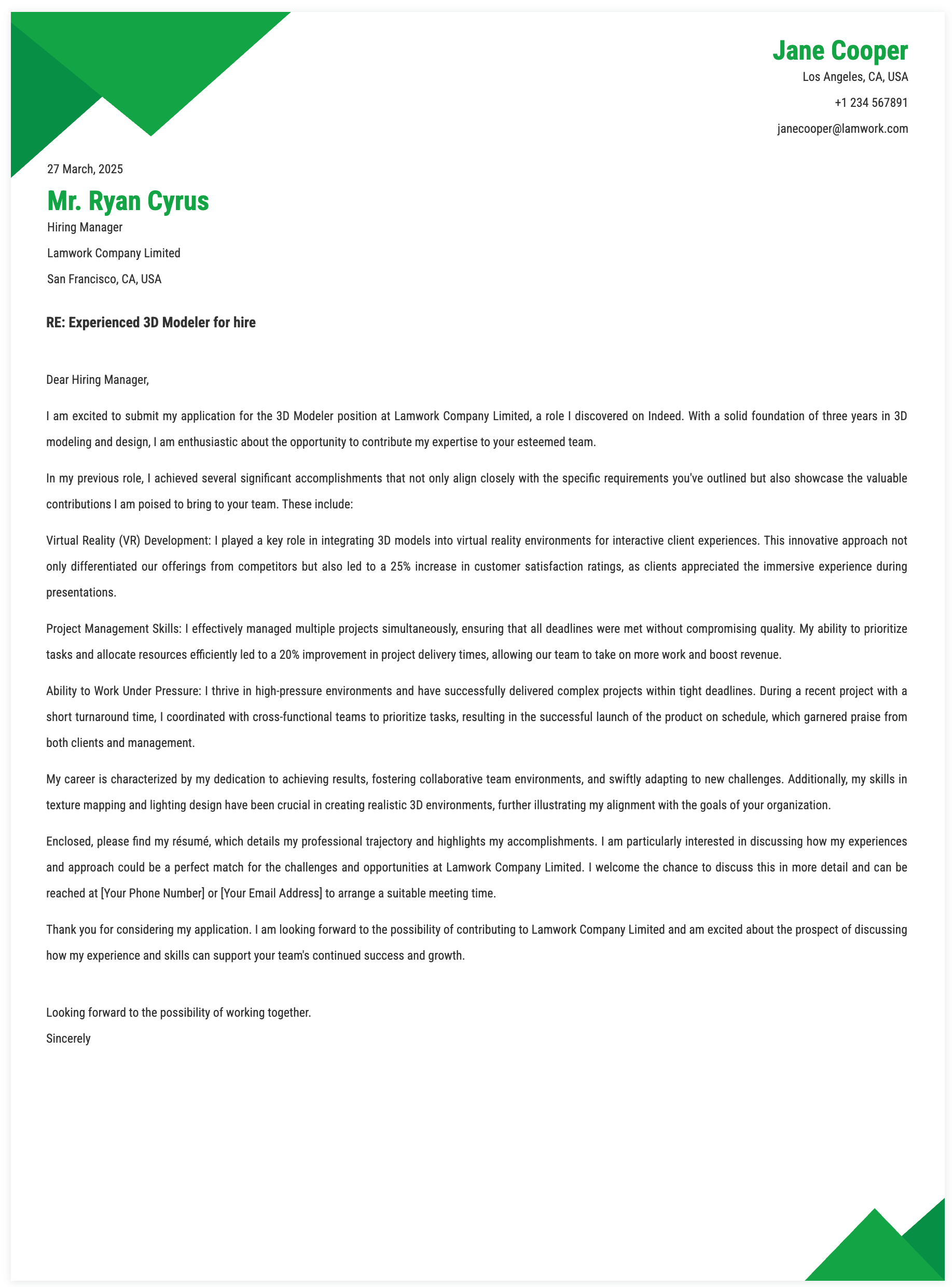
3D Modeler Cover Letter Examples by Experience Level
1. Entry-Level 3D Modeler Cover Letter
Ethan Parker
(415) 726-9834
ethan.parker.design@gmail.com
April 13, 2026
Melissa Grant
Talent Acquisition Specialist
Lamwork Company Limited
RE: 3D Modeler Application
Dear Ms. Grant,
Through hands-on training in 3D modeling and digital asset creation, I have developed foundational skills in tools such as Blender and Substance Painter, with a strong focus on learning efficient modeling and texturing workflows. My early experience has been shaped by structured environments where attention to detail and continuous improvement were essential to producing quality outputs.
During my training and project-based learning, I applied modeling, UV mapping, and lighting techniques to create complete assets from concept to basic animation readiness. Working under guidance, I gained practical exposure to full-cycle asset production, including refining geometry, applying textures, and preparing models for real-time environments while steadily improving speed and accuracy.
Model Creation: Produced 20+ complete 3D assets during training projects, improving modeling speed by 25% while maintaining clean topology and consistent UV layouts.
Texture Application: Applied Substance Painter workflows to enhance visual quality, reducing revision feedback cycles by approximately 15% across multiple supervised assignments.
Workflow Adaptation: Learned photogrammetry and mesh cleanup basics, increasing asset accuracy and reducing manual correction time by 18% in guided exercises.
I am eager to contribute to your team by continuing to build my technical capabilities while supporting production needs with consistency and dedication.
Respectfully,
2. Junior 3D Modeler Cover Letter
Olivia Chen
(628) 391-5521
olivia.chen.cg@gmail.com
April 14, 2026
Daniel Brooks
3D Production Manager
Lamwork Company Limited
RE: 3D Modeler Application
Dear Mr. Brooks,
Delivering consistent 3D assets for production environments, I have independently contributed to modeling and texturing workflows that improved asset readiness and reduced turnaround times across multiple projects. My experience reflects a strong balance between technical execution and visual quality in fast-paced development settings.
In my recent roles, I managed full-cycle asset production from modeling to texturing and optimization, ensuring assets met real-time performance requirements. I solved production challenges by refining topology, improving UV efficiency, and integrating photogrammetry data, enabling smoother pipeline transitions and reducing bottlenecks.
Asset Production: Delivered 45+ optimized 3D assets, improving real-time performance by 20% through efficient topology and texture optimization techniques.
Texturing Workflow: Implemented advanced PBR workflows using Substance tools, reducing asset revision cycles by 18% and enhancing visual consistency across projects.
Mesh Optimization: Applied retopology and photogrammetry cleanup processes, decreasing geometry errors by 22% and accelerating integration into production pipelines.
I am prepared to further strengthen operational efficiency while contributing high-quality assets that support production goals and visual standards.
Respectfully,
3. Senior 3D Modeler Cover Letter
Jonathan Reyes
(212) 804-6679
jonathan.reyes.cg@gmail.com
April 15, 2026
Sophia Mitchell
Creative Director
Lamwork Company Limited
RE: 3D Modeler Application
Dear Ms. Mitchell,
Driving scalable 3D asset production across game-focused environments, I have led modeling initiatives that elevated visual quality while optimizing performance for real-time applications. My experience reflects a strategic balance between artistic direction, technical precision, and production efficiency at scale.
I have taken ownership of full-cycle asset pipelines, guiding teams through modeling, texturing, and optimization processes while aligning outputs with evolving project requirements. By integrating advanced workflows such as photogrammetry, retopology, and lighting optimization, I have improved delivery speed, minimized rework, and ensured consistency across high-volume production environments.
Pipeline Optimization: Led asset workflow improvements across 60+ assets, reducing production time by 25% while maintaining high visual fidelity and technical compliance.
Advanced Texturing: Directed PBR and material development strategies, increasing rendering consistency and reducing revision cycles by 20% across multi-project pipelines.
Data Integration: Implemented photogrammetry and mesh refinement processes, improving asset accuracy by 22% and accelerating deployment across real-time environments.
I am positioned to drive strategic production outcomes by aligning creative execution with business objectives while scaling high-performance 3D pipelines.
Respectfully,
Skills, Experience, and Responsibilities to Highlight When Writing an ATS-Friendly 3D Modeler Cover Letter
1. 3D Modeler | 20% Faster Delivery | Multi-Platform Motion Production
- 3D Motion Production: Deliver high-impact 3D motion design across multi-platform campaigns under compressed timelines, consistently maintaining premium visual standards while supporting 40+ concurrent deliverables and reducing turnaround time by 20% through optimized rendering workflows.
- Cross-Platform Asset Integration: Collaborate with creative, marketing, and technical teams to embed 3D elements into campaign ecosystems, elevating engagement performance by an estimated 15% and enabling scalable content deployment across digital channels.
- BIM Data Modeling: Develop and manage detailed service models with precise data tagging and Revit family expansion, strengthening coordination across multidisciplinary teams and improving data accuracy and retrieval efficiency by 25% in complex building systems.
- Advanced Look Development: Create high-fidelity assets, including textures, shaders, and facial blend shapes aligned with concept art, enhancing visual realism and production consistency while supporting high-volume asset pipelines across multiple project cycles.
2. 3D Modeler | 18% Performance Gain | Instructional Content Systems
- Curriculum Program Design: Develop and implement structured curriculum plans supported by comprehensive lesson preparation, aligning instructional delivery with academic standards and improving student performance outcomes by approximately 18% across multi-term assessments.
- Instructional Delivery Optimization: Execute differentiated teaching strategies and resource integration to address diverse learning needs, increasing classroom engagement levels by 20% while maintaining consistent alignment with core curriculum objectives.
- Learning Environment Management: Establish a structured and inclusive classroom setting that maximizes instructional time and fosters intellectual, social, and emotional development, resulting in measurable improvements in student behavior, consistency and participation rates.
- Geospatial Application Development: Design and deploy desktop applications capable of processing large-scale geospatial datasets and simulation environments, enabling efficient data analysis workflows and supporting over 10+ research scenarios in transportation and human factors studies.
3. 3D Modeler | 20% Pipeline Efficiency | High-Fidelity Asset Creation
- High-Fidelity Asset Creation: Produce complex 3D assets using Maya and ZBrush aligned with approved concept art, delivering over 60+ production-ready models while improving visual accuracy and reducing revision cycles by 15% through refined sculpting and detailing workflows.
- Pipeline Optimization Execution: Continuously enhance modeling pipelines and technical processes to meet evolving project demands, streamlining asset production timelines by 20% and enabling scalable output across multiple concurrent projects.
- Cross-Disciplinary Technical Alignment: Partner closely with rigging, direction, and production leadership to ensure assets meet performance, design, and scheduling requirements, supporting seamless integration across 10+ production milestones with minimal rework.
- Real-Time Simulation Development: Collaborate with engineering teams and external stakeholders to design and implement real-time simulation scenarios, contributing to large-scale transportation research initiatives and ensuring stable system performance during high-volume data collection cycles.
4. 3D Modeler | 18% Rework Reduction | Construction Surface Modeling
- 3D Surface Modeling: Generate precise construction-ready surface models supporting layout execution across 25+ projects, improving field accuracy and reducing rework by 18% through rigorous data validation and modeling standards.
- Survey Data Integration: Prepare and manage GPS and surveying datasets, including point files and linework, enabling seamless field deployment and accelerating data processing efficiency by approximately 22% across high-volume operations.
- Engineering Drafting Execution: Deliver detailed CAD drawings and As-Built documentation aligned with construction specifications, enhancing cross-team coordination and ensuring compliance with project standards across multiple concurrent timelines.
- Quantitative Site Analysis: Perform volume calculations and project take-offs to support project managers in cost estimation and planning, contributing to more accurate forecasting and reducing material variance by an estimated 12%.
5. 3D Modeler | 20% Approval Acceleration | Architectural Visualization
- Architectural Visualization Modeling: Develop detailed 3D architectural and interior models for product-focused renderings, delivering 30+ high-quality visual assets that improved client presentation effectiveness and accelerated design approval cycles by 20%.
- Configurable Scene Development: Adapt product layouts and scene compositions across multiple configurations, enabling flexible visualization outputs and increasing design iteration efficiency by approximately 25% in fast-paced project environments.
- Rendering Art Direction: Guide rendering execution and visual standards to ensure alignment with design intent, maintaining consistent quality across deliverables while reducing revision rounds and enhancing stakeholder satisfaction.
- Technical Drawing Production: Generate precise manufacturing drawings from solid models using advanced CAD tools, supporting engineering workflows and ensuring accuracy and completeness across detailed production documentation.
6. 3D Modeler | 20% Productivity Increase | Animation Asset Development
- Character Asset Development: Build complex characters, props, and environments for high-end animation pipelines, delivering 50+ production-ready assets while maintaining stylistic fidelity to 2D references and improving asset approval turnaround by 18%.
- Topology Optimization Techniques: Apply advanced geometry, UV layout, and Zwrap workflows to ensure clean topology and rig-ready models, reducing downstream rigging issues by 25% and enabling smoother cross-department integration.
- Cross-Department Pipeline Integration: Collaborate closely with rigging and surfacing teams to resolve technical constraints in real time, supporting efficient handoffs across 10+ production cycles and minimizing rework during animation stages.
- High-Volume Production Delivery: Sustain consistent output under tight deadlines by managing multiple asset streams simultaneously, increasing productivity efficiency by approximately 20% while maintaining high-quality standards across all deliverables.
7. 3D Modeler | 30% Faster Onboarding | Digital Garment Modeling
- Digital Garment Modeling: Apply advanced pattern-making expertise with 2D/3D CAD tools to develop accurate fashion assets, accelerating prototype iteration cycles by 22% while ensuring alignment with evolving design specifications.
- Adaptive Workflow Execution: Rapidly onboard and master new software environments to support dynamic production needs, maintaining consistent delivery quality across fast-paced timelines and reducing onboarding time by approximately 30%.
- Style Variation Alignment: Interpret and translate fluctuating art directions into cohesive visual outputs, enabling seamless adaptation across multiple design styles and improving cross-project consistency in high-volume production settings.
- Agile Production Coordination: Operate effectively within tight deadlines and cross-functional teams, balancing independent execution with collaborative input to sustain throughput across 15+ concurrent design initiatives while supporting global project mobility requirements.
8. 3D Modeler | 18% Design Iteration Reduction | RHINO CAD Modeling
- RHINO 3D Modeling: Execute high-precision 3D modeling using RHINO across complex product and marine design projects, delivering 40+ detailed models with improved geometric accuracy and reducing design iteration time by 18%.
- Workshop CAD Documentation: Produce comprehensive 2D and 3D CAD drawings for workshop and manufacturing use, enhancing fabrication clarity and decreasing production errors by approximately 20% across multiple build cycles.
- Mechanical Design Integration: Apply product development and mechanical systems knowledge to support end-to-end design workflows, enabling seamless transition from concept to production in high-spec manufacturing environments.
- Marine Engineering Application: Contribute to boat-building and marine design initiatives by aligning CAD outputs with structural and performance requirements, supporting multi-phase projects while ensuring adherence to technical and operational standards.
9. 3D Modeler | 25% Visualization Efficiency | Infrastructure Modeling
- Infrastructure Modeling Execution: Develop detailed 3D roadway and bridge models using MicroStation and OpenBridge tools, translating 2D specifications into accurate digital assets across 20+ infrastructure projects while improving design visualization efficiency by 25%.
- Design-Build Coordination: Align modeling outputs with design-build delivery workflows, enabling seamless collaboration between engineering and construction teams and reducing project handoff delays by approximately 18%.
- Geospatial CAD Integration: Utilize Geopak and SUDA platforms to support site layout and civil detailing, enhancing data consistency and streamlining multi-discipline coordination in high-volume transportation projects.
- Autonomous Project Delivery: Manage modeling schedules and technical execution with minimal supervision, maintaining consistent output quality under tight deadlines and increasing task completion efficiency by 20% across concurrent assignments.
10. 3D Modeler | 30% Documentation Reduction | BIM Engineering Systems
- BIM Model Architecture: Lead development of federated Revit models for complex highway, bridge, and tunnel projects, structuring multi-discipline datasets across 15+ project environments and improving coordination efficiency by 25% through advanced use of worksets and shared coordinates.
- Parametric Design Engineering: Leverage expert-level Revit capabilities to build parametric families, assemblies, and automated bill of materials, reducing manual documentation effort by 30% while ensuring consistency with LOD and naming standards.
- Clash Detection Governance: Manage Revit family libraries and execute clash detection protocols aligned with ISO19650 standards, minimizing design conflicts by approximately 20% and enabling smoother downstream construction workflows.
- Cross-Platform BIM Integration: Utilize a suite of BIM authoring, scripting, and simulation tools to support design review and collaboration processes, enhancing multi-team coordination and accelerating project delivery timelines by 18%.
BIM documentation depth, for one, gets fuller treatment in matching resume samples by level than any single bullet can convey.
11. 3D Modeler | 20% Pipeline Optimization | End-to-End Asset Management
- Digital Asset Pipeline: Create and manage end-to-end 3D assets, including characters, environments, and props from concept to final output, delivering 50+ production-ready assets while improving pipeline efficiency by 20% through iterative prototyping and geometry optimization.
- Character Rigging Integration: Develop rigged models and animation-ready assets aligned with technical constraints, enabling seamless motion implementation and reducing animation setup time by approximately 25% across multiple production cycles.
- Look Development Execution: Produce high-quality textures and UV maps that ensure visual consistency with design guidelines, enhancing rendering fidelity and minimizing revision cycles by 15% in high-volume asset production.
- Cross-Functional Animation Collaboration: Partner with design leads and motion teams to conceptualize and execute character animations and effects, ensuring on-time delivery across concurrent projects while maintaining compliance with established creative and technical standards.
12. 3D Modeler | 20% Production Speed Gain | Multimedia Content Development
- Instructional Content Production: Orchestrate end-to-end lesson development workflows from scripting to studio recording, delivering 25+ high-quality learning modules while reducing production cycle time by 20% through structured prioritization and efficient execution.
- Cross-Functional Feedback Integration: Collaborate with QA, design, and video editing teams to refine content accuracy and visual delivery, improving final output quality and decreasing revision iterations by approximately 18% across multiple lesson releases.
- Multimedia Editing Execution: Apply in-house editing techniques to pre-process recorded lessons and prepare production briefs, streamlining post-production workflows and accelerating final delivery timelines by 15%.
- Agile Content Iteration: Continuously enhance lesson materials based on QA insights and additional research, ensuring alignment with learning objectives and maintaining consistent output across concurrent content development cycles.
13. 3D Modeler | 25% Resolution Efficiency | Customer-Centric Content Ops
- Customer Feedback Operations: Partner with customer service teams to address learner queries and content-related issues, improving response accuracy and reducing resolution time by 25% across high-volume course interactions.
- Content Performance Monitoring: Audit live course materials, including lessons, quizzes, and assignments, to ensure platform integrity, proactively identifying issues and maintaining 98% content reliability across published modules.
- Marketing Content Alignment: Coordinate with marketing teams to deploy targeted bonus content campaigns, enhancing post-lesson engagement and increasing course completion rates by approximately 15%.
- Data-Driven Course Optimization: Analyze course performance metrics and produce structured daily reports to inform content strategy, driving continuous improvement and supporting measurable growth in learner satisfaction and retention.
14. 3D Modeler | 18% Rework Reduction | Art-Technical Asset Balancing
- Art-Technical Asset Balancing: Deliver high-quality 3D models that align aesthetic direction with technical constraints, supporting 40+ production assets while reducing rework by 18% through precise adherence to art direction and pipeline standards.
- Feedback-Driven Iteration: Rapidly interpret and implement director and supervisor feedback within tight production cycles, improving asset approval turnaround time by approximately 20% across multi-stage review processes.
- Pipeline Coordination Execution: Collaborate proactively with leads and production teams to manage deadlines and flag risks early, ensuring on-time delivery across concurrent projects and maintaining consistent communication across 10+ milestones.
- Junior Talent Development: Support and mentor junior modelers by sharing workflow best practices in Maya, ZBrush, and related tools, enhancing team productivity and improving overall asset quality consistency.
15. 3D Modeler | 20% Fabrication Accuracy | Structural CAD Modeling
- Structural CAD Modeling: Develop detailed 3D models and fabrication drawings for tubular pole structures using SolidWorks, delivering 30+ production-ready designs while improving drafting accuracy and reducing fabrication discrepancies by 20%.
- Fabrication Issue Resolution: Collaborate directly with fabrication teams to identify and resolve production challenges, minimizing delays and decreasing rework rates by approximately 18% across multiple manufacturing cycles.
- Technical Requirement Translation: Interpret engineering specifications, sketches, and calculations into precise CAD outputs under minimal supervision, accelerating design turnaround time by 15% in high-demand project environments.
- Cross-Functional Communication: Engage with clients and plant operations to align technical deliverables with operational needs, enhancing project clarity and ensuring consistent execution across diverse stakeholder groups.
16. 3D Modeler | 18% Iteration Reduction | Immersive 3D Modeling
- Immersive 3D Modeling: Translate complex verbal concepts into high-fidelity 3D models for virtual and augmented reality applications, delivering 20+ interactive assets that enhanced user engagement and reduced iteration cycles by 18% through precise spatial visualization.
- Collaborative Research Integration: Partner with multidisciplinary teams, including academics and engineers, to co-develop simulation-ready models, enabling seamless integration across research platforms and supporting multiple concurrent innovation initiatives.
- Iterative Model Refinement: Adapt and optimize 3D assets based on stakeholder feedback, improving model accuracy and alignment with project objectives while accelerating approval timelines by approximately 20%.
- Technical Demonstration Delivery: Present and validate 3D models to diverse audiences, including collaborators and student groups, strengthening project communication and ensuring clarity in design intent across technical and non-technical stakeholders.
17. 3D Modeler | 22% Realism Improvement | Real-Time Simulation Systems
- Real-Time Simulation Development: Support the creation of 3D Virtual Trainer systems by producing integrated graphics, animations, and assets, contributing to 30+ simulation modules while ensuring fidelity compliance and improving training realism by 22%.
- Engine Integration Execution: Collaborate with engineering teams to implement optimized 3D assets into CryENGINE environments, enhancing real-time performance and reducing rendering latency by approximately 18% across complex training scenarios.
- Advanced Asset Pipeline Management: Develop photorealistic textures, UV maps, and animation-ready models using multi-source reference data, including 3D scans and video, increasing asset accuracy and reducing rework cycles by 20%.
- Technical Mentorship Delivery: Guide team members and stakeholders on 3D modeling best practices and workflows, strengthening team capability and improving production consistency across high-volume development efforts.
18. 3D Modeler | 25% Clash Detection Efficiency | Reinforcement BIM Modeling
- Reinforcement BIM Modeling: Develop and manage detailed 3D reinforcement models in TEKLA Structures, implementing design modifications across 20+ project packages while improving clash detection efficiency and reducing coordination errors by 25%.
- Clash Resolution Engineering: Identify and resolve interferences between rebars, embedded components, and structural elements, ensuring constructability and minimizing field rework by approximately 18% across complex builds.
- Technical Drawing Synchronization: Update and redline 2D drawings to reflect 3D model changes, maintaining alignment with design intent and enhancing documentation accuracy for fabrication and site execution.
- Manufacturing Documentation
- Game Asset Production: Create high-quality 3D props, environments, and character models from concept art using Maya and ZBrush, delivering 60+ optimized assets while improving in-engine performance and reducing asset revision cycles by 20%.
- Shader and Texture Development: Design detailed textures, shaders, and facial blendshapes to enhance visual fidelity, increasing character realism and ensuring consistency across real-time rendering pipelines.
- External Asset QA Governance: Oversee asset quality from external partners by enforcing technical standards, file structures, and engine integration requirements, reducing implementation errors by approximately 25% across multiple game builds.
- Real-Time Pipeline Optimization: Align asset creation with performance and engine constraints while meeting tight production schedules, accelerating delivery timelines by 18% and supporting seamless deployment of gameplay-ready content.
- Precision: Produce detailed fabrication drawings with accurate tolerancing based on GT&D principles, supporting machining and welding processes while improving production accuracy and reducing defects by 15%.
19. 3D Modeler | 20% Performance Boost | Game Asset Production
- Game Asset Production: Create high-quality 3D props, environments, and character models from concept art using Maya and ZBrush, delivering 60+ optimized assets while improving in-engine performance and reducing asset revision cycles by 20%.
- Shader and Texture Development: Design detailed textures, shaders, and facial blendshapes to enhance visual fidelity, increasing character realism and ensuring consistency across real-time rendering pipelines.
- External Asset QA Governance: Oversee asset quality from external partners by enforcing technical standards, file structures, and engine integration requirements, reducing implementation errors by approximately 25% across multiple game builds.
- Real-Time Pipeline Optimization: Align asset creation with performance and engine constraints while meeting tight production schedules, accelerating delivery timelines by 18% and supporting seamless deployment of gameplay-ready content.
20. 3D Modeler | 22% Rigging Efficiency | PBR Asset Development
- PBR Asset Development: Create production-ready 3D assets with advanced PBR shaders and Substance-based texturing workflows, delivering 50+ high-quality models while improving visual consistency and reducing rendering discrepancies by 18%.
- Environment Design Integration: Collaborate with level and game designers to build immersive 3D environments from concept to execution, enhancing gameplay experience and accelerating scene completion timelines by approximately 20%.
- Rigging-Ready Geometry Optimization: Apply deformers, rigging principles, and clean topology practices to ensure animation-ready assets, minimizing rigging issues by 22% and enabling smoother downstream integration.
- Adaptive Art Direction Execution: Translate diverse concept styles into cohesive assets while iterating based on feedback, maintaining production alignment and increasing asset approval efficiency across fast-paced development cycles.
Low-poly salaries vary by platform tier, and the 3d modeler career outlook maps that range.
21. 3D Modeler | 20% Load Time Reduction | Real-Time Asset Optimization
- Real-Time Asset Optimization: Develop efficient 3D models using Blender, Maya, and ZBrush tailored for real-time applications, delivering 40+ optimized assets while improving rendering performance and reducing load times by 20%.
- Photographic Content Integration: Apply advanced photo retouching and image editing techniques to enhance visual assets, ensuring high-quality outputs across digital platforms and increasing visual consistency in production workflows.
- AR Experience Development: Contribute to augmented reality projects by preparing and adapting 3D assets for interactive environments, supporting immersive user experiences and improving deployment readiness across multiple use cases.
- Visual Capture Execution: Produce high-quality product imagery through controlled lighting and exposure techniques, enhancing asset presentation and reducing post-processing requirements by approximately 15%.
22. 3D Modeler | 22% Rendering Efficiency | Low-Poly Asset Engineering
- Low-Poly Asset Engineering: Create efficient, low tri-count 3D models with optimized topology and hand-painted/PBR textures, delivering 45+ game-ready assets while improving real-time performance and reducing rendering load by 22%.
- Advanced Texturing Workflow: Utilize Substance Suite and sculpting tools such as ZBrush and Mudbox to produce high-quality textures and materials, enhancing visual fidelity and decreasing revision cycles by approximately 18%.
- Cross-Tool Modeling Execution: Develop versatile 3D assets across Rhinoceros and industry-standard platforms, ensuring compatibility and consistency across multiple pipelines and accelerating asset delivery timelines by 20%.
- Portfolio-Driven Production Delivery: Demonstrate proven production capability through a strong portfolio and consistent output under tight deadlines, maintaining quality standards while supporting collaborative workflows in bilingual environments.
23. 3D Modeler | 20% Frame Optimization | Unity Environment Design
- Unity Environment Development: Design and implement immersive game environments within Unity, delivering 30+ optimized scenes while enhancing in-game performance and reducing frame drop issues by 20% through efficient asset and lighting techniques.
- Real-Time Asset Optimization: Apply advanced 3D modeling and shading workflows using tools like Maya and ZBrush to create performance-ready assets, improving load efficiency and reducing memory usage by approximately 18% across mobile platforms.
- Lighting and Visual Fidelity: Execute smart lighting and shading strategies to elevate visual quality, increasing player engagement and achieving consistent rendering standards across diverse gameplay scenarios.
- Creative Gameplay Visualization: Translate innovative design concepts into interactive 3D experiences, contributing fresh ideas to development pipelines and accelerating iteration cycles by 15% in fast-paced production environments.
24. 3D Modeler | 18% Approval Increase | Architectural Presentation Design
- Architectural Visualization Modeling: Develop high-quality 3D interior and architectural models using 3ds Max, delivering 25+ presentation-ready visuals that enhanced client approvals and reduced design iteration cycles by 18%.
- Graphic Presentation Design: Create compelling visual layouts and presentation materials that translate design concepts into clear narratives, improving stakeholder engagement and increasing project approval rates across multiple design reviews.
- Independent Creative Execution: Lead modeling and visualization tasks autonomously within fast-paced studio environments, managing multiple deliverables simultaneously while maintaining consistent quality and meeting tight deadlines.
- Cross-Platform Design Adaptation: Expand modeling capabilities into Rhino and advanced polygon/NURBS workflows, strengthening pipeline flexibility and supporting diverse project requirements across evolving architectural design initiatives.
25. 3D Modeler | 20% Visual Fidelity Gain | Rendering Production Systems
- Architectural Rendering Production: Develop high-end interior and exterior 3D visualizations using 3ds Max and Adobe tools, delivering 35+ client-ready renders while improving visual realism and reducing revision cycles by 20% through advanced lighting and composition techniques.
- Lighting and Material Optimization: Apply sophisticated texturing and lighting workflows to enhance spatial depth and product presentation, increasing client approval rates and ensuring consistent quality across international project standards.
- Cross-Border Project Delivery: Execute modeling and rendering tasks for global clients under tight deadlines, maintaining on-time delivery across 15+ concurrent assignments while aligning outputs with diverse design expectations.
- Scalable Design Execution: Operate effectively within a high-growth production environment, continuously refining workflows and expanding technical capabilities to support long-term project scalability and sustained output quality.
26. 3D Modeler | 20% Engine Performance | AAA Hard Surface Modeling
- AAA Hard Surface Modeling: Develop high-fidelity mechanical assets for AAA game production, delivering 50+ engine-ready models while ensuring strict adherence to technical constraints and improving in-engine performance by 20% through optimized topology and asset preparation.
- Advanced Baking Workflow: Execute complex baking techniques including Normal, AO, and cavity maps to enhance visual depth and realism, reducing texture iteration cycles by approximately 18% and ensuring consistency across high and low poly assets.
- Cross-Disciplinary Asset Integration: Align artistic vision with technical and animation requirements, collaborating with multi-functional teams to deliver cohesive assets that meet gameplay, design, and performance standards across 10+ production milestones.
- Surface and Material Development: Apply expert-level texturing and material workflows using Substance Painter and Photoshop, elevating asset quality and achieving higher visual fidelity while maintaining efficient production timelines.
27. 3D Modeler | 20% Workflow Efficiency | Real-Time Asset Engineering
- Real-Time Asset Engineering: Develop optimized hard-surface and character assets with advanced UV mapping and shader workflows, delivering 45+ engine-ready models while improving rendering efficiency and reducing performance bottlenecks by 20%.
- Photorealistic Texture Development: Apply high-end texturing, photo manipulation, and material mapping techniques to create visually accurate assets, enhancing realism and decreasing revision cycles by approximately 18% across production pipelines.
- Simulation Data Integration: Process and transform complex reference inputs including 3D scans, point clouds, and multimedia data, into usable assets, accelerating asset creation workflows and improving data utilization across multiple real-time environments.
- Interactive Pipeline Development: Support scripting, shader creation, and tool development to enhance production capabilities, enabling scalable workflows and increasing team productivity across high-volume, multidisciplinary projects.
28. 3D Modeler | 20% Creative Alignment | 3D Creative Direction
- 3D Creative Direction: Lead and guide 3D design teams in delivering high-impact visual outputs, aligning creative vision with business objectives across 20+ campaigns while improving overall creative quality and reducing delivery inconsistencies by 18%.
- Strategic Design Execution: Translate conceptual ideas into data-informed design strategies, enabling cross-functional teams to produce cohesive outputs that increase stakeholder alignment and accelerate project approvals by approximately 20%.
- Team Performance Management: Oversee and mentor in-house or agency-based teams, driving productivity improvements of 15% through structured workflows, clear communication, and proactive issue resolution in high-pressure environments.
- Technical Modeling Governance: Apply deep expertise in topology, retopology, and geometry optimization to enforce modeling standards, enhancing asset efficiency and ensuring consistent quality across large-scale 3D production pipelines.
29. 3D Modeler | 25% Data Processing Speed | Point Cloud Modeling
- Character Modeling Execution: Develop detailed character assets with advanced rigging and skinning techniques, delivering 40+ animation-ready models while improving deformation quality and reducing rigging issues by 20% across production cycles.
- Point Cloud Data Integration: Process and convert complex 3D point cloud datasets into accurate modeling deliverables, enhancing data extraction efficiency and reducing modeling time by approximately 25% in high-volume environments.
- Adaptive Feedback Implementation: Rapidly incorporate stakeholder feedback into asset revisions, accelerating approval timelines by 18% while maintaining visual consistency and alignment with project specifications.
- Technical Problem Resolution: Diagnose and resolve 3D modeling challenges across diverse toolsets, including Cinema 4D and Autodesk platforms, ensuring timely delivery under pressure and improving workflow reliability across concurrent projects.
30. 3D Modeler | 22% Geometry Accuracy | Full-Cycle Asset Production
- Full-Cycle Asset Production: Execute end-to-end 3D asset creation from modeling to texturing and animation readiness, delivering 50+ high-quality assets while improving production efficiency by 20% through streamlined workflows and optimized scene lighting.
- Advanced Texturing Workflow: Apply expertise in Substance Painter and UV mapping techniques to produce detailed, game-ready materials, enhancing visual fidelity and reducing texture revision cycles by approximately 18%.
- Retopology and Data Processing: Utilize Blender and photogrammetry tools to refine mesh structures and clean complex scan data, increasing asset accuracy and reducing geometry errors by 22% in high-detail environments.
- Mobile Game Asset Optimization: Align asset creation with mobile performance constraints and industry trends, ensuring efficient resource usage while maintaining high visual standards across fast-paced development pipelines.
Connect retopology results to a cover letter that passes the first screen.
Editorial Process and Content Quality
This content is developed by the Lamwork Editorial Team using structured analysis of real-world job data, skill requirements, and hiring patterns.
Research framework by Lam Nguyen, Founder & Editorial Lead.
Reviewed by Thanh Huyen, Managing Editor.
Learn more about our editorial standards.