Release Manager Cover Letter Key Qualifications
Published: Mar 23, 2026. The Release Manager drives large-scale, multi-platform deployments in complex environments, improving release efficiency, quality, and risk control. This role leads cross-functional teams and governs end-to-end release lifecycles using CI/CD and DevOps practices, delivering on-time outcomes with fewer production incidents. The profile also strengthens release governance, automation, and process optimization, enhancing deployment stability, stakeholder alignment, and continuous delivery maturity.

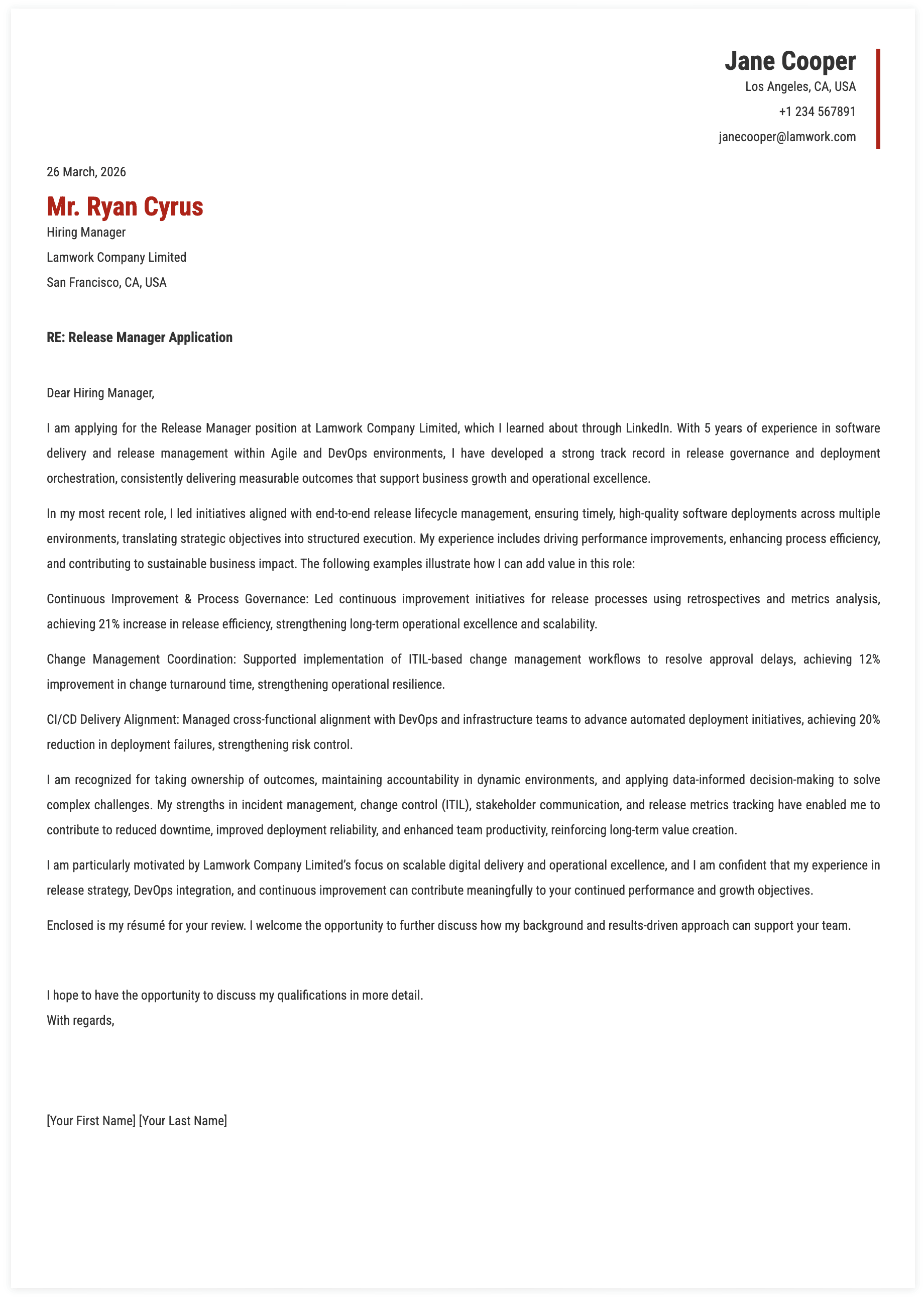
Release Manager Cover Letter Examples by Experience Level
1. Entry-Level Release Manager Cover Letter
Michael Carter
(312) 555-1842
michael.carter.dev@gmail.com
March 21, 2026
Rebecca Lawson
Senior Delivery Manager
Lamwork Company Limited
RE: Release Train Engineer Application
Dear Lawson,
My early experience supporting Agile delivery environments has focused on developing structured release coordination skills while working alongside senior engineers in enterprise software settings. Through hands-on exposure to sprint ceremonies, UAT coordination, and release planning, I have built a strong foundation in understanding how large-scale delivery cycles operate within cross-functional teams.
Working within guided team environments, I contributed to coordinating release activities across multiple Agile teams, supporting communication between development, QA, and stakeholders to ensure timely delivery. This experience strengthened my ability to manage dependencies, track progress, and support release execution while learning best practices in SAFe and Scrum frameworks.
Agile Coordination: Supported 3 Scrum teams in sprint planning and release tracking, improving task completion visibility and contributing to a 15% increase in on-time delivery.
Release Support: Assisted in UAT coordination and client communication, helping reduce testing delays by 12% through improved scheduling and follow-ups.
Dependency Tracking: Maintained release artifacts and tracked cross-team dependencies, enabling clearer reporting and reducing missed handoffs during release cycles.
I am eager to continue growing within a Release Train Engineer role, contributing to structured delivery processes while expanding my ability to support large-scale Agile programs.
Respectfully,
2. Junior Release Manager Cover Letter
Daniel Brooks
(415) 555-7391
daniel.brooks.pm@gmail.com
March 22, 2026
Anthony Rivera
Director of Program Management
Lamwork Company Limited
RE: Release Train Engineer Application
Dear Rivera,
Consistently delivering coordinated releases across Agile environments, I have improved release predictability and execution outcomes by aligning multiple teams around shared delivery goals. My experience spans managing cross-functional dependencies, facilitating sprint planning, and ensuring release readiness within enterprise software programs.
In my current role, I independently manage release coordination across multiple Agile teams, balancing competing priorities while ensuring alignment with delivery timelines. By proactively identifying risks, facilitating stakeholder communication, and driving structured planning, I have strengthened execution consistency and reduced delivery bottlenecks.
Release Coordination: Managed releases across 4 Agile teams, improving on-time delivery rates by 20% through structured planning and dependency alignment.
UAT & Delivery: Coordinated UAT cycles and stakeholder communication, reducing approval delays by 18% and ensuring smoother production readiness.
Risk Management: Identified and mitigated cross-team blockers, decreasing release disruptions by 15% across concurrent project streams.
I am prepared to further enhance operational delivery performance by bringing disciplined execution and strong coordination capabilities to complex release environments.
Respectfully,
3. Senior Release Manager Cover Letter
Sophia Bennett
(646) 555-9027
sophia.bennett.exec@gmail.com
March 23, 2026
Jonathan Meyers
Vice President of Technology Delivery
Lamwork Company Limited
RE: Release Train Engineer Application
Dear Meyers,
Driving large-scale Agile delivery across complex enterprise portfolios, I have led coordinated release trains spanning multiple value streams, consistently improving predictability, quality, and stakeholder alignment. My leadership in Release Train Engineer roles has enabled organizations to deliver high-impact initiatives with measurable gains in execution efficiency and delivery reliability.
Owning end-to-end release orchestration, I have directed cross-functional teams across development, QA, and business units, ensuring alignment from planning through production. By establishing structured governance, optimizing dependency management, and leading executive-level communications, I have translated delivery complexity into scalable, outcome-driven execution.
Release Train Leadership: Directed 6+ Agile teams across value streams, increasing release predictability by 28% and ensuring consistent delivery of enterprise-scale initiatives.
Program Execution: Led end-to-end delivery cycles, including UAT and Go-Live coordination, achieving 92% on-time releases across multi-million-dollar programs.
Cross-Functional Alignment: Established governance frameworks and stakeholder reporting, reducing delivery bottlenecks by 22% and accelerating decision-making across executive and technical teams.
I am positioned to drive strategic release outcomes by aligning large-scale delivery execution with business priorities while strengthening enterprise-wide Agile maturity.
Respectfully,
Skills, Experience, and Responsibilities to Highlight When Writing an ATS-Friendly Release Manager Cover Letter
1. Release Manager | 25% Incident Reduction | Release Governance
- Release Governance: Orchestrate end-to-end release cycles across 40+ integrated deliverables, ensuring dependencies, risks, and regulatory approvals are proactively managed, resulting in a 25% reduction in release-related incidents and improved deployment predictability.
- Cross-Functional Coordination: Align development, testing, operations, and external validation partners to deliver cohesive release packages, accelerating cycle time by 20% while maintaining stability across pre-production and production environments.
- Change & Environment Stability: Oversee pre-production environments and load testing schedules to safeguard system readiness, reducing post-release defects by 18% and enabling consistent high-volume deployment performance.
- Incident & Root Cause Management: Lead post-release analysis and incident response integration, identifying systemic issues and implementing corrective actions that lowered recurring production failures by 30% and strengthened continuous delivery maturity.
2. Release Manager | 35% Deployment Increase | CI/CD Enablement
- Continuous Delivery Enablement: Implement CI/CD frameworks and automated controls governing code promotion from development through QA, increasing deployment frequency by 35% while reducing manual intervention and release errors.
- Release Planning Ownership: Lead end-to-end release planning, scheduling, and validation across multi-team environments, ensuring lifecycle compliance and delivering over 50 coordinated releases annually with zero critical production breaches.
- Quality Monitoring Systems: Establish deployment dashboards and release quality controls to provide real-time visibility into performance and stability, improving defect detection rates by 22% before production rollout.
- Deployment Communication Management: Drive cross-platform release communications and stakeholder alignment, enhancing deployment transparency and reducing post-release support escalations by 28% through proactive readiness validation.
3. Release Manager | 30% Compliance Improvement | Release Standards Governance
- Release Standards Governance: Define and enforce enterprise-wide release standards, controls, and promotion protocols across agile teams, improving deployment consistency by 30% and reducing non-compliant releases through structured lifecycle governance.
- Environment Risk Management: Assess lower lifecycle environment gaps against production and implement compensating controls, mitigating environment-related defects by 20% and strengthening pre-release reliability at scale.
- Automation-Driven Quality: Advance standardized tooling and automation practices across delivery pipelines, increasing release efficiency by 25% while elevating software quality and reducing manual testing overhead.
- Lifecycle Environment Ownership: Oversee SLA performance, incident reviews, and continuous improvement initiatives for non-production environments, enhancing system availability to 99.8% and enabling stable, high-volume testing operations.
- Early Life Support Execution: Lead post-release stabilization and collaborate with security architecture to embed secure development practices, resolving critical incidents within defined SLAs and reducing repeat vulnerabilities in production systems.
4. Release Manager | 20% Delivery Improvement | Enterprise Release Lifecycle
- Release Lifecycle Ownership: Direct the end-to-end release management lifecycle across 30+ enterprise applications, aligning release plans with executive priorities and ensuring milestone adherence, resulting in a 20% improvement in on-time delivery.
- Risk & Dependency Management: Proactively identify and resolve cross-project dependencies and release constraints, driving issue resolution over escalation and reducing schedule slippage by 25% across complex, multi-team programs.
- Cross-Functional Release Coordination: Lead integrated release workflows with architects, product owners, QA, and infrastructure teams across distributed locations, enabling seamless execution of 40+ annual releases with minimal operational disruption.
- Governance & Readiness Assurance: Conduct structured readiness, milestone, and Go/No-Go reviews through formal change control processes, strengthening release quality and decreasing failed deployments by 18%.
- Continuous Process Optimization: Advanced release methodologies and standardized playbooks in partnership with platform and operations teams, improving deployment efficiency by 22% and embedding scalable best practices across the delivery ecosystem.
5. Release Manager | 30% Throughput Increase | Release Window Orchestration
- Release Window Orchestration: Plan and govern release cycles across 8+ concurrent Scrum teams, optimizing deployment windows and eliminating scheduling conflicts to improve release throughput by 30% across production and non-production environments.
- Dependency Resolution Management: Coordinate cross-functional dependencies with product owners, technical leads, and infrastructure stakeholders, proactively removing blockers and reducing release delays by 22% in complex cloud-based delivery pipelines.
- Release Progress Assurance: Monitor requirement traceability and promotion readiness across lifecycle stages, ensuring 100% of release candidates are validated in pre-production environments and decreasing post-release defects by 18%.
- SDLC Compliance Framework: Establish and enforce SDLC documentation and audit-ready controls for each release, strengthening governance standards and achieving full compliance across all audited deployments.
- Stakeholder Alignment Execution: Negotiate release scope and coordinate multi-platform delivery efforts with business and technical stakeholders, enabling consistent delivery of prioritized features while maintaining quality and schedule integrity.
6. Release Manager | 20% Failure Reduction | Release Readiness Governance
- Release Readiness Governance: Lead Go/No-Go reviews and executive demonstrations to validate deployment readiness, strengthening decision confidence and reducing failed releases by 20% across high-impact production rollouts.
- Deployment Execution Leadership: Orchestrate end-to-end go-live activities, including implementation and backout planning, delivering 40+ releases annually with zero critical rollback incidents through rigorous checklist-driven execution.
- Stakeholder Communication Management: Provide structured release communications to business and technical stakeholders across environments, improving transparency and reducing post-deployment escalations by 25%.
- Change Control Facilitation: Present release packages to engineering review boards and CAB forums, ensuring compliance and alignment while accelerating approval cycles by 15% through well-governed release documentation.
- Post-Release Stabilization: Drive retrospectives and coordinate monitoring and support engagement, resolving early-life issues within SLA targets and improving release stability metrics by 18% over successive deployment cycles.
7. Release Manager | 28% Stability Improvement | Environment Governance
- Release & Environment Governance: Provide enterprise-wide oversight of release and environment management practices, establishing standardized policies and controls that improved deployment stability by 28% across multiple concurrent release tracks.
- Process Standardization Framework: Define and implement scalable release standards and operational procedures, enabling faster, lower-risk change flow and increasing delivery efficiency by 20% through consistent tooling and governance.
- Multi-Track Release Orchestration: Coordinate parallel release streams and manage cross-platform dependencies, balancing competing priorities to deliver a steady cadence of 50+ releases annually with minimal customer impact.
- Risk & Impact Mitigation: Anticipate conflicts, govern downtime, and align stakeholder expectations across complex programs, reducing unplanned outages by 18% while maintaining high service continuity in production environments.
- Cross-Domain Integration Leadership: Act as the strategic interface between platform engineering and configuration teams, ensuring cohesive execution and de-risked release schedules through proactive collaboration and informed decision-making.
8. Release Manager | 35% Build Efficiency Gain | Build Pipeline Engineering
- Build Pipeline Engineering: Operate and optimize CI/CD pipelines leveraging Unreal, Perforce, and TeamCity, increasing build throughput by 35% while ensuring stable delivery across multiple active development streams.
- Continuous Integration Delivery: Manage end-to-end build and deployment workflows, enabling rapid and reliable releases with a 25% reduction in build failures through proactive monitoring and issue resolution.
- DevOps Collaboration Enablement: Bridge development, QA, and operations teams to align on release priorities and resolve blockers, improving cross-team efficiency and reducing turnaround time for critical fixes by 20%.
- Pipeline Optimization Strategy: Continuously assess and enhance build and asset pipelines, introducing process improvements that strengthened build robustness and reduced recovery time from failures by 30%.
- Operational Standards Enforcement: Define SLAs and best practices while leading troubleshooting of complex build issues, fostering a culture of accountability and continuous improvement across high-velocity delivery environments.
9. Release Manager | 28% Compliance Improvement | DTAP Release Management
- DTAP Release Compliance: Strengthen release processes aligned to DTAP standards across multi-environment pipelines, improving deployment consistency by 28% while ensuring full regulatory and audit readiness.
- Release Lifecycle Coordination: Lead end-to-end planning and orchestration of releases, including go/no-go reviews and certification alignment, successfully delivering 40+ site deployments annually with high-quality outcomes.
- Risk & Audit Governance: Manage release risks, scope, and audit reporting frameworks, reducing compliance gaps by 20% and ensuring traceability across all regulated deployment activities.
- Deployment Runbook Execution: Design and operationalize detailed runbooks and implementation plans for support teams, accelerating deployment execution time by 18% and improving post-release stability.
- Cross-Functional Roadmap Alignment: Collaborate with product, operations, and engineering stakeholders to align release activities with strategic roadmaps, enabling synchronized delivery and minimizing cross-project conflicts in complex environments.
10. Release Manager | 30% Adherence Increase | Release Process Governance
- Release Process Governance: Drive disciplined release management practices across core product pipelines, improving process adherence by 30% and ensuring consistent, high-quality delivery of roadmap commitments.
- Roadmap Delivery Alignment: Partner with product and engineering teams to prioritize features, enhancements, and technical debt, enabling on-time delivery of 90%+ planned releases across multiple development cycles.
- Metrics & Performance Analytics: Establish and present release health metrics spanning development, QA, and deployment stages, increasing defect detection efficiency by 22% and enabling data-driven decision-making at scale.
- Capacity & Workflow Optimization: Oversee capacity planning and manage Kanban workflows within Jira, improving throughput by 25% while reducing bottlenecks across development and testing pipelines.
- Stakeholder & Release Enablement: Coordinate cross-functional inputs and lead release communications, demos, and enablement assets, enhancing stakeholder alignment and reducing post-release support queries by 18%.
11. Release Manager | 25% Planning Accuracy Gain | Quarterly Release Planning
- Quarterly Release Planning: Lead structured planning cycles across 10–20 program managers, aligning deliverables in ADO and optimizing prioritization frameworks to improve plan accuracy and reduce over-allocation risks by 25%.
- Release Visibility Management: Establish clear tracking of feature delivery timelines and partner commitments, enabling leadership insight into 90%+ of release milestones and reducing off-track deliverables through proactive intervention.
- Cross-Team Dependency Governance: Identify and resolve planning inconsistencies, including budget misalignment and unmanaged dependencies, strengthening execution integrity and improving on-time delivery rates by 20% across interconnected teams.
- Sprint & Backlog Optimization: Collaborate with development teams on bi-weekly sprint planning and backlog prioritization, increasing throughput by 18% while ensuring high-priority features and defects are addressed efficiently.
- Defect & Review Coordination: Drive bug triage, spec reviews, and feature governance forums, accelerating resolution of critical issues and improving product quality by reducing high-severity defects by 22% prior to release.
12. Release Manager | 25% Cycle Efficiency Gain | Agile Release Management
- Agile Release Lifecycle Management: Direct end-to-end change and release processes across agile environments, coordinating builds, schedules, and deployments to improve release cycle efficiency by 25% and ensure consistent delivery across multiple teams.
- Standardization & Process Governance: Implement and enforce structured release methodologies and documentation frameworks, increasing process adherence by 30% and reducing deployment variability across enterprise systems.
- Environment & Deployment Readiness: Plan and manage test environments supporting development through production, enhancing deployment reliability and reducing environment-related defects by 20% in high-volume release cycles.
- Release Tracking & Risk Control: Maintain accurate tracking systems and proactively manage incidents, risks, and issues, improving visibility and reducing release-related disruptions by 18% through data-driven oversight.
- Operational Documentation Enablement: Develop comprehensive checklists, cross-training materials, and lifecycle documentation, strengthening stakeholder readiness and improving execution consistency across distributed delivery teams.
13. Release Manager | 30% Delay Reduction | Platform Release Management
- Platform Release Ownership: Lead end-to-end release processes for multi-platform game deployments, ensuring compliance with ingestion pipelines and certification standards, resulting in a 30% reduction in release delays and smoother public launches.
- Certification & Compliance Management: Partner with development teams to anticipate and resolve platform certification risks, improving first-pass approval rates by 25% and minimizing rework during critical release windows.
- Build Packaging & Verification: Design and execute structured packaging and validation workflows, increasing build integrity and reducing post-release defects by 20% across high-volume content releases.
- Release Issue Resolution: Drive cross-functional communication and rapid troubleshooting of release blockers, decreasing incident resolution time by 18% and maintaining deployment momentum under tight timelines.
- Platform & Stakeholder Advocacy: Represent studio priorities in platform engagements and promotional coordination, aligning release strategies with acquisition and marketing objectives to enhance launch impact and audience reach.
14. Release Manager | 25% Risk Reduction | Release Portfolio Governance
- Release Portfolio Governance: Oversee a portfolio of 100+ applications within a regulated enterprise environment, orchestrating monthly release events and ensuring adherence to SDLC and change control frameworks, resulting in a 25% reduction in production risk incidents.
- Enterprise Release Orchestration: Plan and execute multi-day release cycles in collaboration with CIO, engineering, and production support teams, delivering stable deployments across complex, multi-platform ecosystems with 98% on-time success rates.
- Risk & Stability Management: Apply deep expertise in environment management and ITSM practices to proactively mitigate deployment risks, improving production stability and reducing high-severity incidents by 20% across release cycles.
- Cross-Functional Delivery Alignment: Partner with globally distributed teams across Agile and Waterfall methodologies to coordinate change initiatives, enhancing delivery predictability and accelerating release readiness across diverse technical domains.
- Production Event Execution: Lead control room operations during critical release windows, ensuring real-time issue resolution and seamless execution of 5–6 day release events, minimizing downtime and maintaining business continuity.
15. Release Manager | 30% Merge Stability Gain | Branch Governance
- Branch Merge Governance: Direct parallel branch merge strategies and maintain build repositories with strict version control, improving integration stability by 30% and reducing merge conflicts across high-frequency release cycles.
- Release Planning Optimization: Drive prioritization and trade-off decisions through a deep understanding of development impacts, enabling on-time delivery of 90%+ releases while balancing scope, quality, and resource constraints.
- Risk & Issue Resolution: Proactively identify and mitigate release risks, resolving critical blockers ahead of deployment and reducing schedule disruptions by 22% across complex, multi-stream releases.
- Progress Monitoring & Reporting: Establish structured tracking and reporting frameworks to surface key release insights, enhancing visibility and improving delivery predictability across cross-functional teams.
- Stakeholder Coordination & Negotiation: Align developers, testers, and product leaders through clear communication and expectation management, strengthening collaboration and accelerating issue resolution timelines by 18%.
16. Release Manager | 25% Throughput Increase | Release Window Planning
- Release Window Planning: Design and govern release cycles across complex application stacks, optimizing deployment schedules and improving release throughput by 25% while minimizing conflicts across environments.
- Risk & Impact Mitigation: Identify and resolve risks related to scope, schedule, and quality, collaborating with engineering teams to address merge conflicts and CI failures, reducing release delays by 20%.
- Go-Live Execution Leadership: Lead deployment activities through structured plans and checklists, delivering 40+ releases annually with zero critical failures through disciplined execution and readiness validation.
- Change Management Compliance: Enforce adherence to enterprise change control standards across development, QA, security, and production, achieving 100% audit compliance and strengthening governance across all releases.
- Documentation & Repository Management: Maintain centralized repositories for release procedures, dependencies, and database changes, improving knowledge accessibility and reducing onboarding and execution errors by 18%.
17. Release Manager | 30% Risk Reduction | Release Authority Governance
- Enterprise Release Authority: Act as the central approval authority for deployments, governing release controls across multi-system environments and reducing high-risk deployments by 30% through rigorous readiness validation.
- Integrated Release Planning: Lead early-stage sprint and release planning, incorporating cross-team, technical, and environment dependencies, improving delivery predictability by 25% across complex, multi-stream programs.
- Release Governance & CAB Leadership: Establish and enforce release management frameworks while facilitating CAB forums, accelerating decision-making, and reducing approval cycle times by 20% through structured governance.
- Quality & Verification Management: Define baseline testing standards and oversee build verification processes, increasing release quality and lowering post-deployment defects by 18% through stringent validation controls.
- Risk & Readiness Orchestration: Coordinate end-to-end release readiness across teams, proactively mitigating risks and resolving blockers, ensuring 95%+ of releases meet Go/No-Go criteria without escalation delays.
18. Release Manager | 95% On-Time Delivery | Digital Release Coordination
- Digital Release Coordination: Orchestrate end-to-end delivery of game updates, bundles, and platform store releases, ensuring 95% on-time launches through structured planning and cross-partner alignment.
- Build & Packaging Operations: Execute and manage build pipelines to produce release-ready packages and archives, improving deployment reliability by 20% and reducing packaging errors across multiple release cycles.
- Cross-Partner Alignment: Collaborate with development, publishing, and external platform teams to coordinate release activities, enhancing communication efficiency and reducing release blockers by 18%.
- Release Support Enablement: Provide operational support for builds, environments, and investigations, accelerating issue resolution timelines and improving internal team productivity during critical release windows.
- Process Optimization & Documentation: Continuously refine release workflows and maintain up-to-date documentation, increasing process efficiency by 22% while ensuring scalability and consistency across evolving release operations.
19. Release Manager | 25% Delivery Improvement | Release Execution Management
- Release Delivery Ownership: Lead end-to-end release execution across engineering, QA, and operations, ensuring alignment on scope, schedule, and quality, resulting in a 25% improvement in on-time, defect-free deployments.
- Risk & Issue Mitigation: Proactively identify and resolve release risks and blockers, reducing schedule disruptions by 20% and maintaining consistent delivery performance across distributed teams.
- Cross-Functional Release Coordination: Synchronize activities across globally dispersed teams, enhancing collaboration efficiency and minimizing misalignment to support high-volume, multi-environment releases.
- Governance & Readiness Assurance: Facilitate structured release readiness and Go/No-Go reviews, strengthening deployment confidence and decreasing failed releases by 18% through disciplined validation processes.
- Process Optimization & Standardization: Continuously refine release methodologies and documentation, incorporating emerging best practices to improve operational efficiency by 22% and ensure scalable, repeatable release outcomes.
20. Release Manager | 25% Efficiency Gain | Enterprise Release Coordination
- Enterprise Release Coordination: Orchestrate interdependent release processes across globally distributed teams, aligning stakeholders and vendors to deliver synchronized deployments, improving cross-team efficiency by 25% and reducing scheduling conflicts.
- Release Planning & Execution: Lead negotiation, planning, and execution of release activities, including runbooks and deployment checklists, delivering 40+ releases annually within budget and defined quality standards.
- Progress & Performance Monitoring: Track release metrics, budget adherence, and delivery milestones, increasing on-time release performance to over 90% while maintaining high-quality outcomes across complex programs.
- Technical Release Integration: Collaborate with release engineers to manage code merges, branch impacts, and CI/CD tooling, enhancing build stability and reducing integration failures by 20%.
- Automation & Continuous Improvement: Develop and implement automation scripts and release management tools, accelerating deployment cycles by 22% and enabling scalable, efficient software delivery across evolving enterprise environments.
21. Release Manager | 30% Deployment Increase | DevOps Release Engineering
- DevOps Release Engineering: Lead CI/CD pipeline design and containerized deployments across cloud platforms, increasing deployment frequency by 30% while ensuring stability in microservices-based environments.
- Git Workflow Governance: Architect and manage advanced branching strategies, merges, and cherry-pick operations, reducing integration conflicts by 25% and improving codebase integrity across parallel development streams.
- Cloud Infrastructure Integration: Oversee releases within AWS, Azure, and GCP ecosystems, aligning infrastructure configurations with service mesh, authentication, and database requirements to enhance system scalability and resilience.
- Agile Multi-Team Delivery: Coordinate release activities across multiple agile teams, improving sprint alignment and accelerating feature delivery timelines by 20% in high-velocity development cycles.
- Risk & Issue Analytics: Apply structured risk identification and resolution practices across complex release environments, reducing critical deployment issues by 18% while continuously improving operational processes.
22. Release Manager | 95% Delivery Success | Healthcare Release Governance
- Healthcare Release Governance: Lead end-to-end delivery of EMR-related releases across complex clinical and infrastructure environments, ensuring alignment with healthcare workflows and achieving 95%+ on-time project acceptance with minimal disruption to patient services.
- EMR Environment Management: Oversee application, infrastructure, and end-user device ecosystems, implementing coordinated release controls that reduced environment-related incidents by 20% across large-scale healthcare deployments.
- Program & Vendor Coordination: Manage multidisciplinary teams, budgets, and vendor engagements across enterprise programs, delivering high-quality outcomes across 10+ concurrent initiatives while maintaining strict compliance and reporting standards.
- Change & Stakeholder Alignment: Drive structured change management and stakeholder engagement across clinical and technical teams, improving adoption rates and reducing post-release support issues by 18% through proactive communication and training.
- Project Delivery Execution: Direct full lifecycle delivery from initiation to acceptance using enterprise tools, ensuring milestone adherence and strengthening delivery predictability across regulated, high-impact healthcare systems.
23. Release Manager | 25% Efficiency Gain | Continuous Delivery Management
- Continuous Delivery Management: Oversee end-to-end release pipelines and lifecycle governance, improving deployment efficiency by 25% while ensuring stable, high-frequency product updates across multiple platforms.
- Production Release Triage: Manage incident triage and lifecycle tracking for production releases, reducing resolution time by 20% and maintaining high service reliability in fast-paced environments.
- Cross-Platform Program Coordination: Lead update and upgrade cycles across diverse product ecosystems and browser engines, enabling synchronized releases and improving delivery alignment across 3+ platform streams.
- Version Control Optimization: Leverage Git-based workflows to streamline peer reviews and release planning, reducing merge-related delays by 18% and enhancing code integration quality.
- Autonomous Release Execution: Drive critical release decisions and actively contribute to design and planning sessions, accelerating delivery timelines while maintaining quality standards in iterative development environments.
24. Release Manager | 25% Time-To-Market Gain | Product Launch Management
- Enterprise Product Launch Management: Lead complex, cross-functional product launches spanning multiple technologies and business units, delivering 20+ enterprise releases annually with a 25% improvement in time-to-market.
- Agile Program Execution: Manage large-scale initiatives using agile methodologies, translating complex business requirements into actionable delivery plans and increasing on-time feature delivery rates to over 90%.
- Cross-Functional Alignment: Coordinate diverse stakeholders, including executive leadership, product, and engineering teams, driving unified execution and reducing delivery friction by 20% across distributed teams.
- Complex Problem Resolution: Analyze and resolve multi-layered technical and business challenges, improving release predictability and reducing critical blockers by 18% in high-stakes SaaS environments.
- Stakeholder Engagement Strategy: Facilitate collaborative planning using virtual tools to secure alignment and buy-in from senior stakeholders, strengthening decision-making speed and ensuring consistent delivery outcomes.
25. Release Manager | 25% Reliability Improvement | SDLC Governance
- Release & SDLC Governance: Lead end-to-end release management across hybrid on-premise and cloud environments, applying advanced SDLC practices to improve deployment reliability by 25% within high-volume eCommerce platforms.
- DevOps Toolchain Integration: Leverage Jira, Jenkins, Bitbucket, and Git to streamline CI/CD workflows, increasing automation coverage and reducing manual deployment errors by 20% across distributed teams.
- Cross-Functional Delivery Coordination: Align engineering, operations, and business stakeholders to drive execution of complex initiatives, achieving 90%+ on-time delivery through structured collaboration and dependency management.
- Technical-Business Translation: Bridge technical and commercial priorities by translating system-level insights into actionable business decisions, enhancing stakeholder alignment and accelerating decision cycles in fast-paced delivery environments.
26. Release Manager | 30% Efficiency Gain | Transformation Release Leadership
- Transformation Release Leadership: Drive large-scale IT transformation initiatives across application lifecycle management frameworks, delivering multi-methodology programs that improved release efficiency by 30% and enabled scalable service delivery.
- Vendor & Partner Governance: Manage complex ecosystems of external vendors and partners, aligning delivery across multiple workstreams and reducing integration delays by 25% within enterprise change roadmaps.
- Risk & Decision Management: Evaluate and resolve high-impact technical and business risks, enabling informed decision-making that decreased release disruptions by 20% and improved roadmap execution reliability.
- Operational Governance & Automation: Implement metrics-driven processes and toolchain-enabled automation, increasing test and release efficiency by 28% while ensuring adherence to QA standards and best practices.
- Multi-Stream Delivery Execution: Lead concurrent projects and release workstreams end-to-end, maintaining delivery momentum and achieving over 90% milestone adherence through structured planning and execution discipline.
27. Release Manager | 25% Accuracy Improvement | Data-Driven Release Engineering
- Data-Driven Release Engineering: Leverage deep programming and data integration expertise across APIs, databases, and distributed systems to optimize release workflows, improving deployment accuracy by 25% in data-intensive environments.
- CI/CD Pipeline Optimization: Design and manage automated pipelines using modern DevOps toolchains, increasing release frequency by 30% while reducing manual intervention and deployment errors.
- Version Control Governance: Implement structured Git-based workflows across Bitbucket and GitHub, enhancing code integrity and reducing merge conflicts by 20% in multi-team development environments.
- Agile Delivery Execution: Coordinate releases across Scrum, Kanban, and hybrid methodologies using Jira and Azure DevOps, achieving over 90% on-time delivery in fast-paced, iterative product cycles.
- Technical Program Integration: Translate complex system architecture and infrastructure concepts into actionable plans, aligning engineering and business stakeholders to accelerate decision-making and improve release outcomes.
28. Release Manager | 25% Incident Reduction | Application Release Management
- Application Release Management: Lead complex release cycles across banking-grade Java platforms and enterprise systems, coordinating 100+ integrated components to ensure stable, compliant deployments with a 25% reduction in production incidents.
- Multi-Platform Integration Oversight: Manage releases spanning Salesforce, Oracle, ETL pipelines, and middleware ecosystems, aligning cross-system dependencies and improving deployment success rates to over 95% in high-risk environments.
- Change Control & Service Governance: Enforce ITSM and change management frameworks, including ticketing and approval workflows, achieving full audit compliance and reducing unauthorized changes across release cycles by 20%.
- Runbook & Deployment Execution: Develop and execute detailed runbooks and deployment plans, enabling consistent, error-free releases and decreasing rollback scenarios by 18% across mission-critical applications.
- Cross-Functional Delivery Coordination: Partner with development, support, and business teams to drive knowledge transfer and operational readiness, accelerating issue resolution and improving post-release stability in enterprise production environments.
29. Release Manager | 25% Efficiency Gain | Release Lifecycle Management
- Release Lifecycle Management: Lead end-to-end release processes across SDLC and DevOps frameworks, improving deployment efficiency by 25% while ensuring consistent delivery in dynamic, fast-paced environments.
- CI/CD Pipeline Enablement: Implement and optimize continuous integration and delivery workflows using Jira and version control tools, increasing automation coverage and reducing release cycle time by 20%.
- Change & Service Governance: Apply ITIL-aligned practices to manage change control and service lifecycle processes, enhancing production stability and reducing release-related incidents by 18%.
- Technical Release Integration: Leverage Java and SQL expertise to support build validation, troubleshooting, and process automation, improving release accuracy and minimizing manual intervention across development pipelines.
- Adaptive Delivery Execution: Respond proactively to evolving project requirements, coordinating cross-functional teams to maintain delivery momentum and achieve over 90% adherence to shifting release timelines.
30. Release Manager | 25% Predictability Gain | Release Train Engineering
- Release Train Leadership: Lead long-lived value streams as a certified Release Train Engineer, coordinating 5+ agile teams to deliver large-scale initiatives with a 25% improvement in release predictability and execution consistency.
- Enterprise Agile Delivery: Plan and execute end-to-end programs from concept through production, aligning UAT, client communications, and deployment activities to achieve over 90% on-time delivery across complex portfolios.
- Multi-Team Coordination: Orchestrate cross-functional collaboration in multi-disciplinary, global environments, balancing concurrent workstreams and reducing delivery bottlenecks by 20% through structured planning and alignment.
- Stakeholder Engagement Governance: Communicate technical and program updates to senior leadership, clients, and vendors, strengthening decision-making clarity and accelerating issue resolution timelines across enterprise initiatives.
- Scaled Agile Execution: Apply Scrum and SAFe methodologies to drive continuous delivery, enhancing team throughput by 18% while maintaining high-quality standards across distributed agile release trains.
Editorial Process and Content Quality
This content is developed by the Lamwork Editorial Team using structured analysis of real-world job data, skill requirements, and hiring patterns.
Research framework by Lam Nguyen, Founder & Editorial Lead.
Reviewed by Thanh Huyen, Managing Editor.
Learn more about our editorial standards.