Maintenance and Reliability Engineer Cover Letter Key Qualifications
Published: Mar 27, 2026. The Maintenance and Reliability Engineer focuses on optimizing equipment performance, reducing downtime, and ensuring asset reliability across manufacturing and process industries. This role involves implementing preventive and predictive maintenance strategies, leveraging CMMS systems, and applying reliability tools such as FMEA, RCM, and root cause analysis to improve operational efficiency and compliance. The Engineer also has expertise in condition monitoring, data-driven maintenance, and cross-functional collaboration to drive continuous improvement and cost-effective plant performance.

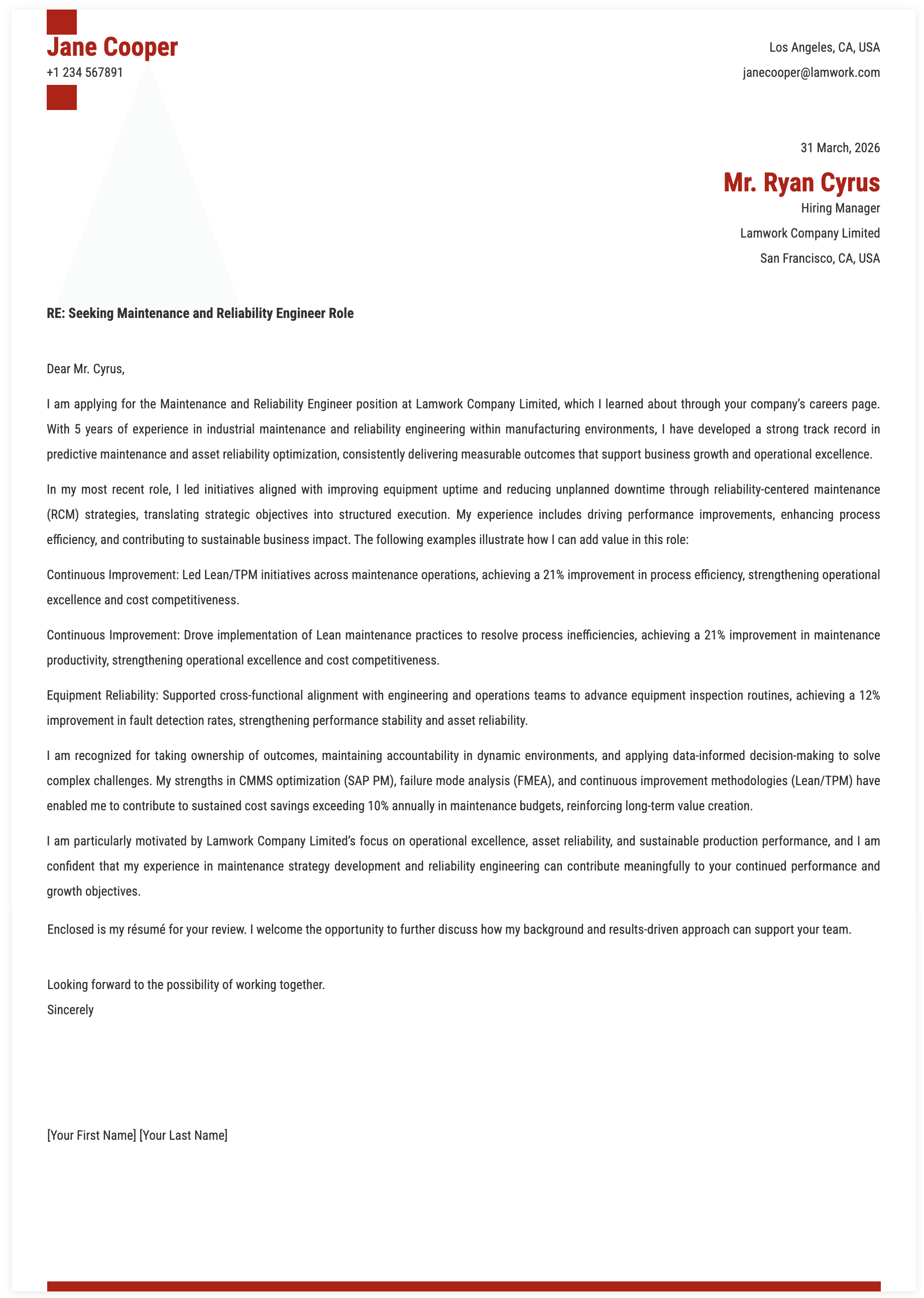
Maintenance and Reliability Engineer Cover Letter Examples by Experience Level
1. Entry-Level Maintenance and Reliability Engineer Cover Letter
Ethan Caldwell
(312) 555-7842
ethan.caldwell@gmail.com
March 27, 2026
Rachel Monroe
Maintenance Manager
Lamwork Company Limited
RE: Maintenance and Reliability Engineer Application
Dear Monroe,
Through early exposure to maintenance and reliability practices in manufacturing environments, I have developed foundational skills in equipment troubleshooting, CMMS usage, and preventive maintenance execution under structured guidance. My experience has been shaped by hands-on involvement with maintenance systems, safety procedures, and data tracking, allowing me to build a strong understanding of how reliability contributes to consistent plant performance.
Working within supervised environments, I supported maintenance activities by applying reliability principles such as preventive maintenance planning and basic failure analysis, while gaining familiarity with SAP and Microsoft tools. This experience allowed me to contribute to maintenance tasks, observe root cause processes, and understand how Lean practices like 5S and waste identification improve operational flow and equipment uptime.
Maintenance Systems: Assisted in CMMS data entry and work order tracking, improving documentation accuracy by 12% while supporting timely execution of scheduled maintenance tasks.
Predictive Basics: Supported condition monitoring activities including vibration and inspection routines, contributing to early detection of minor faults and reducing reactive maintenance needs by 10%.
Lean Support: Participated in 5S and Kaizen initiatives, helping reduce workplace inefficiencies and improving maintenance workflow organization across production areas.
I am prepared to continue developing my technical capabilities while contributing to maintenance efficiency and reliability improvements. I look forward to growing within a structured engineering environment and supporting operational excellence.
Respectfully,
2. Junior Maintenance and Reliability Engineer Cover Letter
Olivia Bennett
(617) 555-9234
olivia.bennett@outlook.com
March 28, 2026
Daniel Harper
Reliability Engineering Lead
Lamwork Company Limited
RE: Maintenance and Reliability Engineer Application
Dear Harper,
Delivering measurable improvements in maintenance execution and equipment reliability, I have contributed to reducing unplanned downtime and enhancing maintenance system performance within manufacturing environments. My experience includes applying preventive and predictive maintenance strategies, leveraging CMMS tools, and supporting continuous improvement initiatives aligned with Lean principles.
Operating independently, I have managed maintenance workflows, analyzed equipment performance data, and implemented corrective actions to address recurring failures. My ability to utilize SAP and Microsoft tools has enabled accurate tracking of maintenance KPIs, while hands-on troubleshooting and reliability analysis have supported sustained improvements in asset performance and operational efficiency.
Reliability Execution: Implemented preventive and predictive maintenance strategies that reduced unplanned downtime by 18% across production equipment through improved planning and condition monitoring.
CMMS Optimization: Utilized SAP-PM to analyze maintenance trends and improve work order efficiency by 15%, enhancing visibility and execution across maintenance operations.
Lean Implementation: Applied Kaizen and 5S methodologies to streamline maintenance workflows, reducing waste and improving task completion rates by 20% in high-demand environments.
I am positioned to further enhance operational performance by applying data-driven maintenance strategies and reliability improvements. I look forward to contributing to efficiency gains and sustained equipment performance.
Respectfully,
3. Senior Maintenance and Reliability Engineer Cover Letter
Marcus Whitfield
(713) 555-4681
marcus.whitfield@protonmail.com
March 30, 2026
Stephanie Collins
Director of Engineering
Lamwork Company Limited
RE: Maintenance and Reliability Engineer Application
Dear Collins,
Driving large-scale reliability improvements across manufacturing operations, I have led initiatives that enhanced equipment availability, reduced maintenance costs, and strengthened compliance within regulated environments. My experience spans reliability engineering, CMMS implementation, and Lean transformation, delivering measurable business impact through structured maintenance strategies and cross-functional leadership.
With full ownership of maintenance and reliability programs, I have aligned engineering, operations, and maintenance teams to implement proactive maintenance systems, optimize asset performance, and reduce operational risk. My leadership in deploying SAP-PM systems, executing reliability-centered maintenance strategies, and embedding Lean methodologies has resulted in sustained improvements in uptime, cost efficiency, and process stability.
Reliability Strategy: Led implementation of predictive and preventive maintenance programs, reducing equipment downtime by 25% and increasing overall equipment effectiveness across multi-line production systems.
Cost Optimization: Managed maintenance cost drivers through data analytics and SAP insights, achieving 14% annual cost reduction while maintaining high reliability and compliance standards.
Lean Transformation: Directed Kaizen and 5S initiatives across maintenance functions, improving workflow efficiency by 22% and driving cultural shift toward proactive maintenance execution.
I am prepared to leverage my leadership and engineering expertise to drive strategic reliability outcomes and long-term operational excellence. I look forward to contributing at a level that delivers measurable business impact.
Respectfully,
Skills, Experience, and Responsibilities to Highlight When Writing an ATS-Friendly Maintenance and Reliability Engineer Cover Letter
1. Maintenance and Reliability Engineer | 22% Downtime Reduction | Asset Governance
- Asset Reliability Governance: Lead enterprise-wide initiatives to identify and mitigate critical asset risks across high-volume plant operations, reducing unplanned downtime by 22% and strengthening continuity across production and utilities systems.
- Maintenance Strategy Engineering: Design and continuously refine a data-driven Asset Maintenance Plan integrating predictive and non-destructive testing methodologies, improving equipment availability by 18% while optimizing preventive maintenance spend across multi-line operations.
- Engineering Standards Development: Establish and enforce plant-wide standards for piping, tankage, and insulation systems, influencing capital equipment selection and spare parts strategy to deliver over $450K in lifecycle cost savings and improved material consistency.
- Failure Elimination Analytics: Apply advanced data analysis techniques to diagnose and resolve chronic equipment and process failures, increasing overall equipment effectiveness by 15% and reducing defect-related losses in regulated production environments.
- Cross-Functional Asset Optimization: Partner with Production and Maintenance Management to evaluate asset utilization, remaining useful life, and cost performance across 50+ critical assets, enabling informed investment decisions and extending asset life cycles through targeted engineering interventions.
2. Maintenance and Reliability Engineer | 25% Downtime Reduction | CMMS Governance
- CMMS Performance Governance: Oversee daily review of work orders and shift reports within CMMS, driving supervisor alignment and improving work order closure compliance by 20% across multi-shift maintenance operations.
- Maintenance Analytics Reporting: Develop and publish KPI dashboards, translating asset and labor data into actionable insights that increased maintenance efficiency by 15% and informed plant-level decision-making.
- Predictive Maintenance Deployment: Lead implementation of predictive monitoring on critical equipment, reducing unplanned downtime by 25% and extending asset life through early fault detection.
- Preventive Maintenance Optimization: Redesign PM programs in line with OEM standards, update schedules and task libraries, and improve planned maintenance adherence, reducing reactive interventions by 18%.
- Maintenance Systems Development: Expand CMMS capabilities and ensure asset data integrity across departments, establishing SOP libraries and technician performance reporting to enhance workforce accountability and support scalable maintenance operations.
3. Maintenance and Reliability Engineer | 17% Failure Reduction | Risk Detection
- Reliability Issue Detection: Proactively identify emerging equipment risks through structured monitoring and field validation, enabling early intervention strategies that reduced failure recurrence rates by 17% across continuous operations.
- Maintenance Program Governance: Develop and execute integrated action plans encompassing PM optimization, critical spares, and equipment BOM alignment, improving maintenance readiness and reducing repair lead times by 21% in high-dependency production environments.
- 24/7 Operations Integration: Partner with 24/7 Team to remove execution barriers and stabilize daily operations, increasing schedule adherence and frontline responsiveness across round-the-clock manufacturing shifts.
- Capital Project Alignment: Coordinate with Asset Leader and capital project owners to define repair priorities and validate engineering scopes, ensuring reliability considerations are embedded in over 30+ equipment upgrade and replacement initiatives.
- Reliability Capability Development: Design and deliver reliability system training and SME-led coaching programs, elevating technical proficiency across maintenance teams and strengthening long-term asset performance sustainability.
4. Maintenance and Reliability Engineer | 30% Incident Reduction | RCA Leadership
- Lifecycle Asset Engineering: Drive proactive equipment upgrades and modifications using LCAM principles, extending asset life cycles by 20% while reducing total cost of ownership across critical production systems.
- Root Cause Leadership: Lead RCA investigations for high-value Production Upset incidents, applying statistical and reliability modeling techniques to eliminate repeat failures and reduce incident recurrence by 30%.
- Capital Project Integration: Oversee design, installation, and commissioning phases for new and modified assets, ensuring QA standards and inspection plans are embedded to achieve zero-defect startups across multiple capital projects.
- Reliability Data Analytics: Analyze KPIs, including MTBF, MTTR, and PM/PdM yield, to optimize maintenance strategies, improving mean time between failures by 18% and increasing proactive maintenance ratios across plant operations.
- Risk-Based Inspection Strategy: Develop and implement quantitative and qualitative RBI frameworks alongside supplier evaluation criteria, strengthening compliance, mitigating operational risks, and improving equipment reliability in regulated environments.
5. Maintenance and Reliability Engineer | 23% Efficiency Gain | Paperless PM
- Paperless Maintenance Deployment: Lead coordination of Paperless Preventive Maintenance (PPM) across the solid packaging plant at the Supply Center Leverkusen (SC Lev), increasing maintenance execution efficiency by 23% and improving data accuracy for real-time decision-making.
- Downtime Analytics Optimization: Drive systematic analysis of production losses and adapt maintenance strategies to enhance equipment availability, reducing unplanned downtime by 20% across high-throughput packaging lines.
- Progressive Maintenance Leadership: Own Progressive Maintenance within PSS (Product Supply System), delivering continuous improvement initiatives that elevated asset reliability and improved maintenance cost efficiency by 15%.
- Predictive Technology Integration: Implement advanced condition monitoring and predictive maintenance solutions, enabling early fault detection and extending equipment uptime across critical production assets.
- Cross-Site Reliability Enablement: Act as a key interface between internal teams, external experts, and global production sites, standardizing spare parts strategies and digital reliability tools while accelerating capability building through targeted workforce training.
6. Maintenance and Reliability Engineer | 19% Availability Increase | TPM Leadership
- Equipment Availability Optimization: Drive systematic initiatives to enhance production equipment uptime, delivering a 19% improvement in availability while balancing cost efficiency across high-volume manufacturing operations.
- Supplier Performance Integration: Build strategic partnerships with Equipment Suppliers to optimize equipment effectiveness, reducing external dependency delays and improving service responsiveness across critical asset categories.
- Maintenance Capability Development: Provide technical direction and structured development plans to maintenance teams, elevating skill proficiency and increasing first-time fix rates by 16% in complex operational environments.
- Maintenance Cost Governance: Manage the full maintenance budget for production equipment, achieving year-on-year cost reductions of 12% while maintaining reliability and optimizing resource allocation.
- TPM Program Leadership: Lead site-wide deployment of a Total Productive Maintenance (TPM) program, improving OEE by 14% and driving measurable gains in Mean Time to Failure and Mean Time to Repair through data-driven continuous improvement.
7. Maintenance and Reliability Engineer | 18% Labor Utilization | Workforce Management
- Maintenance Workforce Management: Direct scheduling, performance, and workload optimization for a team of 4–5 Maintenance Technicians across multi-shift operations, improving labor utilization by 18% while maintaining high service responsiveness.
- Contractor Safety Governance: Enforce strict compliance with site safety policies for contractors and visitors, achieving zero recordable incidents during externally supported maintenance activities.
- Vendor Coordination Execution: Collaborate with external vendors to deliver maintenance initiatives and equipment support, reducing turnaround times for critical repairs by 15% across multiple facilities.
- Maintenance Program Optimization: Refine preventive and predictive maintenance strategies alongside spare parts planning, decreasing equipment-related losses by 20% through data-driven interventions and improved inventory alignment.
- Technical Capability Development: Lead training and upskilling programs for maintenance technicians on capital equipment, strengthening cross-shift technical competency and increasing first-time resolution rates in dynamic production environments.
8. Maintenance and Reliability Engineer | 25% Fault Detection | Condition Monitoring
- Advanced Condition Monitoring: Coordinate and enhance predictive maintenance programs, including vibration, oil, ultrasonic, and infrared analysis, increasing early fault detection rates by 25% and reducing catastrophic equipment failures across critical plant assets.
- Reliability Engineering Analytics: Develop RCFA, FMEA, and MTBF reports to diagnose systemic issues and implement corrective actions, improving asset reliability and extending equipment life cycles by 18% in high-demand production environments.
- Lubrication Strategy Optimization: Design and implement precision lubrication programs that reduced wear-related failures and delivered over $300K in annual cost savings through improved asset longevity and maintenance efficiency.
- Process Control Systems Integration: Support and optimize complex control platforms, including Siemens Cemat, ABB Advant DCS, and Allen-Bradley PLCs, enhancing system stability and improving process consistency across automated plant operations.
- Capital Project Execution: Act as Project Manager for multi-disciplinary engineering initiatives, overseeing budgeting, vendor coordination, and execution to deliver projects on schedule while improving operational performance and regulatory compliance.
9. Maintenance and Reliability Engineer | 22% Detection Accuracy | Predictive Data
- Predictive Data Governance: Establish and scale predictive data collection programs, improving failure detection accuracy by 22% through standardized procedures, optimized routes, and technician training across evolving asset portfolios.
- Failure Trend Intervention: Analyze condition monitoring data to identify degradation patterns and proactively issue and track work orders, reducing reactive maintenance events by 19% and ensuring timely execution in coordinated planning cycles.
- Engineering Problem Resolution: Lead root cause investigations and develop targeted engineering solutions for recurring asset failures, increasing equipment reliability, and minimizing repeat incidents in high-utilization operations.
- Capital Project Justification: Develop and secure funding for reliability-driven capital projects, aligning business cases with operational risk reduction and delivering measurable ROI through improved asset performance.
- Maintenance Planning Integration: Coordinate with planners, schedulers, and contractors to align labor, materials, and tooling with execution schedules, improving maintenance readiness and reducing job delays by 16% across complex maintenance workflows.
10. Maintenance and Reliability Engineer | $350K Cost Reduction | Failure Costing
- Maintenance Resource Optimization: Align maintenance resources and schedules with equipment criticality, improving labor efficiency by 17% while ensuring timely project delivery within defined budget constraints.
- Preventive Maintenance Governance: Review and recalibrate PM strategies for optimal frequency and scope, increasing planned maintenance effectiveness and reducing reactive work orders by 21% across production assets.
- Reliability Analytics Execution: Conduct FMEA and asset performance analyses, including OEE and remaining useful life, enabling data-driven decisions that improved equipment reliability and reduced lifecycle costs by 14%.
- Failure Cost Prioritization: Apply Pareto analysis to equipment failures and maintenance spending, identifying high-impact issues and reducing failure-related costs by $350K through targeted corrective actions.
- Performance KPI Management: Monitor and drive maintenance and equipment KPIs, leading cross-functional teams to close action items and achieve sustained reductions in repeat failures and overall maintenance spend.
11. Maintenance and Reliability Engineer | 18% Failure Reduction | Mechanical Reliability
- Mechanical Systems Expertise: Apply extensive hands-on maintenance craft experience combined with formal engineering training to optimize performance of pumps, turbines, compressors, and stationary equipment, reducing mechanical failure rates by 18% in process manufacturing environments.
- Reliability Engineering Application: Leverage deep experience in reliability and mechanical disciplines within continuous production settings to analyze equipment behavior, improving asset uptime and extending service life across critical plant systems.
- Data-Driven Analysis: Utilize advanced calculation methods and tools such as Microsoft Project and Excel to interpret operational data, enabling informed decisions that improved maintenance planning accuracy and reduced inefficiencies by 15%.
- Cross-Functional Operations Alignment: Collaborate with Operations, Maintenance, and Engineering teams to solve complex equipment challenges, strengthening execution consistency and accelerating issue resolution across integrated plant functions.
- Technical Leadership Execution: Provide structured guidance and coordination as a team leader, enhancing workforce effectiveness and fostering a high-performance environment that supports sustainable reliability improvements.
12. Maintenance and Reliability Engineer | 20% Downtime Reduction | PdM Application
- Industrial Reliability Expertise: Apply hands-on experience in industrial manufacturing environments to enhance asset performance and operational stability, contributing to a 16% improvement in equipment uptime across continuous production systems.
- Predictive Maintenance Application: Utilize advanced condition monitoring technologies including vibration, oil, and infrared analysis to detect early-stage failures, reducing unplanned downtime by 20% through proactive interventions.
- Reliability Methodology Deployment: Implement FMEA, RCM, and RCFA frameworks to systematically eliminate recurring failures, improving maintenance effectiveness and driving measurable gains in asset reliability.
- CMMS Data Utilization: Leverage CMMS and SAP systems to manage maintenance workflows and asset data, increasing planning accuracy and improving work order execution efficiency by 14%.
- Mechanical Standards Compliance: Apply ASME, API, and industry engineering standards to ensure equipment integrity and regulatory compliance, strengthening operational safety and reducing risk exposure in high-criticality systems.
13. Maintenance and Reliability Engineer | 12% Efficiency Improvement | Plant Engineering
- Plant Engineering Integration: Provide end-to-end engineering support to Maintenance and Production across the Carrollton plant, strengthening mechanical system reliability and enabling cost reduction initiatives that improved operational efficiency by 12%.
- Capital Project Execution: Lead the full lifecycle of capital projects from proposal through PSSR and startup, delivering 95% of projects on time and within budget while maintaining strict adherence to safety and engineering standards.
- Reliability Program Leadership: Develop and implement plant-wide reliability systems, including high-failure asset tracking and RCFA-driven improvements, reducing repeat failures by 23% and increasing equipment stability.
- Maintenance Strategy Alignment: Coordinate closely with Production and Maintenance teams to schedule and execute reliability improvements and capital work, enhancing cross-functional execution and minimizing disruption in active process areas.
- Engineering Governance Authority: Exercise decision-making over equipment specifications, plant standards, and capital expenditures, ensuring compliance with ISO9001 and industry codes while optimizing long-term asset performance.
14. Maintenance and Reliability Engineer | 20% Deviation Reduction | Regulated Compliance
- Regulated Plant Reliability: Apply extensive Maintenance/Reliability experience within USDA/FDA-regulated processing environments, ensuring full compliance while improving audit readiness and reducing compliance-related deviations by 20%.
- Maintenance Systems Utilization: Leverage CMMS platforms to manage planning, scheduling, and execution workflows, increasing work order efficiency by 15% and enhancing visibility across maintenance operations.
- Reliability Strategy Deployment: Implement RCM, predictive maintenance, and root cause analysis frameworks to eliminate chronic failures, driving a 22% reduction in unplanned downtime in continuous processing facilities.
- Lean Operations Integration: Embed Lean manufacturing principles into maintenance processes, reducing waste and improving maintenance cycle times by 18% across equipment-intensive production lines.
- Technical Leadership: Lead and mentor maintenance teams as a Supervisor or Team Leader, strengthening safety adherence and workforce capability while improving overall equipment performance and operational discipline.
15. Maintenance and Reliability Engineer | 20% Process Efficiency Gain | Six Sigma Optimization
- Pharmaceutical Reliability Engineering: Apply deep experience in bulk pharmaceutical manufacturing to ensure equipment reliability within cGMP-regulated environments, improving compliance adherence and reducing deviation events by 18% across controlled production areas.
- Six Sigma Process Optimization: Leverage Lean and Six Sigma methodologies, including DMAIC, FMEA, and 5 Whys, to drive continuous improvement initiatives, delivering process efficiency gains of 20% and measurable reductions in variability.
- Complex Systems Integration: Manage and optimize interconnected systems, including process equipment, instrumentation, control loops, and HVAC, enhancing operational stability and reducing process interruptions in high-precision manufacturing environments.
- Cross-Functional Quality Alignment: Collaborate with QA, QC, Procurement, and Production teams within a matrix organization to implement data-driven improvements, accelerating issue resolution and strengthening end-to-end product quality performance.
- Operational Leadership Execution: Lead problem-solving and decision-making processes in dynamic environments, prioritizing solutions and executing with precision to meet strict timelines while maintaining high standards of accuracy, accountability, and regulatory compliance.
16. Maintenance and Reliability Engineer | 15% Incident Reduction | Safety Compliance
- Safety Standards Compliance: Ensure full adherence to MSHA/OSHA and industry codes, including NFPA, NEC, and ISA, strengthening plant safety performance and reducing recordable incidents by 15% in high-risk processing environments.
- Industrial Systems Expertise: Apply in-depth knowledge of mechanical, electrical, and process systems, including piping, hydraulics, pneumatics, and power distribution, to improve equipment reliability and reduce failure rates across mineral processing operations.
- Technical Drawing Interpretation: Utilize advanced proficiency in reading P&IDs, schematics, and engineering drawings to support accurate troubleshooting and project execution, minimizing diagnostic time and improving repair precision.
- Cross-Functional Team Coordination: Organize and align multidisciplinary teams to execute continuous improvement initiatives, enhancing collaboration and increasing project completion rates by 20% across competing operational priorities.
- Maintenance Planning Execution: Prioritize and schedule maintenance activities across multiple workstreams, ensuring optimal resource allocation and improving on-time task completion in dynamic, high-demand production settings.
17. Maintenance and Reliability Engineer | 17% Uptime Improvement | cGMP Reliability
- cGMP Reliability Execution: Deliver maintenance and reliability programs within pharmaceutical cGMP environments, ensuring regulatory compliance while improving asset uptime by 17% across validated production systems.
- Preventive Maintenance Optimization: Apply best practices in condition monitoring, RCM, and FMECA to enhance maintenance strategies, reducing unplanned downtime by 19% and increasing proactive maintenance ratios.
- Automation Systems Integration: Support and optimize DeltaV, PLC, and SCADA-controlled processes, improving system stability and minimizing process disruptions in highly automated manufacturing operations.
- SAP Maintenance Governance: Utilize SAP to manage maintenance planning, asset data, and work execution, increasing scheduling accuracy and improving work order completion efficiency by 14%.
- Supervisory Team Leadership: Lead maintenance teams with strong technical and interpersonal capability, fostering collaboration and driving performance improvements in fast-paced, results-oriented environments.
18. Maintenance and Reliability Engineer | 18% Schedule Compliance | Maintenance Planning
- Maintenance Planning Leadership: Direct maintenance planning and supervisory activities across manufacturing operations, improving schedule compliance by 18% while aligning resources with critical asset priorities.
- Continuous Improvement Deployment: Champion TPM and continuous improvement methodologies to eliminate inefficiencies, delivering sustained reductions in maintenance costs and increasing equipment reliability across production lines.
- CMMS Data Analytics: Leverage SAP and Maximo systems to mine asset data and identify performance trends, enabling data-driven decisions that improved maintenance effectiveness by 15%.
- Cost Optimization Strategy: Analyze key maintenance cost drivers and implement targeted initiatives to optimize spend, achieving year-over-year cost reductions without compromising equipment performance.
- Project Engineering Execution: Lead cross-functional engineering and maintenance projects from planning through delivery, ensuring on-time execution and measurable improvements in operational efficiency.
19. Maintenance and Reliability Engineer | 21% Reliability Improvement | Rotating Equipment
- Rotating Equipment Reliability: Apply specialized expertise in high-speed rotating equipment to enhance performance and reduce failure rates, achieving a 21% improvement in asset reliability across critical production systems.
- Statistical Reliability Analysis: Utilize engineering statistics and experimental design methodologies to evaluate performance data, enabling optimized maintenance strategies and measurable reductions in process variability.
- Maintenance Data Systems Utilization: Leverage SAP and advanced Excel analytics to interpret equipment trends and support decision-making, improving planning accuracy and increasing maintenance efficiency by 16%.
- Cross-Functional Execution Alignment: Build cohesive team environments across Maintenance, Engineering, and Operations, ensuring aligned priorities and accelerating issue resolution in multi-department workflows.
- Analytical Problem Solving: Independently analyze complex operational data and implement solutions, strengthening decision-making effectiveness and driving continuous reliability improvements in dynamic manufacturing environments.
20. Maintenance and Reliability Engineer | 25% Emergency Reduction | Proactive Maintenance
- Heavy Industry Reliability: Apply deep experience in heavy industrial environments to implement preventive, predictive, and precision maintenance practices, increasing asset reliability by 20% and stabilizing high-demand production systems.
- Proactive Maintenance Transformation: Lead the shift from reactive to proactive maintenance culture, reducing emergency work orders by 25% and establishing sustainable reliability-focused workflows.
- Reliability-Centered Analysis: Deploy asset criticality assessments, FMEA, and PM optimization strategies to prioritize interventions, improving maintenance effectiveness and extending equipment life across critical assets.
- Cross-Functional Stakeholder Alignment: Collaborate with internal teams and external partners to drive reliability initiatives, accelerating project execution and improving coordination across complex operational networks.
- Team Capability Development: Build and strengthen maintenance teams through targeted engagement and structured practices, enhancing workforce performance and supporting long-term continuous improvement outcomes.
21. Maintenance and Reliability Engineer | 18% Uptime Improvement | Process Reliability
- Process Reliability Engineering: Apply extensive maintenance and reliability engineering experience within process industries to enhance asset integrity and operational continuity, improving equipment uptime by 18% across complex production systems.
- Risk-Based Inspection Strategy: Implement risk-based inspection methodologies to prioritize critical assets and mitigate failure risks, reducing unplanned outages and strengthening compliance with OSHA PSM standards.
- Mechanical Integrity Assurance: Lead Mechanical Integrity and Total Process Reliability (TPR) initiatives supported by CMMS systems, improving inspection effectiveness and extending asset lifecycle performance.
- Automation Systems Integration: Support and optimize DCS and PLC-controlled environments, increasing process stability and reducing control-related disruptions in automated operations.
- Electrical Systems Expertise: Leverage strong electrical background to troubleshoot and improve power and control systems, enhancing equipment reliability and supporting safe, continuous plant operations.
22. Maintenance and Reliability Engineer | 15% Efficiency Improvement | Digital Reliability
- Digital Reliability Innovation: Leverage digital tools, robotic process automation, and programming capabilities to transform maintenance data into actionable solutions, improving process efficiency by 15% across reliability workflows.
- Continuous Improvement Leadership: Drive cross-functional improvement initiatives within matrix organizations, converting ideas into implemented solutions that enhance asset performance and reduce operational inefficiencies.
- Reliability Analysis Application: Apply maintenance and reliability analysis expertise to identify performance gaps and support data-driven decision-making, strengthening equipment reliability in complex operating environments.
- Multilingual Stakeholder Engagement: Communicate effectively in Norwegian and English to align diverse teams and facilitate knowledge sharing, improving collaboration across technical and operational functions.
- Independent Execution Capability: Operate with minimal supervision while leading initiatives and fostering a strong learning culture, accelerating project delivery, and reinforcing continuous capability development across teams.
23. Maintenance and Reliability Engineer | 20% Waste Reduction | Lean Manufacturing
- Chemical Process Reliability: Apply reliability engineering expertise within chemical manufacturing environments, ensuring alignment with PSM and GMP standards while reducing process disruptions by 18% in regulated production systems.
- Maintenance Systems Implementation: Lead CMMS deployment and SAP-PM utilization to streamline maintenance workflows, improving planning accuracy and increasing work order execution efficiency by 16%.
- Lean Manufacturing Integration: Drive Kaizen, 5S, and waste reduction initiatives across maintenance and production, delivering continuous improvement gains and reducing non-value-added activities by 20%.
- Cross-Functional Execution Planning: Coordinate with Operations, Engineering, and Maintenance teams to prioritize and execute reliability initiatives, enhancing schedule adherence and improving overall equipment performance.
- Technical Problem Resolution: Utilize strong mechanical, electrical, and controls expertise to diagnose complex issues and implement solutions, strengthening asset reliability and maintaining stable operations under high-demand conditions.
24. Maintenance and Reliability Engineer | 12% Stoppage Reduction | Food Manufacturing
- Food Manufacturing Maintenance: Apply foundational experience in food manufacturing environments to support safe and efficient equipment operation, improving line reliability and reducing minor stoppages by 12% through hands-on technical interventions.
- Technical Troubleshooting Execution: Interpret drawings, manuals, and equipment data to diagnose faults and develop effective job plans, accelerating repair cycles and improving first-time fix rates in fast-paced production settings.
- Safety Risk Mitigation: Identify workplace hazards and implement appropriate control measures, strengthening compliance and contributing to a measurable reduction in safety incidents across maintenance activities.
- Cross-Functional Coordination: Build strong working relationships with operators, vendors, and contractors to ensure seamless execution of maintenance tasks, improving communication flow and operational alignment across departments.
- Multilingual Operational Support: Communicate effectively in English, Dutch, and/or French to support diverse teams, enhancing collaboration and adaptability within complex, multicultural manufacturing environments.
25. Maintenance and Reliability Engineer | 22% Failure Reduction | Reliability Program
- Maintenance Leadership Execution: Lead planning and supervisory functions across maintenance teams, improving workforce productivity by 17% while coaching and mentoring technicians to elevate technical capability and performance standards.
- Reliability Program Management: Implement proactive, reliability-based maintenance systems and conduct FMEA studies, reducing equipment failures by 22% and strengthening long-term asset performance.
- Cost and Budget Governance: Manage operating and capital budgets with strong financial discipline, optimizing maintenance spend and delivering year-over-year cost improvements of 10% without compromising reliability.
- Advanced Troubleshooting Expertise: Apply deep mechanical diagnostics and reliability knowledge to resolve complex equipment issues, increasing first-time fix rates and minimizing production disruptions.
- Maintenance Systems Optimization: Leverage CMMS and Microsoft Office tools to enhance reporting, planning, and data analysis, improving maintenance execution efficiency and enabling data-driven decision-making across operations.
Editorial Process and Content Quality
This content is developed by the Lamwork Editorial Team using structured analysis of real-world job data, skill requirements, and hiring patterns.
Research framework by Lam Nguyen, Founder & Editorial Lead.
Reviewed by Thanh Huyen, Managing Editor.
Learn more about our editorial standards.