LATHE OPERATOR SKILLS, EXPERIENCE, AND JOB REQUIREMENTS
Published: Jan 29, 2026 - The Lathe Operator applies proven machining experience to run multi-channel and multi-spindle CNC lathes, interpret complex blueprints using GD&T, and execute precise mill-turn operations. This role requires strong knowledge of CNC processes, including set-ups, monitoring, tool change-outs, and program prove-outs, along with the ability to read work instructions and maintain high accuracy. The operator also communicates professionally, collaborates effectively with team members, and consistently demonstrates exceptional attention to detail.
Essential Hard and Soft Skills for a Standout Lathe Operator Resume
- CNC Programming
- Engine Lathe Operation
- Fanuc CNC Operation
- G Code Programming
- Blueprint Interpretation
- Precision Measurement
- Dimensional Inspection
- Machine Setup Procedures
- Tool Wear Management
- Gauge Calibration
- Attention to Detail
- Quality Focus
- Safety Awareness
- Team Collaboration
- Time Management
- Problem Solving
- Process Improvement
- Adaptability
- Communication Skills
- Organizational Skills

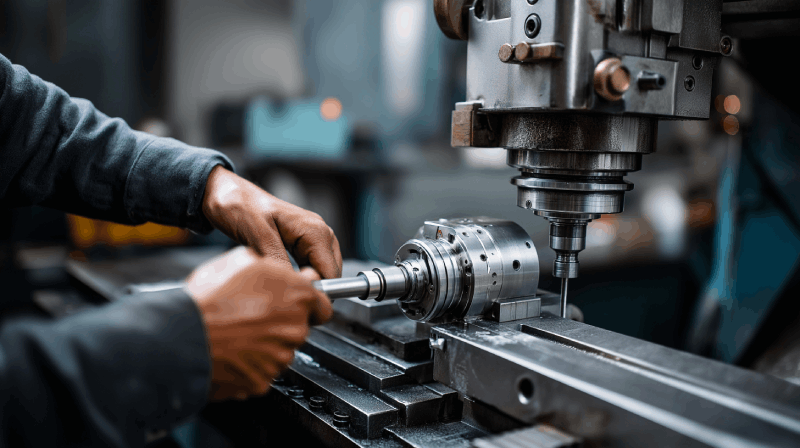
Summary of Lathe Operator Knowledge and Qualifications on Resume
1. BS in Mechanical Engineering with 3 years of Experience
- Experience with mechanized production equipment.
- Mathematical skills, such as addition, subtraction, multiplication, and division in all units of measure, using whole numbers, common fractions, and decimals.
- Skill in keeping accurate records, inventory, inspecting finished product for quality, and a strong attention to detail.
- Ability to read a tape measure, micrometers, and squares to ensure proper tube length, gauge, and square.
- Ability to communicate effectively both verbally and in writing to co-workers, supervisors, and employees from other departments within the division.
- Ability to read and interpret blueprints, production cards, simple instructions, short correspondence, and memos.
- Ability to work independently with little supervision and meet production deadlines.
- Ability to acquire a Valmont forklift operator’s certification.
- Ability to operate cranes and take the required training course.
- High awareness of safety at all times
- Ability to work extended hours, including nights and weekends
- Previous experience in a manufacturing or fabrication environment
- Ability to work in a high-volume, fast-paced environment
- Ability to pay attention to detail and follow work instructions
- Ability to communicate and interact with coworkers in a positive manner
- Ability to identify and communicate maintenance or product problems to the departmental team
- Passion and integrity, who has the drive to excel and deliver exceptional results
2. BA in Industrial Technology with 5 years of Experience
- Previous machining experience
- Experience with a multi-channel lathe or ability to demonstrate aptitude
- Familiarity with multiple spindle operations (upper/lower turret)
- Knowledge of general machining processes using a wide variety of machine tools
- Understanding of CNC-type machines and the processes they use, such as set-ups, monitoring, change-outs, etc.
- Advanced knowledge of the Mill-turn process, able to run, and assist in programming in proving out programs
- Excellent Blueprint reading and GD&T math skills
- Ability to professionally communicate and work cooperatively with others
- Ability to read, follow, and interpret work instructions
- Strong attention to detail
3. BS in Manufacturing Engineering with 3 years of Experience
- Familiarity with CNC setup and running VMC machines
- Ability to communicate and have technical discussions in English
- Ability to read and interpret detailed blueprint drawings.
- Ability to read and interpret documents such as safety rules, operating and maintenance instructions, and procedure manuals.
- Ability to stay organized and ensure that the work area is clean, safe, and orderly.
- Ability to follow oral and written instructions as well as be punctual and dependable.
- Ability to work overtime.
- Good interpersonal skills and ability to multitask.
- Ability to perform basic math, including working with and converting between fractions and decimals.
- Experience in a manufacturing environment.
- Ability to follow all safety procedures.
4. BA in Applied Science with 7 years of Experience
- Experience in programming, setting up, and operating CNC lathes in a fast-paced production environment.
- Be able to program, set up, and machine a range of features on parts such as tapers, spiral grooves, chamfers, and radii, to name a few.
- Ability to consider methods to set up and clamp parts to achieve desired features.
- Familiar with setting and operating bar feeders and selecting the correct tooling to machine required features.
- Knowledge of machining composite materials
- Knowledge of CMM and Shadowgraph use
- Experience working in a target-driven production environment.
- Be able to read and interpret engineering drawings with a good understanding of the related GD&T symbols and how they apply to the part
- Must be able to walk or stand on concrete for up to 4 hours at a time.
- Be flexible to meet or exceed productivity and competency requirements
- Awareness of engineering drawings and metrology equipment
Editorial Process and Content Quality
This content is developed by the Lamwork Editorial Team using structured analysis of real-world job data, skill requirements, and hiring patterns.
Research framework by Lam Nguyen, Founder & Editorial Lead.
Reviewed by Thanh Huyen, Managing Editor.
Learn more about our editorial standards.