ASIC DESIGN ENGINEER RESUME EXAMPLE
The ASIC Design Engineer encapsulates the full spectrum from microarchitecture proposal to SOC verification and silicon validation. Experts in this field develop and integrate cutting-edge image processing algorithms, ensuring optimal performance and power efficiency while collaborating closely with interdisciplinary teams to bring innovative MEMS-based technologies to life. Key responsibilities include creating robust verification environments, performing meticulous system analysis, and contributing to the successful chip bring-up and evaluation, all within a dynamic, solution-driven engineering landscape.

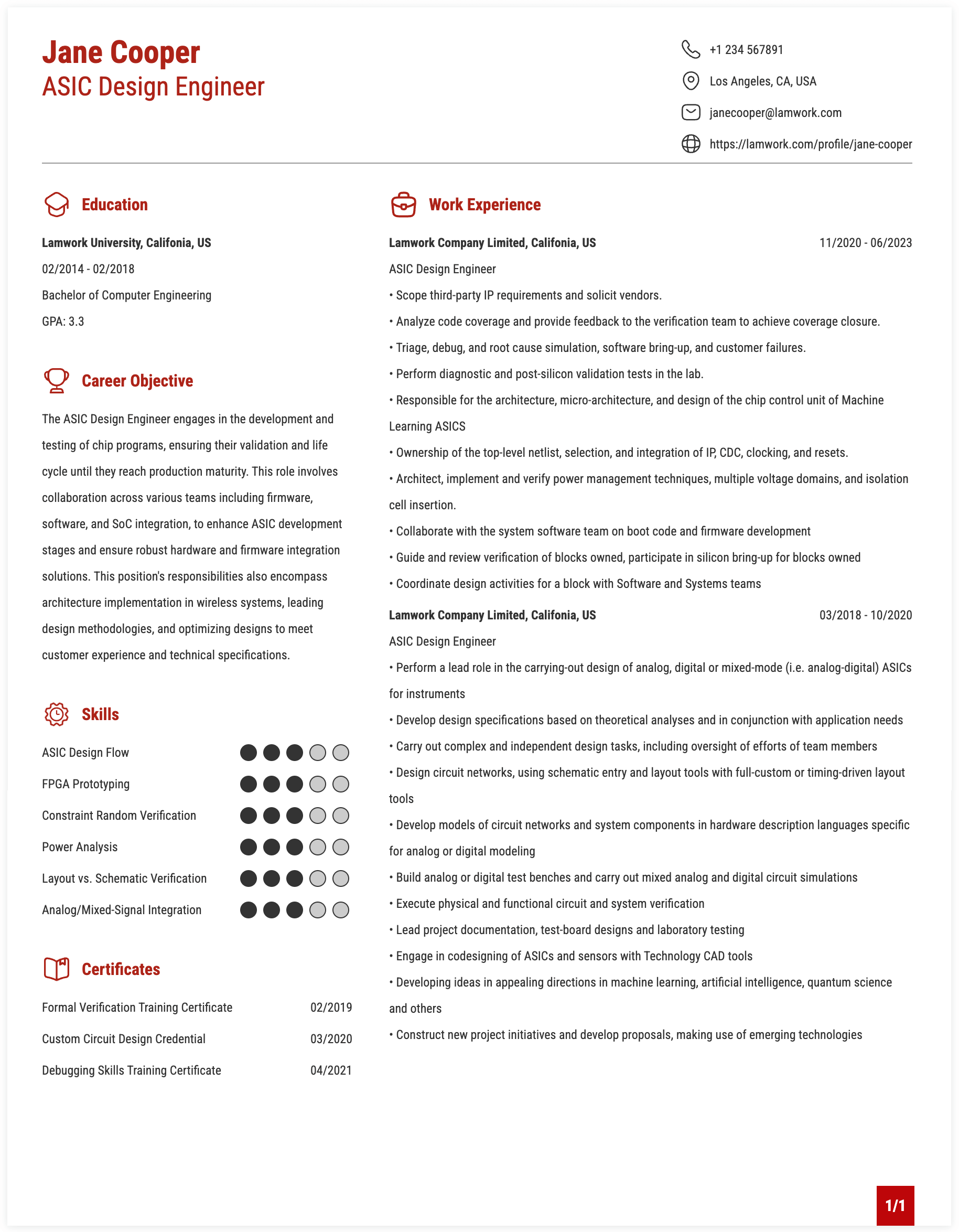
Tips for ASIC Design Engineer Skills and Responsibilities on a Resume
1. ASIC Design Engineer Resume Format
Job Summary:
- Develop module, hard-macro, and floor planning specifications for digital compute processing cores, bus interfaces, and other system-on-a-chip functions
- Investigate, analyze, and present performance, area, power, and system cost tradeoffs for hard macros using constraint, timing, and floor plan-driven optimizations
- Contribute to and drive design, floor planning specifications, and implementation meetings within a multi-disciplinary team
- Implement and debug timing constraints, RTL, Design for Test (DFT), and clock functions
- Perform netlist synthesis, Formal Verification, and Static Timing Analysis of hard macros
- Implement ECOs using automated design flows
- Complete design checks and analyses such as lint, CDC, power intent, and static timing reports
- Develop methodology and automation for design/synthesis using tcl/make/python scripts
- Experience some phases of digital IP design projects from specification, design, and verification, to documentation
- Become familiar with the ARM AXI interface/protocol which is very important almost in all ARM-based SOC design
- Become familiar with DDR SDRAM memory operations which is very important almost in all hardware systems
- Develop basic engineering skills such as documenting, communicating, and presenting ideas and designs, following engineering disciplines and delivering quality designs, … etc
Skills on Resume:
- Digital Design and Architecture (Hard Skills)
- Performance Analysis and Optimization (Hard Skills)
- Team Collaboration (Soft Skills)
- RTL Design and Verification (Hard Skills)
- Synthesis and Analysis Tools (Hard Skills)
- Design Automation (Hard Skills)
- Project Management and Documentation (Soft Skills)
- Familiarity with ARM Architecture and DDR SDRAM (Hard Skills)
2. ASIC Design Engineer Resume Model
Job Summary:
- RTL Coding including block design, top-level design and lower-power design
- Verify design and debug in RTL-level and gate-level
- Simulation, design constraints, coding style checking, cross-clock domain checking, synthesis and timing closure
- Bug analysis and fix, formal check
- Deliver design/ verification/ application documents/ SPEC
- Work closely with architecture to develop/debug new IP/ product
- Work closely with verification/ system/ Firmware engineer to verify/ validate new IP/ product
- Define architecture and micro-architecture specifications
- Take ownership of one or more modules and implement RTL
- Converge functionality and PPA of the design
- Work closely with software teams to ensure end-to-end solutions
- Contribute to design methodology, libraries, and code review
- Define chip-level features and solutions and drive implementation
Skills on Resume:
- RTL Coding Expertise (Hard Skills)
- Verification and Debugging (Hard Skills)
- Simulation and Synthesis (Hard Skills)
- Documentation and Communication (Soft Skills)
- Collaborative Development (Soft Skills)
- Architecture and Micro-architecture Development (Hard Skills)
- Cross-functional Teamwork (Soft Skills)
- Leadership and Innovation (Soft Skills)
3. ASIC Design Engineer Resume PDF Editor
Job Summary:
- Participate in cutting edge Processor design in deep submicron technologies
- Work as part of a Clocks team to design various innovative solutions to support high-frequency Clocks for various platforms
- Perform RTL design, synthesis, logic, and timing verification of the Clock unit
- Handle the design discussions with the rest of the team about the architecture, intent, and implementation
- Work closely with the DFT and Physical Design teams to ensure that the Test and physical constraints are met to ensure Clock quality
- Validation and debugging of digital designs on custom ASICs and FPGA platforms using a logic analyzer and oscilloscope
- Support all stages of development from design through prototype, beta, production, and support
- Write integration plans, integration reports, and test procedures
- Coordinate with Analog IC and System Design teams during product development
- Report bugs found and work with design engineers for resolution
- Develop improvements/enhancements to existing products
- Critically analyze and verify system performance through simulation, test, and measurements
- Provide technical expertise and guidance to engineering staff and other departments
Skills on Resume:
- Processor Design (Hard Skills)
- Clock Design (Hard Skills)
- RTL Design and Verification (Hard Skills)
- Architectural Discussions (Soft Skills)
- Cross-Team Collaboration (Soft Skills)
- Validation and Debugging (Hard Skills)
- Product Development Support (Soft Skills)
- Technical Documentation and Reporting (Soft Skills)
4. ASIC Design Engineer Resume Template
Job Summary:
- Proposal and documentation on microarchitecture
- Build block-level verification environment with the test vector and golden from the algorithm team
- Perform integration into SOC and RTL coding and implementation
- Design image processing kernel code
- Analyze system verification and power/ performance
- Develop test environments for coverage.
- Assist with SOC verification, chip bring up, and perform silicon functional/ performance validation
- Assist with the back-end team in performing place-and-route and timing analysis of modules
- Image processing algorithm study, understanding the interface and design requirement
- Actively participate in the chip bring-up, evaluation, and characterization
- Collaborate closely with MEMS, Characterization and Test Engineers in the development and characterization of the MEMS-based oscillator
- Document assigned blocks, and hold preliminary and final design review meetings
- Provide technical guidance, coaching, and mentoring of the engineering team while nurturing skill sets and capabilities
- Support other projects by management or as business needs change
Skills on Resume:
- Microarchitecture Proposal and Documentation (Hard Skills)
- Block-Level Verification Environment Development (Hard Skills)
- Integration into SOC and RTL Coding (Hard Skills)
- Image Processing Kernel Code Design (Hard Skills)
- System Verification and Power/Performance Analysis (Hard Skills)
- Test Environment Development for Coverage (Hard Skills)
- Assistance with SOC Verification and Silicon Validation (Hard Skills)
- Back-End Support and Timing Analysis (Hard Skills)
- Communication (Soft Skills)
- Mentoring (Soft Skills)
5. ASIC Design Engineer Resume Sample
Job Summary:
- Take full responsibility for designing IPs, being block or sub-system
- Break down Requirements into functionalities and create the appropriate description
- Develop IPs and run the appropriate quality checks
- Support IP integration and verification and ensure design quality
- Continuously improve and optimize ways of working
- Develop competence in the technical domain
- Design of ARM-based SOC subsystem along with security features
- Identify, evaluate, and integrate various ARM IPs like AMBA(AHB/AXI) bus matrix, Crypto cell, ETM, interrupt controller, peripherals, etc.
- Create logic solutions that meet challenging power, frequency, and area goals
- Code RTL representations of hardware design, collaboratively defining verification strategies
- Perform sanity check on ARM SOC subsystem
- Create a verification plan from specification and in coordination with architects and designers
- Work with local and overseas teams with good communication skills
Skills on Resume:
- IP Design and Architecture (Hard Skills)
- Requirements Analysis (Hard Skills)
- Quality Assurance (Hard Skills)
- Integration and Verification Support (Hard Skills)
- Process Improvement (Hard Skills)
- Technical Competence (Hard Skills)
- ARM IP Integration (Hard Skills)
- RTL Design and Verification (Hard Skills)
- Effective Communication (Soft Skills)
6. ASIC Design Engineer Resume PDF Maker
Job Summary:
- Work independently with little supervision
- Develop module specifications and follow through with design and programming specifications
- Model and analyze performance, area, power, and system cost tradeoffs for different micro-architectures
- Implement modules and sub-systems in Verilog RTL
- Develop and update technical documentation on an ongoing basis
- Work closely with the design verification team to define verification methodology, review test plans and develop reference and bus-functional models
- Implement and debug tests at the module, sub-system and SoC levels throughout the ASIC development cycle (pre- and post-silicon)
- Develop and debug synthesis and timing constraints, review clocks, and layout to achieve netlist synthesis and static timing closure
- Define the architecture, design, and roadmap of the ASIC system
- Design analog and mixed-signal circuits meeting architectural requirements and technical specifications
- Led ASIC team in design and verification simulations to ensure building blocks meet specifications at the schematic level and at the post-layout extraction stage, while fully provisioning for DFT and DFM
- Collaborate with the Layout Engineer to validate the proper layout
- Make significant contributions to silicon debugging and analysis
Skills on Resume:
- Independent Work (Soft Skills)
- Module Specification and Design (Hard Skills)
- Tradeoff Analysis (Hard Skills)
- Verilog RTL Implementation (Hard Skills)
- Technical Documentation (Hard Skills)
- Verification Methodology (Hard Skills)
- Synthesis and Timing Constraints (Hard Skills)
- ASIC System Architecture (Hard Skills)
7. ASIC Design Engineer Resume Download
Job Summary:
- Own the top-level integration of a complex mixed-signal SoC
- Contribute to microarchitecture, RTL design, synthesis, and timing closure
- Manage inclusion of internal and external IPs
- Coordinate with the verification team on both block- and top-level simulation and modeling
- Work closely with the physical design team
- Participate in the bring-up and test of initial silicon
- Define architecture and micro-architecture specifications. Take ownership of one or more modules and implement RTL.
- Converge functionality and PPA of the design.
- Work closely with software teams to ensure end-to-end solutions.
- Contribute to design methodology, libraries, and code review.
- Define chip-level features and solutions and drive implementation.
Skills on Resume:
- Mixed-Signal SoC Integration (Hard Skills)
- Microarchitecture and RTL Design (Hard Skills)
- Synthesis and Timing Closure (Hard Skills)
- IP Management (Hard Skills)
- Verification Coordination (Hard Skills)
- Collaboration with Physical Design Team (Soft Skills)
- Chip Bring-up and Test (Hard Skills)
- Architecture and Microarchitecture Specification (Hard Skills)
Resume Standards 2026
Lamwork's key guidelines and best practices for writing a professional, ATS-friendly resume.
1. Contact Information
Name, phone number, professional email, LinkedIn, portfolio (if applicable)
2. Professional Summary (2-3 lines)
Role + years of experience + key strengths
3. Work Experience
Title + company + dates
Bullet points: action verbs + metrics + impact
Add context (what/why) when needed
Not recommended: Increased sales by 20%
Recommended: Increased B2B sales by 20% by optimizing outreach strategy
4. Skills
Hard skills only + match job description keywords (ATS)
5. Education
Degree, school, year (GPA if strong)
6. Projects (if relevant)
Name + tools + outcomes
7. Format
0-5 years: 1 page
5-10 years: up to 2 pages
Clean font, no photo, no personal details
8. ATS Optimization
Use exact keywords from the job description
Avoid tables or columns
Example:
Job says "Data Analysis" -> use "Data Analysis"
Do not change it to "Analyzing Data"
9. Do Not Include
Photo, age, gender, full address, references
10. Final Check
No typos, consistent verb tense, tailored for each job
File name: FirstName_LastName_Resume.pdf
Editorial Process and Content Quality
This content is developed by the Lamwork Editorial Team using structured analysis of real-world job data, skill requirements, and hiring patterns.
Research framework by Lam Nguyen, Founder & Editorial Lead.
Reviewed by Thanh Huyen, Managing Editor.
Learn more about our editorial standards.