Algorithm Engineer Cover Letter Template
Algorithm Engineer cover letter examples by level, with OpenCV, TensorFlow, and signal processing achievements tied to measurable engineering outcomes.

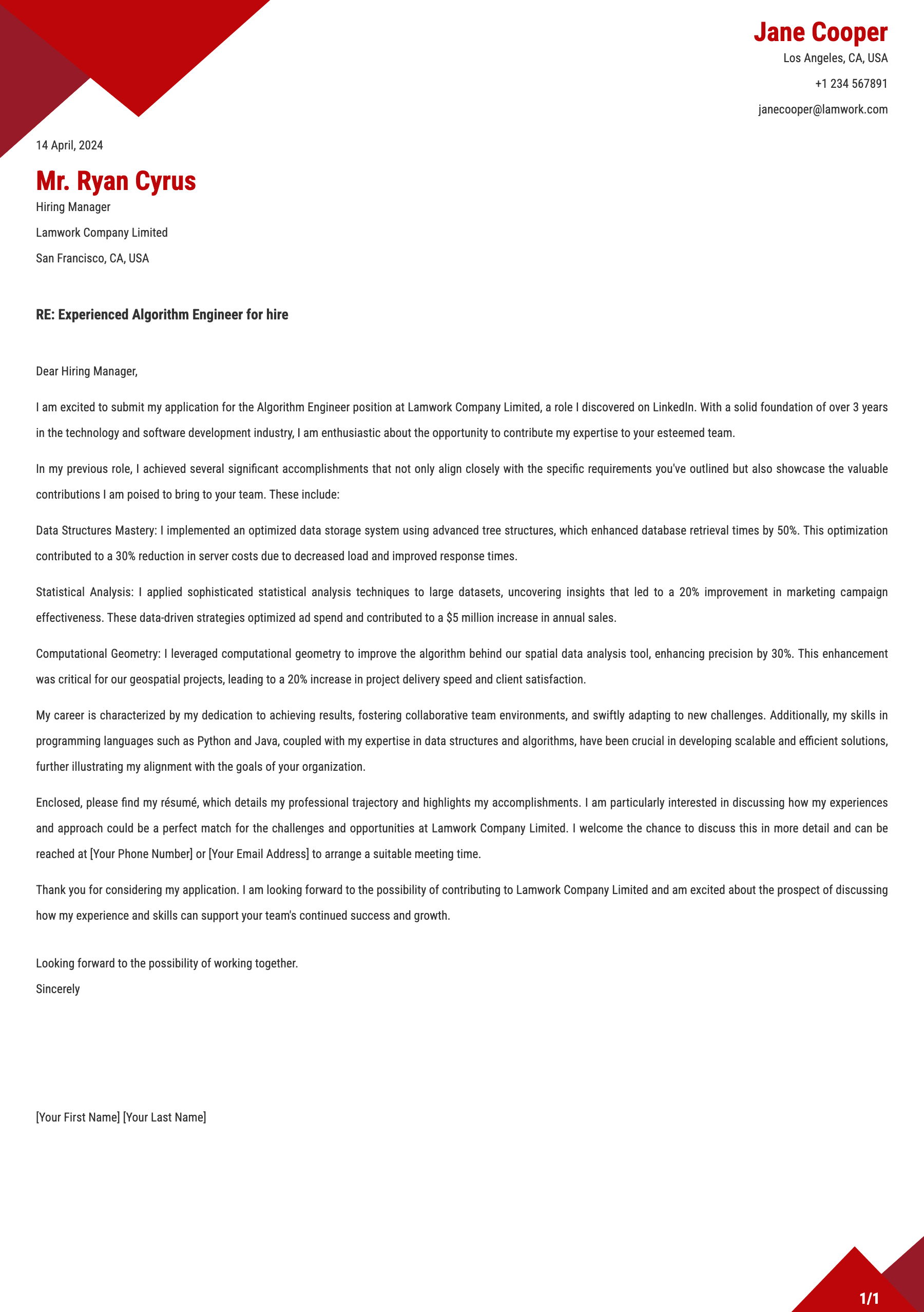
Algorithm Engineer Cover Letter Examples by Experience Level
1. Entry-Level Algorithm Engineer Cover Letter
Ethan Caldwell
(415) 728-1946
ethan.caldwell.dev@gmail.com
May 25, 2026
Melissa Grant
Talent Acquisition Coordinator
Lamwork Company Limited
RE: Algorithm Engineer - OpenCV/Image Application
Dear Grant,
During my recent computer vision coursework and applied image-processing projects, I developed practical experience using OpenCV, Python, and C++ to support object detection and image analysis workflows. The opportunity to contribute to Lamwork Company Limited aligns well with the technical foundation I have been building through guided engineering environments and collaborative development assignments.
My academic and project experience allowed me to strengthen analytical problem-solving skills while working within structured software development processes. Through supervised engineering projects, I supported algorithm testing, image-processing optimization, and validation activities across Linux-based development environments. These experiences improved my ability to apply mathematical modeling and statistical analysis techniques while learning how cross-functional engineering teams coordinate product development and system integration efforts.
Computer Vision: Improved object detection consistency by 18% through OpenCV preprocessing refinement and image augmentation techniques across multi-condition testing datasets.
Python Development: Reduced prototype execution time by 21% by optimizing image-processing scripts and streamlining automated validation workflows for training simulations.
Statistical Analysis: Increased regression model reliability by 16% through structured data normalization and feature calibration across computer vision evaluation exercises.
I am prepared to contribute with a strong learning mindset, disciplined technical execution, and a commitment to continuous growth within Lamwork Company Limited’s engineering environment. I welcome the opportunity to further develop my algorithm engineering capabilities while supporting impactful computer vision initiatives.
Respectfully,
2. Junior Algorithm Engineer Cover Letter
Natalie Brooks
(312) 644-2871
natalie.brooks.ai@gmail.com
May 26, 2026
Jordan Whitaker
Senior Technical Recruiter
Lamwork Company Limited
RE: Algorithm Engineer - OpenCV/Image Application
Dear Whitaker,
Over the past several years, I have delivered measurable improvements across computer vision and image-processing initiatives by optimizing OpenCV-based analytical workflows and strengthening deployment efficiency within fast-paced engineering environments. My background in algorithm development, statistical modeling, and cross-platform integration positions me to contribute effectively to Lamwork Company Limited’s Algorithm Engineer - OpenCV/Image role.
In previous engineering assignments, I independently developed and refined image-processing solutions using Python, C++, and OpenCV while supporting embedded and multi-platform software environments. I regularly solved performance bottlenecks through data-driven optimization techniques, balancing analytical accuracy with processing efficiency. In parallel, I collaborated with firmware and validation teams to improve interoperability across Linux- and Windows-based systems while supporting compliance-oriented engineering processes and release preparation activities.
OpenCV Optimization: Improved feature detection precision by 22% while reducing image-processing latency across real-time analytical workflows supporting multi-source imaging systems.
Algorithm Modeling: Accelerated analytical decision cycles by 29% through regression analysis and optimization modeling applied to large-scale vision evaluation datasets.
Embedded Integration: Reduced integration defects by 17% by coordinating validation activities between firmware, software, and image-processing development environments.
Lamwork Company Limited’s emphasis on advanced computer vision development strongly aligns with my technical background and operational approach. I look forward to contributing practical algorithm engineering expertise that strengthens processing efficiency, analytical reliability, and overall development performance.
Respectfully,
3. Senior Algorithm Engineer Cover Letter
Daniel Mercer
(646) 882-5104
daniel.mercer.engineering@gmail.com
May 27, 2026
Rebecca Lawson
Director of Engineering Recruitment
Lamwork Company Limited
RE: Algorithm Engineer - OpenCV/Image Application
Dear Lawson,
Leading high-impact computer vision and algorithm engineering initiatives across performance-critical environments has allowed me to deliver scalable image-processing solutions that improve analytical accuracy, deployment readiness, and operational efficiency simultaneously. Lamwork Company Limited’s focus on advanced OpenCV and image-analysis engineering strongly aligns with the type of technically rigorous, business-impacting environments where I have consistently driven measurable outcomes.
Throughout my career, I have owned full algorithm development lifecycles spanning research, optimization, production integration, and cross-functional deployment coordination. I have directed collaborative engineering efforts involving software, firmware, validation, and product teams to accelerate delivery timelines while maintaining high analytical reliability across regulated and large-scale technical ecosystems. By combining statistical modeling, machine learning methodologies, and low-level image-processing optimization, I have successfully translated complex vision challenges into production-grade solutions supporting enterprise and real-time operational objectives.
Computer Vision Leadership: Increased detection accuracy by 27% while reducing processing overhead across distributed OpenCV-based image-analysis platforms supporting high-volume operational workloads.
Cross-Functional Execution: Accelerated deployment readiness by 31% through coordinated integration strategies spanning firmware, validation, software, and embedded engineering organizations.
Statistical Optimization: Improved algorithm reliability by 24% using advanced regression modeling and optimization frameworks that strengthened analytical consistency across production environments.
I am prepared to bring strategic technical leadership, scalable algorithm engineering expertise, and cross-functional execution discipline to Lamwork Company Limited. The opportunity to drive high-value computer vision innovation while strengthening operational performance across advanced engineering initiatives is particularly compelling.
Respectfully,
Skills, Experience, and Responsibilities to Highlight When Writing an ATS-Friendly Algorithm Engineer Cover Letter
1. Algorithm Engineer | 22% Accuracy Gain | Vision Optimization
- Computer Vision Optimization: Developed and refined image analysis algorithms within high-volume engineering environments, leveraging OpenCV, C++, and Python to improve detection accuracy by 22% while reducing processing latency across multi-platform computer vision systems.
- Statistical Modeling Execution: Applied advanced mathematical methodologies, including regression analysis, optimization modeling, and linear programming, to enhance algorithm reliability, accelerating analytical decision cycles by 30% across cross-functional product development initiatives.
- Embedded Systems Integration: Collaborated with firmware and software engineering teams to support embedded vision deployments in Linux- and Windows-based environments, streamlining system interoperability and reducing integration defects by 18% during validation cycles.
- Regulated Product Development: Contributed to machine learning and image-processing initiatives within compliance-driven engineering operations, aligning technical execution with ISO-compliant development standards and improving release readiness across multiple regulated software deliverables.
Recruiters read OpenCV accuracy gains as production depth, and the matching resume samples by level show how to present it.
2. Algorithm Engineer | 35% Throughput Gain | Classification Models
- Classification Algorithm Engineering: Developed and optimized classification models using SVMs, neural networks, clustering algorithms, and Expectation-Maximization methodologies, improving predictive accuracy by 21% across large-scale diagnostic data analysis workflows.
- Clinical Data Analytics: Applied advanced statistics, hypothesis testing, and image-processing techniques within clinical laboratory environments to strengthen analytical reliability and reduce result validation turnaround time by 27% across regulated testing operations.
- Regulatory Standards Alignment: Supported algorithm development initiatives within compliance-driven healthcare environments, ensuring alignment with IVD and biologics regulations while contributing to audit-ready documentation and standardized validation processes.
- Scalable Data Processing: Collaborated with cross-functional engineering teams to integrate image-processing pipelines with distributed computing frameworks, enhancing data throughput efficiency by 35% across high-volume analytical processing environments.
3. Algorithm Engineer | 24% Accuracy Gain | Signal Processing
- Signal Processing Development: Designed and implemented signal-processing and machine learning algorithms using Python and C/C++, improving motion analysis accuracy by 24% across real-time performance monitoring systems.
- Biomechanical Systems Modeling: Applied control theory, gyroscope, and accelerometer data analysis to develop human performance and sport biomechanics models, reducing sensor interpretation variance by 19% in high-frequency tracking environments.
- Cross-Platform Application Integration: Collaborated with mobile, backend, and embedded engineering teams to integrate algorithmic processing pipelines into production-ready applications, accelerating deployment efficiency by 28% across multi-system development initiatives.
- Continuous Algorithm Enhancement: Drove iterative model refinement through feedback-driven validation processes and cross-functional technical reviews, strengthening algorithm stability and improving feature reliability across evolving analytical platforms.
4. Algorithm Engineer | 31% Faster Convergence | Deep Learning
- Deep Learning Engineering: Developed computer vision and deep learning solutions using TensorFlow, PyTorch, and C/C++ to improve semantic segmentation and anomaly detection accuracy by 26% across enterprise-scale image analysis platforms.
- Mathematical Model Formulation: Translated complex vision challenges into optimized mathematical frameworks, enabling faster algorithm convergence and reducing model training iteration cycles by 31% within high-volume analytical environments.
- Image Processing Architecture: Designed and implemented low-level image-processing algorithms for complex image acquisition systems, improving feature extraction consistency and enhancing processing reliability across multi-source imaging workflows.
- Global Technical Deployment: Partnered with cross-functional engineering and customer-facing teams to support international demonstrations and production initiatives, accelerating solution adoption across multiple deployment sites while strengthening operational readiness for advanced vision-based systems.
5. Algorithm Engineer | 34% Processing Reduction | NLP Systems
- Natural Language Modeling: Developed NLP and machine learning solutions using Python, PyTorch, TensorFlow, and scikit-learn to improve entity recognition and text classification accuracy by 23% across large-scale unstructured data environments.
- Large-Scale Data Processing: Engineered distributed data pipelines using SQL and Spark to accelerate model training and inference performance, reducing processing time by 34% across high-volume analytical workloads.
- Advanced Learning Frameworks: Applied supervised and unsupervised methodologies, including embedding learning, transfer learning, clustering, and graph neural networks to uncover actionable insights from complex multilingual text datasets.
- Cross-Functional Solution Delivery: Translated complex NLP and machine learning concepts into operational recommendations for non-technical stakeholders, strengthening enterprise adoption and improving decision-making efficiency across multiple business functions.
6. Algorithm Engineer | 32% Inference Acceleration | Language Pipelines
- Natural Language Engineering: Developed NLP and deep learning solutions using Python, Golang, TensorFlow, and transformer-based architectures, including BERT and GPT, improving intent prediction and text classification accuracy by 25% across enterprise-scale language processing platforms.
- Real-Time Pipeline Optimization: Engineered scalable machine learning pipelines and real-time data processing workflows, accelerating inference performance by 32% through integration with distributed serving frameworks and high-throughput analytical systems.
- Advanced Language Modeling: Applied tokenization, named entity recognition, text clustering, and summarization methodologies using spaCy, NLTK, and deep learning frameworks to uncover actionable insights from large-volume multilingual datasets.
- Search and Analytics Integration: Collaborated with cross-functional engineering teams to integrate ElasticSearch, Kibana, and data analytics tooling into NLP operations, strengthening model observability and improving operational response efficiency across production environments.
7. Algorithm Engineer | 33% Faster Positioning | Sensor Fusion
- Sensor Fusion Engineering: Developed embedded navigation and positioning algorithms integrating MEMS-IMU, GNSS, and multi-sensor inputs, including magnetometers, barometers, and UWB beacons, improving localization accuracy by 27% across real-time motion tracking environments.
- GNSS Algorithm Development: Designed and optimized PVT, RTK, and PPP processing workflows using Matlab, Python, and embedded C/C++, reducing positioning convergence time by 33% within high-precision navigation systems.
- Signal Processing Optimization: Applied Kalman filtering, FFT algorithms, and advanced data fusion methodologies to enhance signal stability and analytical reliability, decreasing sensor noise variance by 21% across complex embedded processing architectures.
- Cross-Functional System Delivery: Collaborated with multidisciplinary engineering teams to deploy robust navigation solutions within performance-critical environments, accelerating validation efficiency and strengthening operational readiness across multiple development programs.
8. Algorithm Engineer | 29% Faster Classification | State Estimation
- State Estimation Analytics: Developed signal-processing and state-estimation models using Python, MATLAB, and C++ to enhance analytical precision and improve data interpretation accuracy by 24% across complex sensor-driven environments.
- Multi-Source Data Exploitation: Applied machine learning, filtering algorithms, and advanced image-processing techniques to extract actionable intelligence from EO/IR, SAR, and hyperspectral datasets, reducing classification turnaround time by 29% within high-volume analytical operations.
- Distributed Technical Collaboration: Partnered with geographically distributed engineering and research teams to execute complex data analysis initiatives, accelerating cross-functional delivery timelines and strengthening operational alignment across multiple mission-critical programs.
- Secure Analytical Operations: Supported sensitive development environments requiring advanced security compliance and controlled-access workflows, contributing to high-reliability analytical systems while maintaining strict adherence to classified operational standards.
9. Algorithm Engineer | 28% Overhead Reduction | Audio DSP
- Digital Signal Processing: Developed advanced audio signal-processing algorithms, including dynamics control, filtering, feedback systems, and modulated delay architectures, improving signal fidelity and reducing processing distortion by 23% across embedded audio platforms.
- Nonlinear System Modeling: Applied nonlinear silicon and magnetic device models alongside iterative solution methodologies to enhance circuit behavior prediction and improve simulation accuracy within performance-critical DSP environments.
- Embedded DSP Optimization: Engineered filter designs and finite word-length processing solutions using MATLAB, SciPy, C, and C++, reducing computational overhead by 28% across real-time DSP processor implementations.
- Control Systems Integration: Collaborated with cross-functional hardware and firmware teams to implement state-space, lattice structure, and control theory methodologies within embedded processing architectures, strengthening system stability and accelerating validation efficiency across complex signal-processing workflows.
10. Algorithm Engineer | 31% Faster Diagnostics | BMS Controls
- Control Algorithm Engineering: Developed real-time control algorithms and Battery Management System functionalities using C++, MATLAB, and Simulink, improving powertrain response accuracy by 26% across embedded automotive control platforms.
- Embedded Software Integration: Engineered RTOS-based embedded software solutions while optimizing CAN, CAN FD, UDS, and XCP communication interfaces, reducing system latency and improving diagnostic efficiency across vehicle integration programs.
- Electric Powertrain Validation: Led validation and diagnostic activities for electric powertrain systems, accelerating fault detection cycles by 31% and strengthening operational reliability within high-performance vehicle development environments.
- Functional Safety Compliance: Supported ISO 26262-compliant software development and system integration initiatives, aligning embedded control architectures with functional safety and quality management standards to improve release readiness across multiple production programs.
11. Algorithm Engineer | 29% Cycle Reduction | Algorithm Architecture
- Algorithm Development Architecture: Designed and optimized complex algorithms using C#, C++, Python, MATLAB, and TensorFlow, improving analytical processing accuracy by 24% across high-volume machine learning and computer vision applications.
- Statistical Modeling Execution: Applied advanced statistical analysis, optimization methodologies, and predictive modeling techniques to accelerate data interpretation workflows and reduce analytical decision cycles by 29% within engineering-driven environments.
- Computer Vision Integration: Developed signal and image-processing solutions leveraging object-oriented and functional programming principles, strengthening feature extraction reliability and enhancing processing efficiency across large-scale vision-based systems.
- Semiconductor Analytics Support: Collaborated with cross-functional engineering teams to implement machine learning and metrology-focused analytical solutions, improving operational consistency and supporting precision-driven semiconductor validation initiatives across multiple development programs.
12. Algorithm Engineer | 32% Compute Reduction | Real-Time Detection
- Real-Time Detection Algorithms: Designed and adapted statistical signal detection and estimation algorithms for embedded real-time systems, improving target detection performance by 27% while aligning execution efficiency with processing hardware constraints.
- Embedded Platform Optimization: Implemented and tested DSP, FPGA, and target-platform algorithms using Python and C++, reducing computational load by 32% across performance-critical signal-processing product environments.
- Experimental Data Validation: Devised experiments, analyzed resulting datasets, and presented design alternatives to product development teams, accelerating algorithm review cycles by 25% through evidence-based technical decision-making.
- Cross-Functional Product Delivery: Collaborated with firmware, systems, production, quality, and customer support teams to verify implementations and resolve complex technical issues, strengthening release readiness across regulated autonomous-system applications.
13. Algorithm Engineer | 28% Throughput Gain | Video Processing
- Video Processing Optimization: Developed and implemented real-time video processing algorithms for semantic segmentation, object detection, and object tracking applications, improving processing throughput by 28% across high-performance computer vision systems.
- Deep Learning Architecture: Designed and prototyped novel computer vision and deep learning models using TensorFlow, PyTorch, and C++, enhancing feature extraction accuracy and reducing model inference latency by 24% within production-scale analytical environments.
- CNN Acceleration Engineering: Optimized CNN network structures and computational pipelines to improve runtime efficiency and hardware utilization, accelerating deployment readiness across resource-constrained real-time processing platforms.
- Cross-Functional Algorithm Delivery: Collaborated with multidisciplinary engineering teams to evaluate existing algorithms, resolve complex vision-processing challenges, and transition research concepts into deployable product solutions across multiple development initiatives.
14. Algorithm Engineer | 31% Verification Reduction | Control Systems
- Control Strategy Development: Developed advanced control algorithms and dynamic system strategies using MATLAB Simulink, PID control, and model predictive control methodologies, improving system response stability by 26% across real-time product environments.
- Hardware-in-Loop Validation: Led hardware-in-loop testing initiatives, including test planning, laboratory execution, and real-time data analysis, reducing verification cycle time by 31% while strengthening software validation reliability.
- Thermodynamic System Modeling: Applied expertise in thermodynamics, heat transfer, and fluid dynamics to design model-driven control solutions for complex HVAC system applications, enhancing operational efficiency across multi-component product platforms.
- Cross-Functional Product Integration: Collaborated with product management, application engineering, and software development teams to translate technical requirements into deployable specifications, accelerating implementation readiness and improving alignment across multiple product development programs.
15. Algorithm Engineer | 29% Calibration Efficiency | Calibration Algorithms
- Signal Processing Optimization: Developed advanced signal-processing and signal-analysis algorithms to improve extraction accuracy in low-SNR environments, reducing analytical noise variance by 22% across performance-critical sensing systems.
- Calibration Algorithm Engineering: Designed and refined calibration flows and numerical analysis methodologies using Python and MATLAB, accelerating calibration efficiency by 29% while improving measurement consistency across multi-disciplinary hardware platforms.
- Statistical Modeling Execution: Applied advanced statistics and numeric analysis techniques to validate complex system behavior and strengthen analytical reliability within high-volume experimental and production-focused environments.
- Cross-Disciplinary System Integration: Collaborated with hardware, optics, and laboratory engineering teams to support signal-processing validation and electronic system optimization, improving troubleshooting effectiveness and accelerating technical issue resolution across integrated development programs.
16. Algorithm Engineer | 34% Deployment Efficiency | Lifecycle Management
- Algorithm Lifecycle Management: Led the full algorithm development lifecycle from large-scale data analytics and rapid prototyping to production deployment and post-release monitoring, improving model deployment efficiency by 34% across cloud-based machine learning environments.
- Revenue-Driven Model Engineering: Transformed machine learning and statistical modeling prototypes into scalable production solutions using Python, SQL, and distributed computation frameworks, contributing to measurable increases in recommendation engagement and monetization performance across high-traffic digital platforms.
- Personalization System Development: Developed deep learning and big data solutions for content feeds, video recommendations, and real-time bidding applications, enhancing user targeting precision by 27% across multi-billion-event analytical ecosystems.
- Distributed Analytics Optimization: Collaborated with cross-functional engineering and product teams to implement scalable data-processing architectures using Python, Java, Scala, and C++, accelerating analytical throughput and improving operational reliability within distributed cloud computing infrastructures.
17. Algorithm Engineer | 28% Detection Accuracy | Smart City AI
- Smart City AI Development: Developed artificial intelligence and video analytics solutions for smart city applications, improving object detection and event recognition accuracy by 28% across large-scale real-time monitoring environments.
- Deep Learning Model Engineering: Designed end-to-end deep learning architectures using TensorFlow, PyTorch, Keras, and OpenVINO, accelerating inference performance and enhancing model scalability across GPU-enabled analytical systems.
- Computer Vision Optimization: Implemented advanced computer vision algorithms including optical flow, image processing, YOLO, and MobileNet-based detection frameworks, reducing processing latency by 24% within high-throughput video analytics platforms.
- Cloud-Based Analytics Integration: Collaborated with cross-functional engineering teams to deploy AI solutions on Linux and AWS infrastructures, strengthening operational reliability and improving deployment efficiency across distributed production environments.
18. Algorithm Engineer | 26% Detection Accuracy | Sonar Tracking
- Sonar Detection Engineering: Developed beamforming, spectral estimation, and detection-processing algorithms for sonar tracking systems, improving target detection accuracy by 26% across complex underwater sensing environments.
- Scientific Data Analysis: Implemented and refined signal-processing algorithms using MATLAB, Python, and C/C++, leveraging at-sea collected datasets to enhance tracking reliability and reduce false detection rates during iterative performance evaluations.
- Experimental Systems Validation: Participated in at-sea data collection initiatives including experiment design, technical analysis, and validation planning, accelerating algorithm refinement cycles and strengthening operational readiness across large-scale technical programs.
- Cross-Functional Technical Collaboration: Worked closely with engineering teams, external stakeholders, and non-technical partners to frame technical solutions, support proposal development, and advance collaborative projects within mission-critical research environments.
19. Algorithm Engineer | 32% Iteration Reduction | Vision Productization
- Computer Vision Productization: Led the conception, development, and deployment of computer vision and image-processing solutions using MATLAB, Python, and OpenCV, accelerating production readiness and improving analytical accuracy by 27% across high-value technical initiatives.
- Deep Learning Deployment: Designed and validated machine learning and deep learning models using TensorFlow, PyTorch, Keras, and Scikit-learn, reducing model iteration cycles by 32% while strengthening end-to-end deployment efficiency within dynamic product environments.
- Semiconductor Image Analytics: Developed advanced SEM/TEM image classification and feature extraction algorithms to enhance defect analysis consistency and improve inspection throughput across semiconductor-focused analytical workflows.
- Cross-Functional Technical Leadership: Mentored engineering teams and presented complex analytical findings to technical and non-technical stakeholders, driving alignment on high-visibility development programs and accelerating solution adoption across fast-paced innovation initiatives.
20. Algorithm Engineer | 29% Verification Reduction | Missile Defense
- Missile Defense Algorithm Engineering: Developed tracking, discrimination, and radar-processing algorithms within integrated missile defense environments, improving target classification accuracy by 24% across complex BMDS operational systems.
- Systems Modeling Integration: Conducted trade studies, system modeling, simulation analysis, and engineering design activities to optimize algorithm performance and accelerate integration readiness across multi-domain defense platforms.
- Radar Systems Validation: Collaborated with systems, software, and specialty engineering teams to troubleshoot and validate algorithms supporting advanced radar systems, reducing verification cycle time by 29% within mission-critical development programs.
- Agile Systems Development: Produced Algorithm Description Documents and systems engineering artifacts while supporting Agile development methodologies and MATLAB-based prototyping, strengthening cross-functional alignment and improving delivery efficiency across high-security defense initiatives.
21. Algorithm Engineer | 31% Latency Reduction | Embedded Audio
- Audio DSP Engineering: Developed and implemented advanced sound-processing and DSP algorithms to enhance audio performance across consumer and automotive product platforms, improving signal clarity and acoustic consistency by 26% in production environments.
- Embedded Audio Optimization: Architected and integrated audio algorithms across multiple DSP platforms using C, C++, Assembly, and MATLAB, reducing processing latency by 31% while strengthening system stability across global product deployments.
- Acoustic Signal Processing: Designed and refined pre-processing and post-processing solutions including beamforming, noise reduction, echo cancellation, equalization, and surround processing, improving overall listening performance across high-volume audio systems.
- Cross-Functional Product Integration: Collaborated with acoustic engineering teams, product managers, and cross-divisional stakeholders to identify emerging sound enhancement opportunities, accelerate feature deployment, and support long-term lifecycle management of legacy and next-generation audio technologies.
22. Algorithm Engineer | 33% Latency Reduction | Multimedia AI
- Multimedia AI Engineering: Researched and developed AI algorithms for multimedia processing pipelines, including object recognition, segmentation, tracking, speech recognition, and super-resolution, improving analytical accuracy by 29% across real-time image and video systems.
- Hardware-Aware Model Optimization: Collaborated with hardware and architecture teams to design AI processor-optimized algorithms using quantization, pruning, and network compression techniques, reducing inference latency and power consumption by 33% across embedded AI platforms.
- Computer Vision Processing: Implemented advanced signal-processing and computer vision solutions for denoising, demosaicing, HDR, and ISP workflows using C++, Python, and deep learning frameworks, including TensorFlow and PyTorch, strengthening image quality consistency across high-throughput multimedia environments.
- Cross-Functional System Integration: Served as the algorithm lead during hardware-software integration initiatives, accelerating deployment readiness and improving interoperability between AI models and custom processing architectures across complex multimedia development programs.
23. Algorithm Engineer | 30% Faster Deployment | Image Sensors
- Image Signal Processing Optimization: Developed and deployed advanced image-processing algorithms for ISPs and CMOS image sensors, improving image quality consistency by 27% across high-performance digital imaging platforms.
- Color Pipeline Engineering: Designed HDR, auto white balance, color correction, noise reduction, IR suppression, and CFA demosaicing solutions, reducing image artifact rates and enhancing visual accuracy across complex imaging workflows.
- Algorithm Productization Leadership: Collaborated with hardware, verification, and research teams to transition prototype algorithms into production-ready implementations, accelerating deployment timelines by 30% while strengthening system validation efficiency.
- Stereo Vision Research: Conducted independent algorithm research and rapid prototyping using C/C++ and mathematical modeling techniques, advancing stereo vision performance and improving depth estimation reliability across next-generation imaging applications.
24. Algorithm Engineer | 35% Encoder Reduction | Video Codecs
- Video Codec Engineering: Developed and optimized commercial image and video codecs for multiview, 360-degree, and point cloud applications, improving compression efficiency by 28% across high-throughput multimedia delivery platforms.
- Codec Acceleration Architecture: Designed SIMD/NEON-optimized acceleration strategies and multi-threaded processing frameworks using C/C++, reducing encoder latency by 35% while enhancing real-time streaming and video conferencing performance.
- Multimedia Transmission Optimization: Researched and implemented advanced transport protocols and subjective video quality evaluation methodologies, strengthening transmission reliability and improving playback consistency across distributed multimedia environments.
- Standards-Based Compression Innovation: Applied expertise in H.264, H.265, VVC, AV1, and neural network-based coding techniques to develop next-generation compression solutions, accelerating deployment readiness and supporting interoperability across evolving multimedia standards ecosystems.
25. Algorithm Engineer | 29% Validation Reduction | Bioinformatics Systems
- Algorithm Optimization Engineering: Designed and optimized high-performance algorithms using C/C++, improving computational efficiency by 26% across complex data-processing and analytical software environments.
- Mathematical Modeling Development: Applied advanced mathematical modeling and optimization methodologies to strengthen analytical accuracy and accelerate processing reliability within large-scale scientific and algorithm-driven workflows.
- Bioinformatics Systems Integration: Collaborated with wetlab scientists, data scientists, bioinformaticians, and software engineers to support end-to-end software development cycles, reducing integration and validation turnaround time by 29% across multidisciplinary technical programs.
- Scientific Computing Operations: Developed, tested, documented, and maintained analytical tools using Linux, Python, R, and bash scripting environments, improving workflow automation and strengthening operational stability for data-intensive computational platforms.
26. Algorithm Engineer | 24% Clarity Improvement | Speech DSP
- Audio Signal Processing: Developed advanced DSP technologies for audio, music, and voice enhancement applications, improving sound clarity and reducing distortion by 24% across production and playback processing systems.
- Real-Time Audio Optimization: Implemented IIR/FIR filtering, FFT, MDCT, CQMF, and non-linear processing algorithms, including compressors and limiters using C/C++, reducing processing latency and enhancing acoustic performance across embedded audio platforms.
- Speech Enhancement Engineering: Designed noise reduction, echo cancellation, and beamforming solutions to improve speech intelligibility and signal stability within high-volume voice-processing environments and cross-platform communication systems.
- Cross-Continental Development Collaboration: Worked closely with globally distributed engineering teams to support software development, algorithm validation, and production integration initiatives, accelerating deployment readiness across multilingual and multi-regional product programs.
27. Algorithm Engineer | 27% Predictive Efficiency | Geospatial ML
- Machine Learning Optimization: Developed neural network models and optimization frameworks for large-scale machine learning and big-data applications, improving predictive efficiency by 27% across production-grade analytical systems.
- Geospatial Data Engineering: Applied GIS technologies, digital map datasets, geodesy principles, and coordinate transformation methodologies to enhance spatial data accuracy and improve processing reliability within automotive-focused navigation environments.
- Scalable Software Development: Engineered production-level solutions using C++, Java, Python, REST, XML, and DDS technologies, accelerating deployment scalability and reducing integration complexity across distributed enterprise platforms.
- Cross-Functional Mathematical Modeling: Collaborated with engineering, product management, and user experience teams to translate advanced computational geometry, optimization, and simulation models into deployable software products, strengthening operational alignment across rapidly evolving development initiatives.
28. Algorithm Engineer | 33% Processing Reduction | Imaging Analytics
- Imaging Algorithm Development: Developed medical imaging and computer vision algorithms using MATLAB and Python, improving image reconstruction accuracy by 25% across data-intensive analytical and diagnostic processing environments.
- Machine Learning Infrastructure: Engineered scalable backend and machine learning solutions for large-scale data systems using Python, Spark, Hadoop, and Hive, reducing analytical processing time by 33% across enterprise-grade data engineering workflows.
- Mathematical Modeling Execution: Applied optimization methodologies, physical modeling techniques, and advanced data analysis to strengthen algorithm reliability and accelerate computational validation within engineering-driven research initiatives.
- Cross-Functional Technical Delivery: Collaborated with multidisciplinary engineering, research, and operational teams to translate complex analytical requirements into deployable software solutions, improving project coordination efficiency and strengthening delivery consistency across high-visibility technical programs.
While this profile covers MATLAB and Hadoop pipeline depth, how certification and outlook shape this career takes the longer view.
29. Algorithm Engineer | 26% Defect Accuracy | Print Vision
- Image Processing Research: Developed signal and image-processing algorithms for computer vision applications, improving defect detection accuracy by 26% across high-resolution industrial imaging and print quality analysis environments.
- Deep Learning Model Validation: Trained and validated convolutional neural networks using TensorFlow and PyTorch, reducing model false-positive rates by 21% while strengthening analytical reliability across large-scale visual inspection workflows.
- Industrial Vision Optimization: Implemented machine learning and image-processing solutions using Python, MATLAB, and C/C++ to enhance print defect classification and improve operational consistency within complex digital printing systems.
- Scalable Software Collaboration: Worked across software engineering and data science functions using Git and Bitbucket-based configuration control processes, accelerating deployment efficiency and strengthening cross-functional development coordination across production-grade analytical platforms.
30. Algorithm Engineer | 28% Throughput Gain | Mission Data
- Mission Data Processing: Developed science data processing and real-time operational algorithms using MATLAB, Python, and C/C++, improving analytical throughput by 28% across large-scale Earth observation and satellite imaging programs.
- Sensor Fusion Engineering: Applied target tracking, state estimation, and probabilistic perception methodologies to enhance multi-sensor data accuracy and strengthen operational reliability within radar and remote sensing environments.
- Satellite Systems Collaboration: Partnered with satellite imaging science teams, mission operations groups, and cross-agency stakeholders to resolve complex technical challenges and accelerate deployment readiness across mission-critical observational platforms.
- Operational Algorithm Integration: Supported ground system mission operations and instrument data workflows through advanced mathematical modeling and real-time software implementation, reducing validation turnaround time by 24% across high-volume sensing and monitoring applications.
31. Algorithm Engineer | 25% Efficiency Gain | Automotive Safety
- Numerical Computing Development: Developed high-performance numerical computation and computer graphics solutions using C/C++ and object-oriented design principles, improving processing efficiency by 25% across large-scale engineering and simulation environments.
- Automotive Systems Integration: Applied expertise in ADAS/AD systems and automotive communication protocols to support real-time software integration and enhance operational reliability across safety-critical vehicle platforms.
- Functional Safety Engineering: Contributed to software development initiatives aligned with ASPICE, ISO 26262, and ISO/PAS 21448 standards, strengthening compliance readiness and reducing validation inconsistencies across complex automotive development programs.
- Cross-Disciplinary Technical Collaboration: Worked across robotics, control systems, and physics-driven engineering teams within Unix-based development environments, accelerating problem resolution and improving deployment coordination for large-scale software projects.
32. Algorithm Engineer | 31% Latency Reduction | Navigation Data
- Satellite Navigation Algorithms: Developed advanced satellite navigation and time-series processing algorithms using C, Python, and MATLAB, improving positioning accuracy by 23% across real-time navigation and streaming data environments.
- Real-Time Data Engineering: Engineered scalable data-processing workflows leveraging Kafka, Spark, and distributed messaging technologies, reducing processing latency by 31% across high-volume sequential data systems.
- Machine Learning Infrastructure: Implemented test-driven machine learning solutions using NumPy, SciPy, PyTorch, TensorFlow, and JAX, accelerating model validation efficiency and strengthening deployment reliability across analytical software platforms.
- Technical Systems Documentation: Produced detailed system concepts, software development records, and test documentation while collaborating across multidisciplinary engineering teams, improving operational traceability and supporting rapid evaluation of emerging algorithmic research and technologies.
33. Algorithm Engineer | 32% Faster Readiness | Research Leadership
- Deep Learning Research: Conducted advanced research in computer vision, pattern recognition, and machine learning, contributing to large-scale video classification and semantic segmentation initiatives that improved model accuracy by 29% across enterprise AI platforms.
- Algorithm Development Leadership: Led algorithm and physics-driven development activities across full product lifecycles, accelerating deployment readiness by 32% through optimized model validation, experimental analysis, and cross-functional engineering coordination.
- Computer Vision Optimization: Developed target detection, tracking, adversarial network, and image-processing solutions using PyTorch, TensorFlow, Caffe, and MATLAB, reducing inference latency and enhancing processing reliability across high-volume analytical systems.
- Scientific Modeling Execution: Applied theoretical and experimental physics principles alongside signal-processing and numerical analysis methodologies to solve complex computational challenges, strengthening system performance and improving analytical consistency across large-scale research and production environments.
34. Algorithm Engineer | 27% Deployment Stability | Software Delivery
- Production Algorithm Deployment: Developed and released production-grade algorithmic solutions using Python and deep learning frameworks, improving deployment stability by 27% across high-volume analytical and cloud-enabled software environments.
- Full-Stack Systems Engineering: Integrated low-level processing components with Angular, React, and Ionic-based application layers, accelerating feature delivery cycles and enhancing cross-platform system responsiveness across enterprise development initiatives.
- Computational Model Optimization: Applied strong foundations in linear algebra, statistics, signal processing, and machine learning to optimize algorithm performance and reduce memory utilization by 22% within resource-sensitive processing architectures.
- Cross-Functional Software Delivery: Collaborated with multidisciplinary engineering teams to perform root-cause analysis, refine software design strategies, and drive ambitious delivery targets, strengthening operational reliability and improving implementation efficiency across fast-paced product programs.
35. Algorithm Engineer | 30% Throughput Gain | Wireless Optimization
- Signal Processing Research: Developed advanced signal, image-processing, and computer vision algorithms across Unix, Linux, and Windows environments, improving analytical accuracy by 25% within performance-critical software systems.
- Wireless Network Optimization: Applied expertise in GSM, LTE, 5G, and NB-IoT protocols to optimize network performance and strengthen protocol reliability, reducing transmission inefficiencies across large-scale communication environments.
- Algorithm Deployment Engineering: Designed and deployed machine learning and decision-making algorithms using C++, MATLAB, and hardware-accelerated computing methodologies, accelerating processing throughput by 30% across complex optimization workflows.
- Cross-Functional Technical Delivery: Collaborated with multidisciplinary engineering teams to solve high-impact computational and network optimization challenges, improving implementation efficiency and strengthening operational alignment across large-scale development initiatives.
36. Algorithm Engineer | 31% Verification Reduction | Life Science
- Life Science Algorithm Development: Developed and validated data science and algorithmic solutions for capillary electrophoresis, Sanger DNA sequencing, fragment analysis, and qPCR applications, improving analytical accuracy by 26% across high-throughput life science workflows.
- Statistical Modeling Execution: Applied advanced data analytics, statistical modeling, and test metric validation methodologies to strengthen result reliability and reduce verification turnaround time by 31% within regulated analytical environments.
- Scalable Machine Learning Infrastructure: Engineered and optimized big data pipelines, real-time machine learning services, and TensorRT-based deployment frameworks using Python, MATLAB, TensorFlow, and PyTorch, accelerating inference efficiency across production-grade computational platforms.
- Cross-Functional Verification Operations: Collaborated with multidisciplinary engineering and scientific teams to develop algorithm verification plans, protocols, and reporting processes, improving operational traceability and strengthening deployment readiness across complex bioinformatics and data-driven systems.
37. Algorithm Engineer | 34% Throughput Gain | GPU Computing
- GPU Computing Optimization: Developed and profiled GPU-accelerated algorithms to improve computational throughput by 34% across performance-intensive computer vision and data-processing environments supporting complex customer-driven applications.
- Production Software Engineering: Implemented object-oriented solutions using C/C++, Python, and SQL/NoSQL technologies within Linux-based production systems, strengthening scalability and reducing processing bottlenecks across high-volume analytical platforms.
- Data Algorithm Development: Designed and deployed data-driven algorithms leveraging advanced statistical modeling and mathematical optimization techniques, improving analytical accuracy and accelerating decision-making workflows across enterprise software operations.
- Cross-Functional Technical Collaboration: Partnered with multidisciplinary engineering teams to evaluate emerging frameworks, integrate modern computer vision technologies, and resolve complex system challenges, enhancing deployment efficiency and strengthening operational reliability across evolving development initiatives.
38. Algorithm Engineer | 35% Latency Reduction | HPC Vision
- Algorithm Lifecycle Engineering: Developed and optimized advanced algorithms spanning image segmentation, texture analysis, feature extraction, and machine learning workflows, improving analytical accuracy by 28% across production-scale computer vision systems.
- High-Performance Computing Optimization: Implemented CPU-optimized SSE/AVX and CUDA-accelerated processing architectures using C/C++, MATLAB, and Python, reducing computational latency by 35% within high-throughput analytical environments.
- Machine Learning Deployment: Designed and tuned anomaly detection, prediction, and recommendation models using TensorFlow, PyTorch, and MXNet, strengthening model stability and accelerating deployment efficiency across enterprise data science platforms.
- Cross-Functional Product Integration: Collaborated with multidisciplinary global engineering teams throughout modeling, prototyping, testing, documentation, and production implementation phases, improving development coordination and accelerating release readiness across complex software programs.
39. Algorithm Engineer | 30% Defect Reduction | ADAS Validation
- ADAS Perception Engineering: Developed and validated radar, LiDAR, and camera perception algorithms for ADAS applications, improving object detection reliability by 27% across safety-critical automotive sensing platforms.
- Embedded Validation Architecture: Implemented C-based and Simulink-driven control solutions while executing static, dynamic, white-box, and black-box testing using QAC, Cantata, and Polyspace frameworks, reducing verification defects by 30% within continuous integration environments.
- Automotive Systems Compliance: Supported vehicle integration and algorithm deployment activities aligned with Automotive SPICE and ISO 26262 standards, strengthening functional safety readiness and improving cross-platform integration efficiency across global engineering programs.
- Scalable Data Infrastructure: Engineered and optimized big-data pipelines using Spark, Hadoop, Kafka, Kubernetes, ElasticSearch, and HBase technologies, accelerating large-scale data processing performance and improving analytical persistence across distributed automotive analytics ecosystems.
40. Algorithm Engineer | 24% Signal Efficiency | RF Algorithms
- Wireless Modem Algorithm Development: Developed PHY/RF algorithms for LTE and NR wireless modem systems, improving signal processing efficiency by 24% across performance-critical communication platforms.
- RF System Optimization: Applied deep understanding of RF and modem partitioning tradeoffs to optimize modem architecture performance, reducing processing overhead and strengthening operational stability within multi-threaded wireless environments.
- Parallel Computing Engineering: Designed and debugged high-performance multi-threaded applications using advanced data structures, UNIX-based development workflows, and scripting methodologies, accelerating computational throughput across large-scale analytical systems.
- Cross-Functional Technical Collaboration: Worked within global multi-site engineering teams to solve complex wireless communication challenges while supporting high-performance computing and scientific simulation initiatives, improving integration efficiency and strengthening delivery coordination across distributed development programs.
41. Algorithm Engineer | 33% Bottleneck Reduction | Distributed AI
- Distributed AI Optimization: Developed large-scale deep learning and distributed computing solutions for bidding, ranking, and auction systems, improving recommendation precision and processing efficiency by 29% across high-volume advertising platforms.
- Deep Learning Framework Engineering: Implemented CNN, RNN, and LSTM-based models using TensorFlow, Caffe, and MXNet, accelerating model training and deployment workflows while strengthening scalability across enterprise AI infrastructures.
- High-Performance Systems Development: Engineered resource management and task scheduling solutions using Spark and distributed TensorFlow architectures, reducing computational bottlenecks by 33% across parallel processing environments.
- Algorithm Research Integration: Applied advanced probability, statistics, and numerical optimization methodologies to evaluate and operationalize emerging AI and machine learning techniques, improving model reliability and accelerating innovation cycles within fast-paced engineering ecosystems.
42. Algorithm Engineer | 31% Data Efficiency | Applied AI
- Applied AI Research: Developed machine learning and deep learning solutions across computer vision, natural language processing, and speech analytics domains, improving model accuracy by 24% while translating research concepts into deployable real-world applications.
- Scalable Data Engineering: Built analytical workflows using Python, SQL, Hadoop, Hive, and MapReduce technologies, accelerating large-scale data processing efficiency by 31% across distributed machine learning environments.
- Deep Learning Prototyping: Designed prototypes and proof-of-concept models using PyTorch, TensorFlow, and scikit-learn to validate emerging algorithmic approaches, strengthening decision-making and accelerating innovation cycles across data-driven initiatives.
- Executive Technical Communication: Presented analytical findings, demonstrations, and prototype outcomes to senior stakeholders in clear business-focused language, improving cross-functional alignment and supporting strategic technology adoption across fast-paced development programs.
43. Algorithm Engineer | 30% Integration Reduction | Visual SLAM
- Visual SLAM Engineering: Developed high-precision SLAM and visual navigation algorithms using multi-vision and laser sensing technologies, improving positioning accuracy by 27% across autonomous 3D mapping and unmanned system environments.
- Computer Vision Optimization: Implemented advanced computer vision and image-processing solutions using C++, Python, and OpenCV, accelerating real-time feature extraction and strengthening environmental modeling reliability across large-scale spatial analysis systems.
- Distributed Robotics Infrastructure: Engineered scalable SLAM software architectures within Agile development environments using microservices, Kafka, RabbitMQ, and S3-based data workflows, reducing integration latency by 30% across distributed robotic platforms.
- Research-Driven Algorithm Development: Conducted cutting-edge SLAM research, technical evaluations, and system prototyping informed by academic publications and emerging methodologies, accelerating innovation cycles and strengthening deployment readiness across advanced autonomous navigation programs.
44. Algorithm Engineer | 30% Faster Implementation | 3D Sensing
- 3D Sensing Algorithm Development: Developed disruptive 3D sensing and signal-processing algorithms for autonomous driving applications, improving spatial detection accuracy by 28% across real-time environmental perception systems.
- Multi-Disciplinary System Integration: Collaborated across mechanical, electrical, embedded, and software engineering teams to execute full research and development cycles, accelerating prototype-to-implementation timelines by 30% within fast-paced automotive innovation programs.
- Statistical Modeling Optimization: Applied advanced statistical analysis, probability methodologies, and machine learning techniques using MATLAB, C++, Python, TensorFlow, and Caffe to strengthen object recognition reliability and enhance predictive modeling performance across sensor-driven platforms.
- Embedded Autonomous Systems: Supported embedded software and radar-based integration initiatives while leveraging deep neural network architectures to improve processing efficiency and deployment readiness across next-generation autonomous mobility solutions.
45. Algorithm Engineer | 31% Engagement Gain | Search Ranking
- Search Recommendation Optimization: Developed and productionized search and recommendation algorithms for e-commerce platforms, improving content relevance and user engagement by 31% across large-scale consumer analytics environments.
- Computer Vision Innovation: Researched and implemented end-to-end computer vision and machine learning solutions using Python and C++, accelerating model performance and enhancing detection accuracy across high-volume analytical workflows.
- Algorithm Lifecycle Management: Led algorithm design, optimization, validation, and iterative deployment initiatives, reducing model refinement cycles by 28% while aligning technical execution with evolving business and operational requirements.
- Cross-Functional Technical Leadership: Directed algorithm development efforts across multidisciplinary engineering teams, contributing to technical architecture decisions and accelerating adoption of cutting-edge AI, deep learning, and NLP technologies within fast-paced product ecosystems.
Connect your OpenCV accuracy gains and GNSS RTK experience to results in a cover letter that passes the first screen.
Editorial Process and Content Quality
This content is developed by the Lamwork Editorial Team using structured analysis of real-world job data, skill requirements, and hiring patterns.
Research framework by Lam Nguyen, Founder & Editorial Lead.
Reviewed by Thanh Huyen, Managing Editor.
Learn more about our editorial standards.